Left-pointing white chevron arrow on a transparent background.
Back to article listing
Articles

B2B Pricing Is an ERP Problem, Not an Ecommerce Feature:

April 16, 2026
By-
Kensium’s B2B Ecommerce Strategy & Solutions Team

PrimaryAudience: Mid-Market B2B Operators Dealing with Pricing Complexity

Audience Who They Are Core Problem What They're Thinking
Ecommerce Leaders VP/Director of Ecommerce Pricing doesn’t work properly on site "Why can't my platform handle B2B pricing?"
IT / ERP Leaders Director of IT, ERP Manager Data inconsistency, broken integrations "Pricing should live in ERP... why is this messy?"
Operations / Finance Ops Head, Finance Lead Margin leakage, poor pricing control "We're losing control over discounts and pricing rules"
B2B Founders / CEOs $10M–$100M business owners Overall operational chaos "Why is our pricing and ordering so messy?"
Active Buyers Evaluating platforms / partners Choosing right architecture "What's the right way to structure this?"

Key Definitions

Before diving in, here are the core concepts referenced throughout this article:

  • ERP (Enterprise Resource Planning): A centralized software system that manages core business processes including finance, inventory, procurement, and pricing. Examples: Acumatica, SAP, Oracle NetSuite.
  • B2B Pricing Architecture: The structural design of how pricing logic is stored, governed, and distributed across business systems (ERP, ecommerce, sales tools, EDI).
  • Source of Truth for Pricing: The single authoritative system that defines what a customer should pay. All other systems should request pricing from this source rather than store their own version.
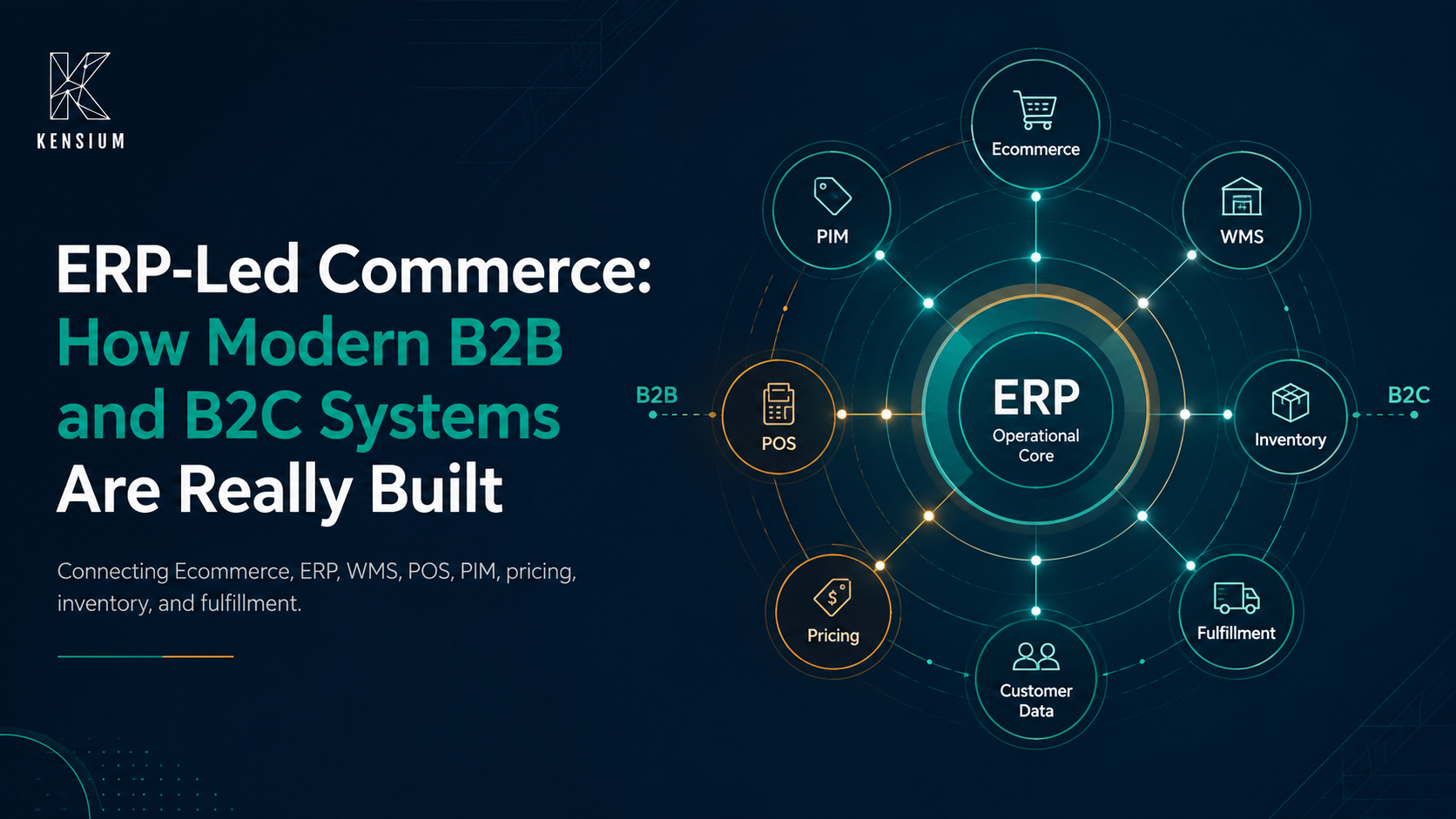
  • Orchestration Layer: Middleware that synchronizes data across multiple systems (ERP, ecommerce, marketplaces) to ensure consistency. Example: OmnifiCX.
  • Customer-Specific Pricing: Pricing that varies by individual customer based on contracts, volume agreements, or negotiated terms, rather than being set at the product or catalog level.
  • ERP Pricing vs. Ecommerce Pricing: The distinction between pricing governed by ERP (based on financial rules and contracts) and pricing managed within ecommerce platforms (typically rule-based catalog segmentation).

Executive Summary

Most B2B ecommerce pricing failures are not caused by the storefront. They occur when businesses rely on ecommerce platforms to manage B2B pricing strategy, even though pricing logic belongs in ERP systems.

In a scalable B2B pricing architecture:

  • The ERP acts as the source of truth for pricing, governing customer-specific pricing, contracts, and margin rules
  • The ecommerce platform focuses on presentation and order capture
  • An orchestration layer distributes pricing consistently across all channels

The most effective approach is a clear ERP pricing vs. ecommerce pricing separation, where ERP owns pricing decisions and an orchestration layer distributes those prices consistently.

Industry research from Forrester found that pricing errors and inconsistencies cost B2B companies an average of 1–3% of revenue annually — with mid-market operators disproportionately affected due to manual workarounds.(B2B Commerce Forecast, 2023)

Most B2B Pricing Problems Don't Start in Ecommerce. They Surface There.

A customer logs in and sees incorrect customer-specific pricing. A sales rep overrides pricing to match a contract. Finance later adjusts the invoice to correct margin impact.

Over time, these issues point to a deeper flaw in the B2B pricing architecture: pricing is no longer governed by a single system of record. Instead, it is fragmented across systems, creating inconsistencies that no ecommerce platform alone can resolve.

The Assumption That Breaks Everything

When companies invest in ecommerce, they often assume the platform should manage their B2B pricing strategy.

This assumption drives teams to configure pricing rules directly within the storefront using features like:

  • Customer groups and price lists
  • Catalog segmentation by account tier
  • Promotional rule engines

While these capabilities support customer-specific pricing in B2B ecommerce, they are designed for presentation, not governance. As pricing complexity increases, this approach breaks down because the ecommerce platform is not built to serve as the source of truth for pricing.

Why B2B Pricing Is Fundamentally Different

B2B pricing isn't just a number assigned to a product. It's a financial agreement. It's tied to:

  • Customer contracts and negotiated terms
  • Volume tiers and quantity breaks
  • Effective dates and contract expiration
  • Margin constraints and cost floors
  • Multi-channel consistency requirements

This is what makes B2B pricing strategy fundamentally different from standard ecommerce pricing. It requires customer-specific pricing logic that is governed, not just displayed.

ERP systems like Acumatica are designed for exactly this. They treat pricing as part of the financial system rather than a storefront feature. Ecommerce platforms, by contrast, are designed for experience: they determine how pricing is presented, not how it is governed.

That distinction is where most ERP pricing vs. ecommerce pricing architectures begin to break.

According to Gartner, by 2026, more than 75% of B2B sales organizations will supplement traditional sales playbooks with AI-guided selling and ERP-integrated pricing workflows — reinforcing that pricing governance must live in the system of record, not the storefront. (Gartner, "Future of Sales," 2022)

How Things Unravel at Scale

At smaller volumes, gaps in B2B pricing architecture are manageable. A few manual fixes don't seem like a big deal. But as the business grows, the cracks widen:

  • Pricing exists in multiple places simultaneously
  • The ERP holds one version of the B2B pricing strategy
  • The ecommerce platform reflects another
  • Sales teams introduce their own adjustments to match customer-specific pricing agreements
  • Spreadsheets begin to fill the gaps

Even guidance from BigCommerce highlights how B2B environments can drift into "one customer, one price list" models, which quickly become difficult to maintain at scale. What began as flexibility turns into fragmentation.

And once pricing is fragmented, everything downstream suffers: orders, invoices, margins, and customer trust.

Case Study: Stormtech
Global apparel distributor operating B2B and DTC storefronts
The Problem:
As customer-specific pricing, promotions, and regional rules expanded, pricing logic drifted into the ecommerce layer. This created mismatches between what customers saw, what sales teams quoted, and what finance invoiced.
The Fix:
Pricing logic — including contract pricing, customer tiers, and promotional rules — was centralized in ERP. The ecommerce storefront was reconfigured to request and display pricing rather than calculate it.
The Results:
  • Consistent customer-specific pricing across all channels
  • Elimination of manual pricing overrides by the sales team
  • Full alignment between ecommerce, sales, and finance invoicing

The Three-Layer B2B Pricing Architecture: A Framework

Companies that solve the ERP vs. ecommerce pricing problem don't add more tools. They establish clear ownership. Here is the framework Kensium recommends for mid-market B2B operators:

Layer 1: ERP Layer 2: Orchestration Layer 3: Ecommerce
Owns Pricing Logic Distributes Pricing Presents Pricing

Determines correct price based on:

  • Customer contracts
  • Volume tiers
  • Margin rules
  • Promotions & effective dates

Ensures consistency across:

  • Ecommerce storefronts
  • Sales rep tools (CRM)
  • B2B / marketplace channels
Example: OmniFCX

Displays and captures:

  • Customer-facing prices
  • Order placement & UX
  • No pricing ownership
Examples: BigCommerce, Adobe Commerce

Key insight: In this model, ecommerce no longer calculates pricing — it requests it. The ERP remains the source of truth, and every channel reflects the same decision.

When This Becomes Unavoidable: 5 Signals You Need ERP-Owned Pricing

# Signal What It Looks Like in Practice
1 Customer-specific pricing based on contracts Different customers see different prices for the same SKU; sales reps have printed price sheets that don’t match the website
2 Contract-based pricing with defined rules and conditions Net 30 pricing tiers, rebate structures, or promotional agreements that expire on specific dates
3 Volume discounts and tiered pricing structures Price breaks at 100, 500, and 1,000 units that must stay in sync across ecommerce, sales reps, and ERP
4 Multi-channel sales environments Same customer buys via website, a sales rep, and EDI—and expects the same price every time
5 Frequent manual pricing overrides or corrections Finance team spends hours each week correcting invoices or chasing down why sales reps changed the price

What ERP-Owned Pricing Actually Fixes

When pricing is owned by ERP and distributed correctly, improvements are immediate and measurable:

  • Pricing consistency across all channels: Website, sales reps, EDI, customer service all reflect the same price
  • Accurate customer-specific pricing: Aligned with contracts and terms, no manual lookup required
  • Fewer manual overrides: McKinsey research indicates that B2B companies with centralized pricing governance reduce manual price overrides by 30–50%, directly improving margin retention
  • Reduced reconciliation effort: Finance teams spend significantly less time correcting invoice discrepancies
  • Stronger margin control: ERP-governed pricing enforces cost floors and margin thresholds automatically
Real-world benchmark: A Kensium client in industrial distribution reduced pricing-related invoice corrections by 67% within 90 days of moving pricing governance to Acumatica ERP. Their finance team reclaimed approximately 12 hours per week previously spent on manual reconciliation.

The Tradeoff Most Teams Resist

Moving pricing into ERP introduces structure. Changes are no longer made instantly in the storefront. Instead, they follow defined workflows governed by the source of truth for pricing.

For ecommerce teams used to moving quickly, this can feel limiting. But that limitation is intentional.

Many "quick changes" in B2B environments are actually symptoms of a broken B2B pricing strategy:

  • Contract violations disguised as "one-time exceptions"
  • Margin leakage from ad hoc discounts without approval workflows
  • Inconsistent customer-specific pricing policies applied differently by different sales reps

What feels like flexibility is often a lack of control. The ERP-led model replaces that chaos with governed agility — pricing changes still happen, but through auditable, controlled workflows.

The Real Issue Isn't the Platform

It's easy to blame ecommerce when pricing breaks. But in most cases, the platform is doing exactly what it was designed to do.

The real issue is architectural. Pricing has been placed in a system that was never meant to own the B2B pricing strategy. When ecommerce is forced to act as the source of truth for pricing, it creates structural misalignment that no amount of customization will fully solve.

Kensium Prediction: The ERP-Led Commerce Shift (2025–2027)
As AI-powered commerce and real-time personalization become table stakes, the B2B businesses that will scale without breaking are those that established ERP as the pricing source of truth before growth demanded it. We predict:
  • 60%+ of mid-market B2B operators will migrate pricing governance to ERP by 2027, up from an estimated 35% today
  • Orchestration layers will become standard infrastructure (not optional) for any business selling across 3+ channels
  • Ecommerce platforms will increasingly position themselves as "pricing display" layers rather than pricing engines, responding to market demand for cleaner architecture


Why This Matters for Modern Commerce

As businesses scale, disconnected systems create operational friction across the entire B2B pricing architecture. An ERP-led B2B pricing strategy reduces this friction by ensuring that:

  • Pricing, inventory, and orders are governed centrally
  • ERP acts as the source of truth for pricing
  • Customer-specific pricing is distributed consistently across all channels
  • Consistency becomes a competitive advantage, not a technical challenge

This alignment is critical in multi-channel environments where the same customer may interact with your business via website, phone, sales rep, and EDI — and expects a coherent experience across all of them.

Final Takeaway

B2B pricing is not an ecommerce feature. It is a financial control system. And financial control systems belong in ERP.


One Line to Remember:

"If you can't point to one system that owns pricing, you don't have a pricing strategy — you have a pricing problem."

Ready to Fix Your Pricing Architecture?

If your team is dealing with pricing inconsistencies, manual overrides, or channel conflicts, it is usually not a platform issue. It is an architecture issue.

We can help you evaluate where pricing should live, how it should be governed, and how to distribute it cleanly across your entire commerce stack.

Talk to an Expert at Kensium

FAQ: B2B Pricing, ERP, and Ecommerce

Q1: What is ERP-led B2B pricing architecture?

ERP-led B2B pricing architecture is a system design in which the ERP (Enterprise Resource Planning) platform serves as the single source of truth for all pricing decisions. The ERP governs contract pricing, volume tiers, margin rules, and customer-specific agreements. Other systems — including ecommerce platforms, CRM, and EDI channels — request and display prices from the ERP rather than storing or calculating their own pricing logic.

Q2: Should pricing be managed in ERP or ecommerce?

Pricing should be managed in ERP for B2B businesses because it involves contracts, customer-specific rules, and financial controls. Ecommerce platforms should display pricing, not govern it. Platforms like BigCommerce and Adobe Commerce are designed for presentation and UX, not for complex pricing logic tied to customer agreements and margin constraints.

Q3: What is customer-specific pricing in B2B ecommerce?

Customer-specific pricing is a pricing model where individual customers or customer segments receive different prices for the same products, based on negotiated contracts, volume commitments, or account classification. In B2B environments, this is the norm rather than the exception. It must be governed centrally (in ERP) and displayed consistently across all sales channels.

Q4: Why is B2B pricing difficult to manage in ecommerce platforms?

Ecommerce platforms are optimized for catalog-level rules and segment-based pricing. When pricing depends on individual customer contracts, effective dates, and financial margin floors, ecommerce platforms lack the governance infrastructure to manage these reliably. They can display customer-specific pricing, but they cannot own or enforce the underlying business rules without creating inconsistencies.

Q5: What happens when pricing is managed in multiple systems?

When pricing exists in multiple systems simultaneously — ERP, ecommerce, spreadsheets, CRM — businesses experience pricing inconsistencies, manual corrections, margin leakage, and customer trust erosion. Multiple pricing sources create conflicting versions of the truth, which downstream systems (orders, invoices, fulfillment) cannot reconcile automatically.

Q6: What is an orchestration layer and why does B2B need one?

An orchestration layer is middleware that synchronizes data across multiple systems in real time. In B2B commerce, it ensures that pricing decisions made in ERP are distributed consistently to ecommerce platforms, sales tools, EDI networks, and marketplaces. Without an orchestration layer, businesses rely on point-to-point integrations that are fragile and prone to data mismatches. OmnifiCX is an example of an orchestration layer built specifically for B2B commerce environments.

Q7: What is ERP-led commerce?

ERP-led commerce is an architecture where ERP systems control core business logic — pricing, inventory, order processing, and financial rules — while ecommerce platforms handle the customer-facing experience and transaction capture. This model ensures that commercial decisions are governed by the system of financial record, not the storefront.

Q8: When does a B2B business need to move pricing governance to ERP?

The shift becomes necessary when: (1) pricing varies by customer contract rather than product catalog; (2) volume discounts or tiered pricing structures require consistent enforcement across channels; (3) the business sells through multiple channels (web, sales reps, EDI, marketplace); or (4) finance teams are spending significant time manually correcting pricing discrepancies in invoices.

Sources and References

  • Forrester Research, "B2B Commerce Forecast 2023" — pricing error cost benchmarks
  • Gartner, "Future of Sales 2022" — ERP-integrated pricing workflow adoption forecast
  • McKinsey & Company, "The Hidden Value of Pricing Excellence in B2B" — manual override reduction benchmarks
  • BigCommerce B2B Edition Documentation — price list architecture guidance
  • Adobe Commerce (Magento) B2B Feature Reference — shared catalog and customer group segmentation
  • Kensium Client Data — Acumatica ERP pricing governance case benchmarks (industrial distribution)
Share this on
Black Facebook social media logo icon on transparent background.Twitter bird logo in light blue on a transparent background.LinkedIn social media platform icon in blue and white.
Written by
Kensium’s B2B Ecommerce Strategy & Solutions Team
Specializes in building scalable, ROI-driven ecommerce platforms for manufacturers, distributors, and DTC brands. The team’s expertise spans BigCommerce B2B Edition, Shopify Plus, Adobe Commerce, and ERP integrations, delivering 150+ successful projects. Their work blends strategic consulting with technical execution, covering Core Web Vitals optimization, headless builds, and data-backed customization frameworks that help merchants convert more, grow faster, and scale sustainably.
Left-pointing chevron arrow icon.
Back to Blogs

B2B Pricing Is an ERP Problem, Not an Ecommerce Feature:

Ecommerce
ERP
Reading Time:
3
min
Published on:
April 16, 2026
Updated on:
April 16, 2026
Our Editorial Team
Kensium’s B2B Ecommerce Strategy & Solutions Team

PrimaryAudience: Mid-Market B2B Operators Dealing with Pricing Complexity

Audience Who They Are Core Problem What They're Thinking
Ecommerce Leaders VP/Director of Ecommerce Pricing doesn’t work properly on site "Why can't my platform handle B2B pricing?"
IT / ERP Leaders Director of IT, ERP Manager Data inconsistency, broken integrations "Pricing should live in ERP... why is this messy?"
Operations / Finance Ops Head, Finance Lead Margin leakage, poor pricing control "We're losing control over discounts and pricing rules"
B2B Founders / CEOs $10M–$100M business owners Overall operational chaos "Why is our pricing and ordering so messy?"
Active Buyers Evaluating platforms / partners Choosing right architecture "What's the right way to structure this?"

Key Definitions

Before diving in, here are the core concepts referenced throughout this article:

  • ERP (Enterprise Resource Planning): A centralized software system that manages core business processes including finance, inventory, procurement, and pricing. Examples: Acumatica, SAP, Oracle NetSuite.
  • B2B Pricing Architecture: The structural design of how pricing logic is stored, governed, and distributed across business systems (ERP, ecommerce, sales tools, EDI).
  • Source of Truth for Pricing: The single authoritative system that defines what a customer should pay. All other systems should request pricing from this source rather than store their own version.
  • Orchestration Layer: Middleware that synchronizes data across multiple systems (ERP, ecommerce, marketplaces) to ensure consistency. Example: OmnifiCX.
  • Customer-Specific Pricing: Pricing that varies by individual customer based on contracts, volume agreements, or negotiated terms, rather than being set at the product or catalog level.
  • ERP Pricing vs. Ecommerce Pricing: The distinction between pricing governed by ERP (based on financial rules and contracts) and pricing managed within ecommerce platforms (typically rule-based catalog segmentation).

Executive Summary

Most B2B ecommerce pricing failures are not caused by the storefront. They occur when businesses rely on ecommerce platforms to manage B2B pricing strategy, even though pricing logic belongs in ERP systems.

In a scalable B2B pricing architecture:

  • The ERP acts as the source of truth for pricing, governing customer-specific pricing, contracts, and margin rules
  • The ecommerce platform focuses on presentation and order capture
  • An orchestration layer distributes pricing consistently across all channels

The most effective approach is a clear ERP pricing vs. ecommerce pricing separation, where ERP owns pricing decisions and an orchestration layer distributes those prices consistently.

Industry research from Forrester found that pricing errors and inconsistencies cost B2B companies an average of 1–3% of revenue annually — with mid-market operators disproportionately affected due to manual workarounds.(B2B Commerce Forecast, 2023)

Most B2B Pricing Problems Don't Start in Ecommerce. They Surface There.

A customer logs in and sees incorrect customer-specific pricing. A sales rep overrides pricing to match a contract. Finance later adjusts the invoice to correct margin impact.

Over time, these issues point to a deeper flaw in the B2B pricing architecture: pricing is no longer governed by a single system of record. Instead, it is fragmented across systems, creating inconsistencies that no ecommerce platform alone can resolve.

The Assumption That Breaks Everything

When companies invest in ecommerce, they often assume the platform should manage their B2B pricing strategy.

This assumption drives teams to configure pricing rules directly within the storefront using features like:

  • Customer groups and price lists
  • Catalog segmentation by account tier
  • Promotional rule engines

While these capabilities support customer-specific pricing in B2B ecommerce, they are designed for presentation, not governance. As pricing complexity increases, this approach breaks down because the ecommerce platform is not built to serve as the source of truth for pricing.

Why B2B Pricing Is Fundamentally Different

B2B pricing isn't just a number assigned to a product. It's a financial agreement. It's tied to:

  • Customer contracts and negotiated terms
  • Volume tiers and quantity breaks
  • Effective dates and contract expiration
  • Margin constraints and cost floors
  • Multi-channel consistency requirements

This is what makes B2B pricing strategy fundamentally different from standard ecommerce pricing. It requires customer-specific pricing logic that is governed, not just displayed.

ERP systems like Acumatica are designed for exactly this. They treat pricing as part of the financial system rather than a storefront feature. Ecommerce platforms, by contrast, are designed for experience: they determine how pricing is presented, not how it is governed.

That distinction is where most ERP pricing vs. ecommerce pricing architectures begin to break.

According to Gartner, by 2026, more than 75% of B2B sales organizations will supplement traditional sales playbooks with AI-guided selling and ERP-integrated pricing workflows — reinforcing that pricing governance must live in the system of record, not the storefront. (Gartner, "Future of Sales," 2022)

How Things Unravel at Scale

At smaller volumes, gaps in B2B pricing architecture are manageable. A few manual fixes don't seem like a big deal. But as the business grows, the cracks widen:

  • Pricing exists in multiple places simultaneously
  • The ERP holds one version of the B2B pricing strategy
  • The ecommerce platform reflects another
  • Sales teams introduce their own adjustments to match customer-specific pricing agreements
  • Spreadsheets begin to fill the gaps

Even guidance from BigCommerce highlights how B2B environments can drift into "one customer, one price list" models, which quickly become difficult to maintain at scale. What began as flexibility turns into fragmentation.

And once pricing is fragmented, everything downstream suffers: orders, invoices, margins, and customer trust.

Case Study: Stormtech
Global apparel distributor operating B2B and DTC storefronts
The Problem:
As customer-specific pricing, promotions, and regional rules expanded, pricing logic drifted into the ecommerce layer. This created mismatches between what customers saw, what sales teams quoted, and what finance invoiced.
The Fix:
Pricing logic — including contract pricing, customer tiers, and promotional rules — was centralized in ERP. The ecommerce storefront was reconfigured to request and display pricing rather than calculate it.
The Results:
  • Consistent customer-specific pricing across all channels
  • Elimination of manual pricing overrides by the sales team
  • Full alignment between ecommerce, sales, and finance invoicing

The Three-Layer B2B Pricing Architecture: A Framework

Companies that solve the ERP vs. ecommerce pricing problem don't add more tools. They establish clear ownership. Here is the framework Kensium recommends for mid-market B2B operators:

Layer 1: ERP Layer 2: Orchestration Layer 3: Ecommerce
Owns Pricing Logic Distributes Pricing Presents Pricing

Determines correct price based on:

  • Customer contracts
  • Volume tiers
  • Margin rules
  • Promotions & effective dates

Ensures consistency across:

  • Ecommerce storefronts
  • Sales rep tools (CRM)
  • B2B / marketplace channels
Example: OmniFCX

Displays and captures:

  • Customer-facing prices
  • Order placement & UX
  • No pricing ownership
Examples: BigCommerce, Adobe Commerce

Key insight: In this model, ecommerce no longer calculates pricing — it requests it. The ERP remains the source of truth, and every channel reflects the same decision.

When This Becomes Unavoidable: 5 Signals You Need ERP-Owned Pricing

# Signal What It Looks Like in Practice
1 Customer-specific pricing based on contracts Different customers see different prices for the same SKU; sales reps have printed price sheets that don’t match the website
2 Contract-based pricing with defined rules and conditions Net 30 pricing tiers, rebate structures, or promotional agreements that expire on specific dates
3 Volume discounts and tiered pricing structures Price breaks at 100, 500, and 1,000 units that must stay in sync across ecommerce, sales reps, and ERP
4 Multi-channel sales environments Same customer buys via website, a sales rep, and EDI—and expects the same price every time
5 Frequent manual pricing overrides or corrections Finance team spends hours each week correcting invoices or chasing down why sales reps changed the price

What ERP-Owned Pricing Actually Fixes

When pricing is owned by ERP and distributed correctly, improvements are immediate and measurable:

  • Pricing consistency across all channels: Website, sales reps, EDI, customer service all reflect the same price
  • Accurate customer-specific pricing: Aligned with contracts and terms, no manual lookup required
  • Fewer manual overrides: McKinsey research indicates that B2B companies with centralized pricing governance reduce manual price overrides by 30–50%, directly improving margin retention
  • Reduced reconciliation effort: Finance teams spend significantly less time correcting invoice discrepancies
  • Stronger margin control: ERP-governed pricing enforces cost floors and margin thresholds automatically
Real-world benchmark: A Kensium client in industrial distribution reduced pricing-related invoice corrections by 67% within 90 days of moving pricing governance to Acumatica ERP. Their finance team reclaimed approximately 12 hours per week previously spent on manual reconciliation.

The Tradeoff Most Teams Resist

Moving pricing into ERP introduces structure. Changes are no longer made instantly in the storefront. Instead, they follow defined workflows governed by the source of truth for pricing.

For ecommerce teams used to moving quickly, this can feel limiting. But that limitation is intentional.

Many "quick changes" in B2B environments are actually symptoms of a broken B2B pricing strategy:

  • Contract violations disguised as "one-time exceptions"
  • Margin leakage from ad hoc discounts without approval workflows
  • Inconsistent customer-specific pricing policies applied differently by different sales reps

What feels like flexibility is often a lack of control. The ERP-led model replaces that chaos with governed agility — pricing changes still happen, but through auditable, controlled workflows.

The Real Issue Isn't the Platform

It's easy to blame ecommerce when pricing breaks. But in most cases, the platform is doing exactly what it was designed to do.

The real issue is architectural. Pricing has been placed in a system that was never meant to own the B2B pricing strategy. When ecommerce is forced to act as the source of truth for pricing, it creates structural misalignment that no amount of customization will fully solve.

Kensium Prediction: The ERP-Led Commerce Shift (2025–2027)
As AI-powered commerce and real-time personalization become table stakes, the B2B businesses that will scale without breaking are those that established ERP as the pricing source of truth before growth demanded it. We predict:
  • 60%+ of mid-market B2B operators will migrate pricing governance to ERP by 2027, up from an estimated 35% today
  • Orchestration layers will become standard infrastructure (not optional) for any business selling across 3+ channels
  • Ecommerce platforms will increasingly position themselves as "pricing display" layers rather than pricing engines, responding to market demand for cleaner architecture


Why This Matters for Modern Commerce

As businesses scale, disconnected systems create operational friction across the entire B2B pricing architecture. An ERP-led B2B pricing strategy reduces this friction by ensuring that:

  • Pricing, inventory, and orders are governed centrally
  • ERP acts as the source of truth for pricing
  • Customer-specific pricing is distributed consistently across all channels
  • Consistency becomes a competitive advantage, not a technical challenge

This alignment is critical in multi-channel environments where the same customer may interact with your business via website, phone, sales rep, and EDI — and expects a coherent experience across all of them.

Final Takeaway

B2B pricing is not an ecommerce feature. It is a financial control system. And financial control systems belong in ERP.


One Line to Remember:

"If you can't point to one system that owns pricing, you don't have a pricing strategy — you have a pricing problem."

Ready to Fix Your Pricing Architecture?

If your team is dealing with pricing inconsistencies, manual overrides, or channel conflicts, it is usually not a platform issue. It is an architecture issue.

We can help you evaluate where pricing should live, how it should be governed, and how to distribute it cleanly across your entire commerce stack.

Talk to an Expert at Kensium

FAQ: B2B Pricing, ERP, and Ecommerce

Q1: What is ERP-led B2B pricing architecture?

ERP-led B2B pricing architecture is a system design in which the ERP (Enterprise Resource Planning) platform serves as the single source of truth for all pricing decisions. The ERP governs contract pricing, volume tiers, margin rules, and customer-specific agreements. Other systems — including ecommerce platforms, CRM, and EDI channels — request and display prices from the ERP rather than storing or calculating their own pricing logic.

Q2: Should pricing be managed in ERP or ecommerce?

Pricing should be managed in ERP for B2B businesses because it involves contracts, customer-specific rules, and financial controls. Ecommerce platforms should display pricing, not govern it. Platforms like BigCommerce and Adobe Commerce are designed for presentation and UX, not for complex pricing logic tied to customer agreements and margin constraints.

Q3: What is customer-specific pricing in B2B ecommerce?

Customer-specific pricing is a pricing model where individual customers or customer segments receive different prices for the same products, based on negotiated contracts, volume commitments, or account classification. In B2B environments, this is the norm rather than the exception. It must be governed centrally (in ERP) and displayed consistently across all sales channels.
Q4: Why is B2B pricing difficult to manage in ecommerce platforms?

Ecommerce platforms are optimized for catalog-level rules and segment-based pricing. When pricing depends on individual customer contracts, effective dates, and financial margin floors, ecommerce platforms lack the governance infrastructure to manage these reliably. They can display customer-specific pricing, but they cannot own or enforce the underlying business rules without creating inconsistencies.

Q5: What happens when pricing is managed in multiple systems?

When pricing exists in multiple systems simultaneously — ERP, ecommerce, spreadsheets, CRM — businesses experience pricing inconsistencies, manual corrections, margin leakage, and customer trust erosion. Multiple pricing sources create conflicting versions of the truth, which downstream systems (orders, invoices, fulfillment) cannot reconcile automatically.

Q6: What is an orchestration layer and why does B2B need one?

An orchestration layer is middleware that synchronizes data across multiple systems in real time. In B2B commerce, it ensures that pricing decisions made in ERP are distributed consistently to ecommerce platforms, sales tools, EDI networks, and marketplaces. Without an orchestration layer, businesses rely on point-to-point integrations that are fragile and prone to data mismatches. OmnifiCX is an example of an orchestration layer built specifically for B2B commerce environments.

Q7: What is ERP-led commerce?

ERP-led commerce is an architecture where ERP systems control core business logic — pricing, inventory, order processing, and financial rules — while ecommerce platforms handle the customer-facing experience and transaction capture. This model ensures that commercial decisions are governed by the system of financial record, not the storefront.

Q8: When does a B2B business need to move pricing governance to ERP?

The shift becomes necessary when: (1) pricing varies by customer contract rather than product catalog; (2) volume discounts or tiered pricing structures require consistent enforcement across channels; (3) the business sells through multiple channels (web, sales reps, EDI, marketplace); or (4) finance teams are spending significant time manually correcting pricing discrepancies in invoices.

Sources and References

  • Forrester Research, "B2B Commerce Forecast 2023" — pricing error cost benchmarks
  • Gartner, "Future of Sales 2022" — ERP-integrated pricing workflow adoption forecast
  • McKinsey & Company, "The Hidden Value of Pricing Excellence in B2B" — manual override reduction benchmarks
  • BigCommerce B2B Edition Documentation — price list architecture guidance
  • Adobe Commerce (Magento) B2B Feature Reference — shared catalog and customer group segmentation
  • Kensium Client Data — Acumatica ERP pricing governance case benchmarks (industrial distribution)
Our Editorial Team
Kensium’s B2B Ecommerce Strategy & Solutions Team

Explore Related Blogs

caret right
Ecommerce
ERP
ERP vs Ecommerce Pricing: Why B2B Pricing Belongs in ERP
OmnifiCX by Kensium – future of connected commerce architecture connecting ecommerce, payments, and systems
Ecommerce
Future of Connected Commerce: Key Leader Questions
Ecommerce
Acumatica BigCommerce Integration Without Spreadsheets
Ecommerce
ERP
Who Can Actually Integrate Acumatica with Ecommerce, POS, and Warehouse Systems?
Ecommerce
Keeping Your Adobe Commerce Site Secure: Why Regular Patches and Upgrades Matter
Kensium POS: What ERP-Centric Retailers Need to Know
ERP
Kensium POS in 2026: What ERP-Centric Retailers Need
ERP
What Is Quick Commerce - and How Kensium Enables It at Scale  
Ecommerce
Why Growth Breaks Without Integration and Tax Compliance
Ecommerce
ERP
Why Most ERP–Ecommerce Integrations Fail at Scale: A System Architecture Autopsy
Ecommerce
Which Ecommerce Platform Is Right for Your Business?
ERP
Why Retailers Are Flocking to ERP-Integrated POS Systems in 2026
Ecommerce
2026 Ecommerce Trends Forecast: What’s Next for B2B & B2C
Ecommerce
B2B Buyer Portals: Empowering U.S. Businesses in the Digital Age
ERP
Manufacturers: Still Using Legacy ERP? Here’s What You’re Missing
Ecommerce
Here’s What IDC Found About BigCommerce B2B Edition
ERP
Why Industrial Website Design Is Critical for B2B Growth
ERP
Custom ERP Integrations for Unique Manufacturing Workflows
ERP
Real-Time Retail: ERP Integration to Prevent Stockouts
Shopify
ERP
Ecommerce
Shopify, Adobe Commerce & BigCommerce: ERP Integration Guide
How B2B Ecommerce ERP Integration Boosts Sales
ERP
Ecommerce
B2B Ecommerce ERP Integration for Wholesale Sales Growth Pro
Seamless Workspace Transformation – Integrating ERP and Ecommerce for Efficiency
Ecommerce
ERP
Distribution Needs eCommerce ERP Integration: 5 Signs
Ecommerce Optimization Dashboard – Data-Driven Insights for Shopify Merchants
Ecommerce
Marketing
eCommerce CRO Checklist & Playbook for Higher Conversions
Ecommerce
E-Commerce Growth Playbook: Holiday Shopping 2026
ERP
Scaling Up Your Small Business for E-Commerce Growth
Ecommerce
Integrating eCommerce Platforms with NetSuite
ERP
Why Can’t My Online Store Talk to My ERP? – How to Eliminate Data Silos in Retail
Ecommerce
B2B Ecommerce Customization Framework: How Kensium Maximizes ROI & Avoids Costly Pitfalls
B2B eCommerce Strategy Guide to Generative Engine Optimization by Kensium
Ecommerce
Generative Engine Optimization for B2B eCommerce in 2026| Kensium
Ecommerce
Cost-Cutting Strategies for eCommerce Growth in 2026
Ecommerce
Behavioral Economics in E-commerce: 10 Proven Tactics That Convert
Artificial Intelligence (AI)
Ecommerce
10 AI Strategies That Actually Drive B2B Ecommerce Growth
Ecommerce
Is Your B2B Store Costing You Sales? UX Fixes D2C Brands Already Use
Ecommerce
Amazon Prime Day 2025: Record Sales, AI Chatbots, and Key Takeaways for Sellers
Ecommerce
News & Update
Shopify
Embrace the Future: USDC Payments on Shopify via Coinbase & Stripe – Powered by Kensium
Ecommerce
How E-commerce Brands Can Profit from US Tariffs: A Complete Guide
Unlocking the Power of Shopify Magic: AI-Driven Commerce for the Modern B2B Merchant
Ecommerce
Artificial Intelligence (AI)
Shopify
Unlocking the Power of Shopify Magic: AI-Driven Commerce for the Modern B2B Merchant
Ecommerce
Your Website Is Not a Brochure: 5 Upgrades That Convert B2B Traffic
Ecommerce
7 Signs Your B2B eCommerce Platform Is Dying
Ecommerce
Customized B2B eCommerce Solutions: Max ROI, Avoid Templates
ERP
The Returns Black Hole: How Inefficient Processes Drain Revenue—And How to Fix It
Ecommerce
Retrieving data. Wait a few seconds and try to cut or copy again.
Ecommerce
Marketing
How Tech & Analytics Elevate eCommerce Marketing
Ecommerce
The Vanishing Product: Don’t Let End-of-Life Cost You Loyal Customers
Ecommerce
The Delivery Deadline Doom: Are Late Shipments Killing Your Brand?
ERP
Ecommerce Mastery: Insider Strategies from a 5-Time Award-Winning ERP Partner to Boost Sales
Ecommerce
Click to Convert: Mastering CTAs for Maximum Ecommerce Success
Ecommerce Shipping Delays: Impact, Causes & Solutions by kensium
Ecommerce
Ecommerce Shipping Delays: How Delivery Issues Hurt Brands
Ecommerce
The Abandoned Cart Cemetery: Revive Your Lost Sales
Ecommerce
Unlock the Potential of Your Adobe Commerce Store with Adobe App Builder
Ecommerce
The Holiday Hangover: Don't Let Lost Sales Haunt You All Year
Ecommerce
Is it Time to Refresh Your Company’s Website?
Ecommerce
how-omnichannel-ecommerce-will-drive-b2b-sales-in-2025-insights-from-mckinseys-latest-survey
Ecommerce
The Rise of Composable Commerce: How Adobe Commerce is Leading the Charge
Ecommerce
Sustainable E-Commerce: How BigCommerce Supports Eco-Friendly Practices
Ecommerce
The Power of User-Generated Content: Boosting Engagement on Shopify Stores
Ecommerce
The Rise of Conversational Commerce: Revolutionizing Customer Support and Boosting Conversion Rates
Maximizing ROI with Acumatica in 2026: Unlocking Hidden Cost Savings for Retail & Ecommerce
ERP
Maximizing ROI with Acumatica for Retail & Ecommerce in 2026
ERP
Elevate Your Ecommerce with Cloud POS and Barcode Scanners
ERP
Mastering Inventory Management in Ecommerce with Acumatica
Ecommerce
Upgrading to Magento 2.4.7 and PHP 8.3
Ecommerce
Managing Multi-Channel Inventory with Ease on Shopify
ERP
How Acumatica ERP Tames Order Fulfillment for Ecom Businesses
Ecommerce
Why Every Ecommerce Business Needs an ERP
Ecommerce
The Power of PunchOut Integrations: How They Revolutionize B2B Transactions
Ecommerce
How Shopify Merchants Can Dominate with Dynamic Pricing
ERP
The Power of Real-Time Analytics: Unleashing Retail Success with Kensium and Acumatica
ERP
Navigating Compliance and Inventory Management in Cannabis Dispensaries with Acumatica
Ecommerce
Unifying B2B and B2C Experiences with Headless Commerce: How Kensium Leads the Charge
Ecommerce
Solo but Strong: My Experience as the Only Woman in Kensium's Sales Team
ERP
Acumatica 2024 R1: Unlocking Growth Through Aesthetic Innovation and Cross-Industry Collaboration
Ecommerce
Unlocking Success: Essential Ecommerce Metrics Every Business Should Track
Ecommerce
Ecommerce Predictions in 2024: Reimagining Customer Experience with Hyper-Personalization
ERP
Top 5 Things to Watch for at the Acumatica Summit 2024
Ecommerce
Exploring the Potential of the Metaverse to Revolutionize Ecommerce Businesses
Ecommerce
Top 20 Best Practices to Protect your Magento Store from Cyber Attacks
Ecommerce
Top 8 Cyber Resilience Strategies to Safeguard your Magento Store
ERP
Unlocking Growth Potential: A Look at Acumatica 2023 R2
Ecommerce
Harnessing the Power of ChatGPT for Ecommerce Transformation
Ecommerce
Composable Commerce: Understanding its Significance
ERP
5 Reasons Why ERP Implementations fail
ERP
Acumatica ERP vs QuickBooks
ERP
Decoding the ERP Dilemma: Cloud or On-Premise
Ecommerce
Picking right Adobe Commerce (Magento) trends
Ecommerce
How ChatGPT Transforms Ecommerce & Cybersecurity
Ecommerce
How to Increase Ecommerce Average Order Value (AOV)?
ERP
District Camera - Case Study
Ecommerce
Navigating the New Adobe Commerce Lifecycle Policy with Kensium's Support
Ecommerce
BigCommerce Unveils Powerful Features for B2B Edition. How can Kensium Help you Leverage Them?
Ecommerce
Simplify Online Shopping with Quick Checkout by Bolt for Adobe
Ecommerce
Amazon Buy with Prime
Ecommerce
Headless vs Composable vs PWA
Ecommerce
Allparts - Support Case Study
ERP
Acumatica 2023 R1: A Comprehensive Overview of the Latest Release
Ecommerce
Boost Your E-commerce Sales with BigCommerce's BOPIS Feature
Ecommerce
Stay Ahead of the Game with Adobe Magento 2.4.6's Improved Functionality
ERP
How To Create An Effective Omnichannel Strategy
ERP
How To Streamline Operations And Increase Customer Satisfaction
ERP
Ditch The Pen And Paper And Take Sales Orders From Anywhere
ERP
Changing Direction - How D2C Increases Profit For Manufacturers
ERP
Why Integrating Amazon And Acumatica Offers Better Inventory Control