Left-pointing white chevron arrow on a transparent background.
Back to article listing
Articles

The First Warning Sign Your Ecommerce Architecture Is Breaking Down

May 4, 2026
By-
Kensium’s Commerce Strategy Team
Kensium ecommerce architecture concept showing cracked block with shopping cart icon symbolizing rising cost of change

Executive Summary

The first warning sign of a failing ecommerce architecture is not traffic, conversion, or even uptime. It is the rising cost of routine change. When a pricing update, promotion, bundle, channel launch, platform patch, or ERP integration tweak starts requiring excessive coordination, regression testing, and cleanup, the architecture has stopped absorbing change and started amplifying it. Official guidance from Adobe Commerce, BigCommerce, and Shopify points toward the same answer: scalable commerce depends on modular architecture, version-controlled customization, API-first or event-driven integration, real-time sync where it matters, and strong operational visibility. Kensium case studies show what happens when those disciplines are in place: fewer manual touches, better inventory accuracy, faster execution, and measurable commercial gains. Practitioner threads show the opposite pattern: app sprawl, leftover code, sync lag, and cross-platform firefighting. [1]

The Breaking Point

Introduction

Most ecommerce architecture does not “break” in one dramatic moment. It erodes. One app gets added to solve a merchandising gap. One script is written to handle a pricing edge case. One export is created so finance can reconcile payouts. Each decision is understandable. The problem is cumulative: hidden dependencies multiply, more than one system starts “owning” the same data, and the business ends up paying more for every future change. That is why scalable commerce is fundamentally about changeability, not just throughput. [2]
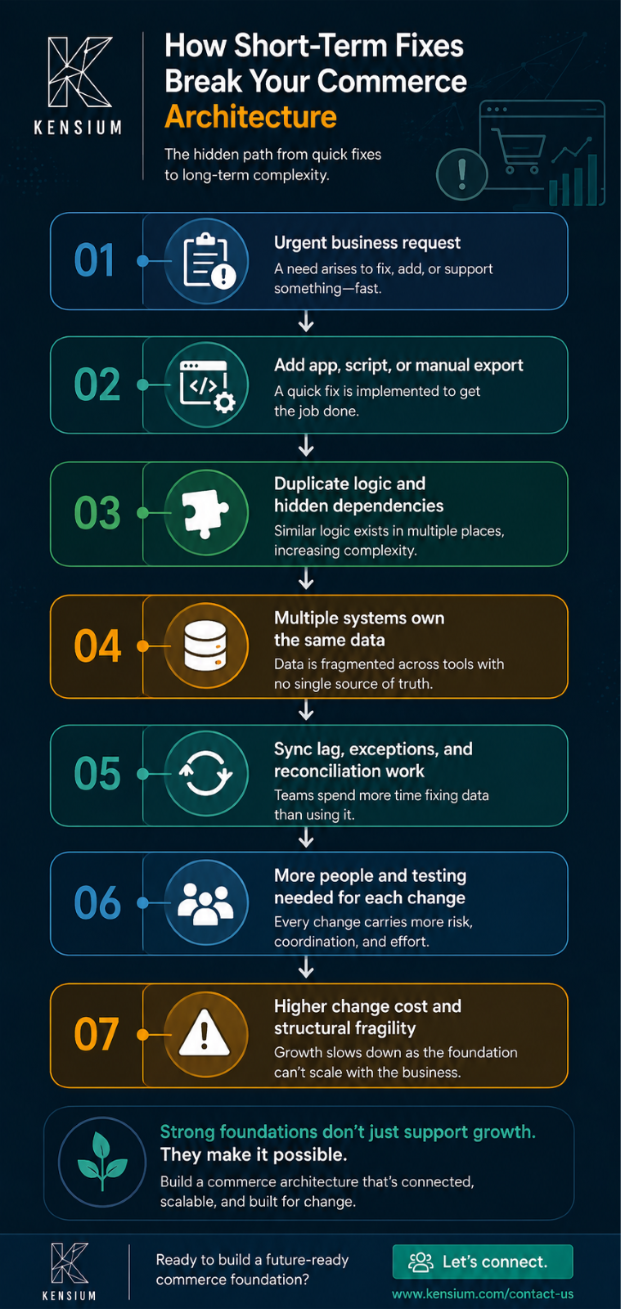
This failure pattern is consistent with platform guidance and practitioner experience alike. Adobe emphasizes API-first, event-driven extensibility and isolated services; BigCommerce emphasizes modular features, webhook-driven sync, and visible logs; Shopify emphasizes webhooks, version control, and real-time integrations. Community threads surface what happens when those disciplines are missing: slow stores, leftover code, overselling, and constant backend switching. [3]

Why Short-Term Fixes Feel Right

Short-term fixes feel right because they often are right in the moment. Commerce teams are under pressure to ship promotions, launch bundles, add channels, and close operational gaps without waiting for a full re-architecture. Shopify, BigCommerce, and Adobe Commerce all make extension possible, which is a strength. But extensibility without governance becomes accumulation. Reddit and Shopify Community discussions repeatedly describe the same pain points: too many apps slowing stores, bundle logic that takes hours to set up correctly, uninstall remnants left in theme code, and multichannel operations that create inventory anxiety and overselling. What begins as agility becomes fragility when ownership, versioning, and data contracts are unclear. [4]

The First Real Warning Sign: Change Gets Expensive

The first real warning sign is simple: ordinary change becomes disproportionately expensive. Adobe’s upgrade guidance tells teams to check compatibility for custom themes, third-party extensions, and custom code before upgrading. Shopify recommends GitHub-based theme version control so changes can be tracked and managed. DORA formalizes the same operating reality with metrics such as change lead time, change fail rate, and failed deployment recovery time. In ecommerce terms, those metrics become highly practical: how long does it take to ship a pricing or checkout change, how often does a release create production issues, and how long does it take to recover when it does. A useful business-side complement is cost-per-change, meaning the total engineering, QA, ops, and business testing time tied to a release divided by the number of meaningful changes delivered. When those numbers rise, your ecommerce architecture is signaling distress. [5]

What the Symptoms Look Like

Operational Symptoms

Operational symptoms usually appear before leadership names the architecture problem. Inventory mismatches, stale availability, delayed order status, payout reconciliation work, inconsistent pricing across channels, and unexplained storefront slowdowns are all common signs that the commerce stack is connected, but not coordinated. Shopify positions webhooks as a near-real-time alternative to polling and explicitly cites inventory,

shipping, and accounting workflows as webhook use cases. BigCommerce recommends real-time webhook sync, merchant-visible logs, and modular feature controls. Adobe recommends API-first and event-driven integration patterns for ERP, PIM, OMS, and CRM. The common lesson is straightforward: if your operating model still depends on batch jobs, manual exports, or app-by-app patches, error rates tend to rise with growth. [6]

Symptom Root Cause Short-term Fixes Scalable Remediation
Inventory mismatches and overselling More than one system owns stock data; sync happens too slowly or inconsistently. [7] Spreadsheet checks, batch syncs, channel-specific apps. Assign a system of record for inventory, use webhook or event-based updates, and monitor exceptions. [8]
Routine releases take too long Tight coupling across themes, extensions, and custom logic. [9] Freeze upgrades, patch directly in production, add another app. Put customizations under version control, test compatibility before release, and isolate services where possible. [10]
Reporting and reconciliation lag Order, payout, tax, and fulfillment data are split across systems. [11] CSV exports, manual journal entries, extra reconciliation steps. Automate payout, order, and shipment sync into ERP with visible logs and exception handling. [12]
Storefront performance degrades over time App and script sprawl, leftover code, and heavy front-end dependencies. [13] Uninstall apps and hope speed returns. Use a performance dashboard, reduce unnecessary JavaScript, clean residual code, and keep observability in place. [14]

Three Kensium examples make the pattern concrete. A holiday décor brand that reconnected Shopify and Acumatica around a single source of truth reported 66% revenue growth, 40% higher average order value, and 67% fewer errors. A seed retailer running Adobe Commerce with Acumatica unified product, customer, order, warehouse, and 3PL processes so orders flowed into finance in real time and manual entry dropped materially. A membership-driven retailer connected Shopify Plus to Sage X3 through middleware, automating catalog sync, inventory sync, selective order routing, payouts, and shipment updates while reducing manual intervention and reconciliation risk. [15]

Architecture That Coordinates, Not Just Connects

Integration vs Orchestration

Integration moves data. Orchestration defines ownership, timing, and exception handling. That distinction matters because ERP and storefront systems move at different speeds. Shopify’s enterprise guidance notes that ERPs sit at the center of many commerce stacks, but are slow and risky to change, while commerce still needs rapid updates for pricing, inventory, and order status. Adobe frames the answer as API-first and event-driven architecture. BigCommerce describes it through modular, decoupled services and an API-first model with broad platform exposure. In other words, scalable commerce does not merely pass data between systems. It deliberately coordinates which system decides what, when updates propagate, and how failures are surfaced. [16]

What a Scalable Commerce Foundation Looks Like

A scalable commerce foundation usually has five traits. First, system-of-record ownership is explicit: for many organizations, ERP owns pricing, inventory, fulfillment truth, and financial records, while the commerce platform owns merchandising, content, and customer experience. Second, critical updates move through APIs, webhooks, and events rather than spreadsheets or polling. Third, customization is versioned. Fourth, services are isolated enough to upgrade independently. Fifth, the operation is observable through logs, dashboards, and release metrics. Adobe’s reference architecture emphasizes isolation and simplified upgrades. Shopify provides version control, real-user performance reporting, and real-time APIs. BigCommerce recommends webhook-driven sync, modular apps, and human-readable logs. That is what scalable ecommerce architecture looks like in practice. [17]

Stop Adding Tools Blindly

Before You Add Another Tool: Questions to Ask

Before you add another connector, app, or customization, ask four questions. Does this remove complexity or hide it? Does it introduce another owner of the same data? Can it be versioned, monitored, and rolled back cleanly? Will it improve your delivery scorecard, especially change lead time, fail rate, and exception volume? If the answer to those questions is weak, you are probably funding a workaround instead of strengthening the architecture. Official platform guidance consistently favors modularity, observability, and controlled extensibility over one-off patches. [18]

FAQ

Is app count itself the problem?

Not by itself. The more relevant issue is unmanaged app footprint, unclear ownership, and code or scripts that remain after changes. Community threads and Shopify performance guidance both show that unused or residual code can create real drag. [19]

Can Shopify, BigCommerce, and Adobe Commerce support scalable commerce?

Yes. All three platforms provide the architectural building blocks: APIs, webhooks or events, modular extension paths, and upgrade-friendly practices. The limiting factor is usually implementation discipline, not platform capability. [20]

Should ERP always be the source of truth?

Not for every domain, but often for inventory, pricing, fulfillment, and financial data when ERP is the operational backbone. The storefront should optimize commerce experiences, not become an accidental back-office system. [21]

What should teams measure first?

Start with change lead time, change fail rate, failed deployment recovery time, manual touches per order, reconciliation exceptions, inventory mismatch rate, and key storefront performance metrics on core journeys. That mix captures both software delivery health and operational friction. [22]

Conclusion

The first warning sign your ecommerce architecture is breaking down is not a dramatic outage. It is the moment ordinary change becomes too expensive, too risky, and too cross-functional to be considered normal. At that point, growth is no longer exposing demand constraints. It is exposing architectural debt. If you want to assess whether your current stack is built for scalable commerce and durable ERP integration, talk with Kensium’s commerce team. [23]

Sources

  • Adobe Commerce official guidance on scaled architecture, upgrade best practices, extensibility, and isolated services. [24]
  • BigCommerce official guidance on composable commerce, API-first architecture, webhook-driven sync, and merchant-visible logging. [25]
  • Shopify official docs and enterprise pages on APIs, webhooks, version control, ERP integration, ERP consolidation, and performance instrumentation. [26]
  • Kensium case studies on Dekra-Lite[27], American Meadows[28], and American Kennel Club[29]. [15]
  • Reddit and Shopify Community threads on app sprawl, overselling, slow stores, and multichannel operational friction. [30]

[1][17][27] Enterprise reference architecture | Adobe Commerce

https://experienceleague.adobe.com/en/docs/commerce-operations/implementation-playbook/architecture/enterprise-blueprint

[2][3]https://experienceleague.adobe.com/en/perspectives/effective-extensibility-in-adobe-commerce

https://experienceleague.adobe.com/en/perspectives/effective-extensibility-in-adobe-commerce

[4] Manage extensions | Adobe Commerce

https://experienceleague.adobe.com/en/docs/commerce-on-cloud/user-guide/configure-store/extensions

[5][9][10] Best practices for upgrading your project | Adobe Commerce

https://experienceleague.adobe.com/en/docs/commerce-on-cloud/user-guide/develop/upgrade/best-practices

[6][8][20][26][29]https://shopify.dev/docs/apps/build/webhooks

https://shopify.dev/docs/apps/build/webhooks

[7]https://community.shopify.com/t/its-difficult-to-unify-orders-and-inventory-across-multiple-platforms-and-its-annoying-to-switch-between-backends/576820

https://community.shopify.com/t/its-difficult-to-unify-orders-and-inventory-across-multiple-platforms-and-its-annoying-to-switch-between-backends/576820

[11][12][28] AKC

https://www.kensium.com/case-study/akc

[13][19][30]

https://www.reddit.com/r/shopify/comments/1s8viv5/creating_a_shopify_for_the_first_time_what_ad_ons/

https://www.reddit.com/r/shopify/comments/1s8viv5/creating_a_shopify_for_the_first_time_what_ad_ons/

[14]https://shopify.dev/docs/storefronts/themes/best-practices/performance

https://shopify.dev/docs/storefronts/themes/best-practices/performance

[15] Dekra Lite Shopify & ERP Integration Case Study – Kensium

https://www.kensium.com/case-study/dekra-lite

[16]https://www.shopify.com/enterprise/blog/erp-consolidation

https://www.shopify.com/enterprise/blog/erp-consolidation

[18][22]https://dora.dev/guides/dora-metrics/

https://dora.dev/guides/dora-metrics/

[21]https://www.shopify.com/enterprise/blog/erp-inventory-management

https://www.shopify.com/enterprise/blog/erp-inventory-management

[23]https://www.kensium.com/contact-us

https://www.kensium.com/contact-us

[24] Scaled architecture | Adobe Commerce

https://experienceleague.adobe.com/en/docs/commerce-on-cloud/user-guide/architecture/scaled-architecture

[25] Composable Commerce in 2026 (Redefine You Tech Stack)

https://www.bigcommerce.com/articles/ecommerce/composable-commerce/

Share this on
Black Facebook social media logo icon on transparent background.Twitter bird logo in light blue on a transparent background.LinkedIn social media platform icon in blue and white.
Written by
Kensium’s Commerce Strategy Team
Kensium’s Commerce Strategy Team helps brands align strategy, technology, and operations to unlock growth across B2B and B2C channels. With expertise spanning customer experience, checkout optimization, marketing automation, ERP–eCommerce integration, and compliance, the team delivers holistic solutions that reduce friction, increase conversions, and scale digital commerce profitably.
Left-pointing chevron arrow icon.
Back to Blogs

The First Warning Sign Your Ecommerce Architecture Is Breaking Down

Marketing
Reading Time:
3
min
Published on:
May 4, 2026
Updated on:
May 4, 2026
Kensium ecommerce architecture concept showing cracked block with shopping cart icon symbolizing rising cost of change
Our Editorial Team
Kensium’s Commerce Strategy Team

Executive Summary

The first warning sign of a failing ecommerce architecture is not traffic, conversion, or even uptime. It is the rising cost of routine change. When a pricing update, promotion, bundle, channel launch, platform patch, or ERP integration tweak starts requiring excessive coordination, regression testing, and cleanup, the architecture has stopped absorbing change and started amplifying it. Official guidance from Adobe Commerce, BigCommerce, and Shopify points toward the same answer: scalable commerce depends on modular architecture, version-controlled customization, API-first or event-driven integration, real-time sync where it matters, and strong operational visibility. Kensium case studies show what happens when those disciplines are in place: fewer manual touches, better inventory accuracy, faster execution, and measurable commercial gains. Practitioner threads show the opposite pattern: app sprawl, leftover code, sync lag, and cross-platform firefighting. [1]

The Breaking Point

Introduction

Most ecommerce architecture does not “break” in one dramatic moment. It erodes. One app gets added to solve a merchandising gap. One script is written to handle a pricing edge case. One export is created so finance can reconcile payouts. Each decision is understandable. The problem is cumulative: hidden dependencies multiply, more than one system starts “owning” the same data, and the business ends up paying more for every future change. That is why scalable commerce is fundamentally about changeability, not just throughput. [2]

This failure pattern is consistent with platform guidance and practitioner experience alike. Adobe emphasizes API-first, event-driven extensibility and isolated services; BigCommerce emphasizes modular features, webhook-driven sync, and visible logs; Shopify emphasizes webhooks, version control, and real-time integrations. Community threads surface what happens when those disciplines are missing: slow stores, leftover code, overselling, and constant backend switching. [3]

Why Short-Term Fixes Feel Right

Short-term fixes feel right because they often are right in the moment. Commerce teams are under pressure to ship promotions, launch bundles, add channels, and close operational gaps without waiting for a full re-architecture. Shopify, BigCommerce, and Adobe Commerce all make extension possible, which is a strength. But extensibility without governance becomes accumulation. Reddit and Shopify Community discussions repeatedly describe the same pain points: too many apps slowing stores, bundle logic that takes hours to set up correctly, uninstall remnants left in theme code, and multichannel operations that create inventory anxiety and overselling. What begins as agility becomes fragility when ownership, versioning, and data contracts are unclear. [4]

The First Real Warning Sign: Change Gets Expensive

The first real warning sign is simple: ordinary change becomes disproportionately expensive. Adobe’s upgrade guidance tells teams to check compatibility for custom themes, third-party extensions, and custom code before upgrading. Shopify recommends GitHub-based theme version control so changes can be tracked and managed. DORA formalizes the same operating reality with metrics such as change lead time, change fail rate, and failed deployment recovery time. In ecommerce terms, those metrics become highly practical: how long does it take to ship a pricing or checkout change, how often does a release create production issues, and how long does it take to recover when it does. A useful business-side complement is cost-per-change, meaning the total engineering, QA, ops, and business testing time tied to a release divided by the number of meaningful changes delivered. When those numbers rise, your ecommerce architecture is signaling distress. [5]

What the Symptoms Look Like

Operational Symptoms

Operational symptoms usually appear before leadership names the architecture problem. Inventory mismatches, stale availability, delayed order status, payout reconciliation work, inconsistent pricing across channels, and unexplained storefront slowdowns are all common signs that the commerce stack is connected, but not coordinated. Shopify positions webhooks as a near-real-time alternative to polling and explicitly cites inventory,

shipping, and accounting workflows as webhook use cases. BigCommerce recommends real-time webhook sync, merchant-visible logs, and modular feature controls. Adobe recommends API-first and event-driven integration patterns for ERP, PIM, OMS, and CRM. The common lesson is straightforward: if your operating model still depends on batch jobs, manual exports, or app-by-app patches, error rates tend to rise with growth. [6]

Symptom Root Cause Short-term Fixes Scalable Remediation
Inventory mismatches and overselling More than one system owns stock data; sync happens too slowly or inconsistently. [7] Spreadsheet checks, batch syncs, channel-specific apps. Assign a system of record for inventory, use webhook or event-based updates, and monitor exceptions. [8]
Routine releases take too long Tight coupling across themes, extensions, and custom logic. [9] Freeze upgrades, patch directly in production, add another app. Put customizations under version control, test compatibility before release, and isolate services where possible. [10]
Reporting and reconciliation lag Order, payout, tax, and fulfillment data are split across systems. [11] CSV exports, manual journal entries, extra reconciliation steps. Automate payout, order, and shipment sync into ERP with visible logs and exception handling. [12]
Storefront performance degrades over time App and script sprawl, leftover code, and heavy front-end dependencies. [13] Uninstall apps and hope speed returns. Use a performance dashboard, reduce unnecessary JavaScript, clean residual code, and keep observability in place. [14]

Three Kensium examples make the pattern concrete. A holiday décor brand that reconnected Shopify and Acumatica around a single source of truth reported 66% revenue growth, 40% higher average order value, and 67% fewer errors. A seed retailer running Adobe Commerce with Acumatica unified product, customer, order, warehouse, and 3PL processes so orders flowed into finance in real time and manual entry dropped materially. A membership-driven retailer connected Shopify Plus to Sage X3 through middleware, automating catalog sync, inventory sync, selective order routing, payouts, and shipment updates while reducing manual intervention and reconciliation risk. [15]

Architecture That Coordinates, Not Just Connects

Integration vs Orchestration

Integration moves data. Orchestration defines ownership, timing, and exception handling. That distinction matters because ERP and storefront systems move at different speeds. Shopify’s enterprise guidance notes that ERPs sit at the center of many commerce stacks, but are slow and risky to change, while commerce still needs rapid updates for pricing, inventory, and order status. Adobe frames the answer as API-first and event-driven architecture. BigCommerce describes it through modular, decoupled services and an API-first model with broad platform exposure. In other words, scalable commerce does not merely pass data between systems. It deliberately coordinates which system decides what, when updates propagate, and how failures are surfaced. [16]

What a Scalable Commerce Foundation Looks Like

A scalable commerce foundation usually has five traits. First, system-of-record ownership is explicit: for many organizations, ERP owns pricing, inventory, fulfillment truth, and financial records, while the commerce platform owns merchandising, content, and customer experience. Second, critical updates move through APIs, webhooks, and events rather than spreadsheets or polling. Third, customization is versioned. Fourth, services are isolated enough to upgrade independently. Fifth, the operation is observable through logs, dashboards, and release metrics. Adobe’s reference architecture emphasizes isolation and simplified upgrades. Shopify provides version control, real-user performance reporting, and real-time APIs. BigCommerce recommends webhook-driven sync, modular apps, and human-readable logs. That is what scalable ecommerce architecture looks like in practice. [17]

Stop Adding Tools Blindly

Before You Add Another Tool: Questions to Ask

Before you add another connector, app, or customization, ask four questions. Does this remove complexity or hide it? Does it introduce another owner of the same data? Can it be versioned, monitored, and rolled back cleanly? Will it improve your delivery scorecard, especially change lead time, fail rate, and exception volume? If the answer to those questions is weak, you are probably funding a workaround instead of strengthening the architecture. Official platform guidance consistently favors modularity, observability, and controlled extensibility over one-off patches. [18]

FAQ

Is app count itself the problem?

Not by itself. The more relevant issue is unmanaged app footprint, unclear ownership, and code or scripts that remain after changes. Community threads and Shopify performance guidance both show that unused or residual code can create real drag. [19]

Can Shopify, BigCommerce, and Adobe Commerce support scalable commerce?

Yes. All three platforms provide the architectural building blocks: APIs, webhooks or events, modular extension paths, and upgrade-friendly practices. The limiting factor is usually implementation discipline, not platform capability. [20]

Should ERP always be the source of truth?

Not for every domain, but often for inventory, pricing, fulfillment, and financial data when ERP is the operational backbone. The storefront should optimize commerce experiences, not become an accidental back-office system. [21]

What should teams measure first?

Start with change lead time, change fail rate, failed deployment recovery time, manual touches per order, reconciliation exceptions, inventory mismatch rate, and key storefront performance metrics on core journeys. That mix captures both software delivery health and operational friction. [22]

Conclusion

The first warning sign your ecommerce architecture is breaking down is not a dramatic outage. It is the moment ordinary change becomes too expensive, too risky, and too cross-functional to be considered normal. At that point, growth is no longer exposing demand constraints. It is exposing architectural debt. If you want to assess whether your current stack is built for scalable commerce and durable ERP integration, talk with Kensium’s commerce team. [23]

Sources

  • Adobe Commerce official guidance on scaled architecture, upgrade best practices, extensibility, and isolated services. [24]
  • BigCommerce official guidance on composable commerce, API-first architecture, webhook-driven sync, and merchant-visible logging. [25]
  • Shopify official docs and enterprise pages on APIs, webhooks, version control, ERP integration, ERP consolidation, and performance instrumentation. [26]
  • Kensium case studies on Dekra-Lite[27], American Meadows[28], and American Kennel Club[29]. [15]
  • Reddit and Shopify Community threads on app sprawl, overselling, slow stores, and multichannel operational friction. [30]

[1][17][27] Enterprise reference architecture | Adobe Commerce

https://experienceleague.adobe.com/en/docs/commerce-operations/implementation-playbook/architecture/enterprise-blueprint

[2][3]https://experienceleague.adobe.com/en/perspectives/effective-extensibility-in-adobe-commerce

https://experienceleague.adobe.com/en/perspectives/effective-extensibility-in-adobe-commerce

[4] Manage extensions | Adobe Commerce

https://experienceleague.adobe.com/en/docs/commerce-on-cloud/user-guide/configure-store/extensions

[5][9][10] Best practices for upgrading your project | Adobe Commerce

https://experienceleague.adobe.com/en/docs/commerce-on-cloud/user-guide/develop/upgrade/best-practices

[6][8][20][26][29]https://shopify.dev/docs/apps/build/webhooks

https://shopify.dev/docs/apps/build/webhooks

[7]https://community.shopify.com/t/its-difficult-to-unify-orders-and-inventory-across-multiple-platforms-and-its-annoying-to-switch-between-backends/576820

https://community.shopify.com/t/its-difficult-to-unify-orders-and-inventory-across-multiple-platforms-and-its-annoying-to-switch-between-backends/576820

[11][12][28] AKC

https://www.kensium.com/case-study/akc

[13][19][30]

https://www.reddit.com/r/shopify/comments/1s8viv5/creating_a_shopify_for_the_first_time_what_ad_ons/

https://www.reddit.com/r/shopify/comments/1s8viv5/creating_a_shopify_for_the_first_time_what_ad_ons/

[14]https://shopify.dev/docs/storefronts/themes/best-practices/performance

https://shopify.dev/docs/storefronts/themes/best-practices/performance

[15] Dekra Lite Shopify & ERP Integration Case Study – Kensium

https://www.kensium.com/case-study/dekra-lite

[16]https://www.shopify.com/enterprise/blog/erp-consolidation

https://www.shopify.com/enterprise/blog/erp-consolidation

[18][22]https://dora.dev/guides/dora-metrics/

https://dora.dev/guides/dora-metrics/

[21]https://www.shopify.com/enterprise/blog/erp-inventory-management

https://www.shopify.com/enterprise/blog/erp-inventory-management

[23]https://www.kensium.com/contact-us

https://www.kensium.com/contact-us

[24] Scaled architecture | Adobe Commerce

https://experienceleague.adobe.com/en/docs/commerce-on-cloud/user-guide/architecture/scaled-architecture

[25] Composable Commerce in 2026 (Redefine You Tech Stack)

https://www.bigcommerce.com/articles/ecommerce/composable-commerce/

Our Editorial Team
Kensium’s Commerce Strategy Team

Explore Related Blogs

caret right
Kensium ecommerce architecture concept showing cracked block with shopping cart icon symbolizing rising cost of change
Marketing
First Warning Sign Your Ecommerce Architecture Is Failing | Kensium
Marketing
Webinar Recap: Shopify + ERP Connected Commerce | Kensium
Shopify Native B2B on All Plans: Architecture, ERP Integration & Strategy
Marketing
Shopify Native B2B on All Plans: Architecture, ERP Integration & Strategy
How Amazon’s New AI Interactive Voice Chatbot Will Transform Listings, Engagement, and Sales for Sellers
Marketing
Amazon’s AI Voice Chatbot: Impact on Listings, Sales & SEO
Marketing
Amazon Seller Margins Shrinking in 2025 and How to Fix it in 2026
Ecommerce Optimization Dashboard – Data-Driven Insights for Shopify Merchants
Ecommerce
Marketing
eCommerce CRO Checklist & Playbook for Higher Conversions
Marketing
From Chaos to Clarity: How an Integrated eCommerce Tech Stack Boosts Operational Efficiency
Marketing
Amazon Buy with Prime and Seller Central: Why Optimization Is Critical for eCommerce Growth in 2026
Marketing
7 B2B Email Automation Flows That Actually Drive Sales
Marketing
Why B2B Digital Marketing Needs More than Search in 2026
Marketing
Boost Conversions Without Boosting Traffic: Why CRO Matters
Image Altext: Team reviewing Meta Facebook Business Account Recovery process shown on a presentation screen.
Marketing
Meta (Facebook) Business Account Recovery Guide
Personalization and Automation in B2B E-Commerce Digital Marketing: Striking the Perfect Balance
Marketing
Personalization & Automation in B2B E-Commerce Marketing
Marketing
Data-Driven Strategies: Optimizing Your B2B E-Commerce Digital Marketing
Marketing
The Content Gap That’s Costing You Sales: Why Product Descriptions Matter More Than You Think
Artificial Intelligence (AI)
Marketing
Leveraging AI-Powered Analytics for Data-Driven SEO Success
Ecommerce
Marketing
How Tech & Analytics Elevate eCommerce Marketing
Marketing
Top B2B E-Commerce Digital Marketing Trends for 2026
Artificial Intelligence (AI)
Marketing
Leveraging AI for B2B E-Commerce Digital Marketing Success 
Marketing
How AI Is Changing the Game for Marketers (And What I Learned at SMMW) 
Marketing
Mastering D2C Marketing: A Step-by-Step Guide to Growing Your eCommerce Brand
Marketing
The Evolution of Marketing: How eCommerce Brands Can Blend Tradition with Innovation for Maximum Impact 
Marketing
Best Practices for Growing Direct-to-Consumer (D2C) Marketing Efforts
Marketing
B2B to B2C Marketing: Transition Strategies & Growth| Kensium
Marketing
Is Your Marketing Company Gaslighting You? Navigating the Maze of Digital Marketing Scams
Marketing
The Illusion of Marketing Control: Now you have it...now you don’t.
Marketing
Conversion Rate Optimization (CRO) Assessments Are a Win-Win!
Marketing
Five Effective Remarketing Strategies Tailored to your needs
Why Social Media Marketing Matters for B2B Companies
Marketing
Why Social Media Marketing Matters for B2B Companies in 2026
Marketing
End of UA and a Guide for Migrating to GA4
Marketing
How To Drive External Traffic To Your Amazon Listings
Marketing
How To Monetize Your Digital Ecommerce Solutions
Marketing
Digital Maturity Is The Key To Ecommerce Growth
Marketing
How Get Lit Boosted Their User Base By Over 100%
Marketing
The B2B Digital Maturity Model
Marketing
Pro Social Media Tips: YouTube, Reddit, Spotify & Pinterest
Marketing
Kensium's Pro Tips For Social Media Marketing (Part 1)
Marketing
3 Low-Cost Ways To Grow Your Small Business In 2019
Marketing
Efficiency Leads To Higher Customer Lifetime Value
Marketing
Why HTTPS Certification Matters - And How To Get Secure For Google's July Update
Marketing
A Comparison Of Free + Paid Product Listings Across Google Shopping
Marketing
Micro-Animating The Purchase Path To Boost Conversions
Marketing
6 Ways To Maximize Conversions With Holiday Sales
Marketing
Website Performance Phishing
Marketing
Why Your Business Should Look Ahead To The Metaverse
Marketing
Why Google Chrome Ranks Your Website Better With An SSL Certificate
Marketing
The Powerful Value Of Referral Marketing In ECommerce