Left-pointing white chevron arrow on a transparent background.
Back to article listing
Articles

Top Questions Commerce Leaders Are Asking About the Future of Connected Commerce

March 16, 2026
By-
Kensium’s OmnifiCX Team
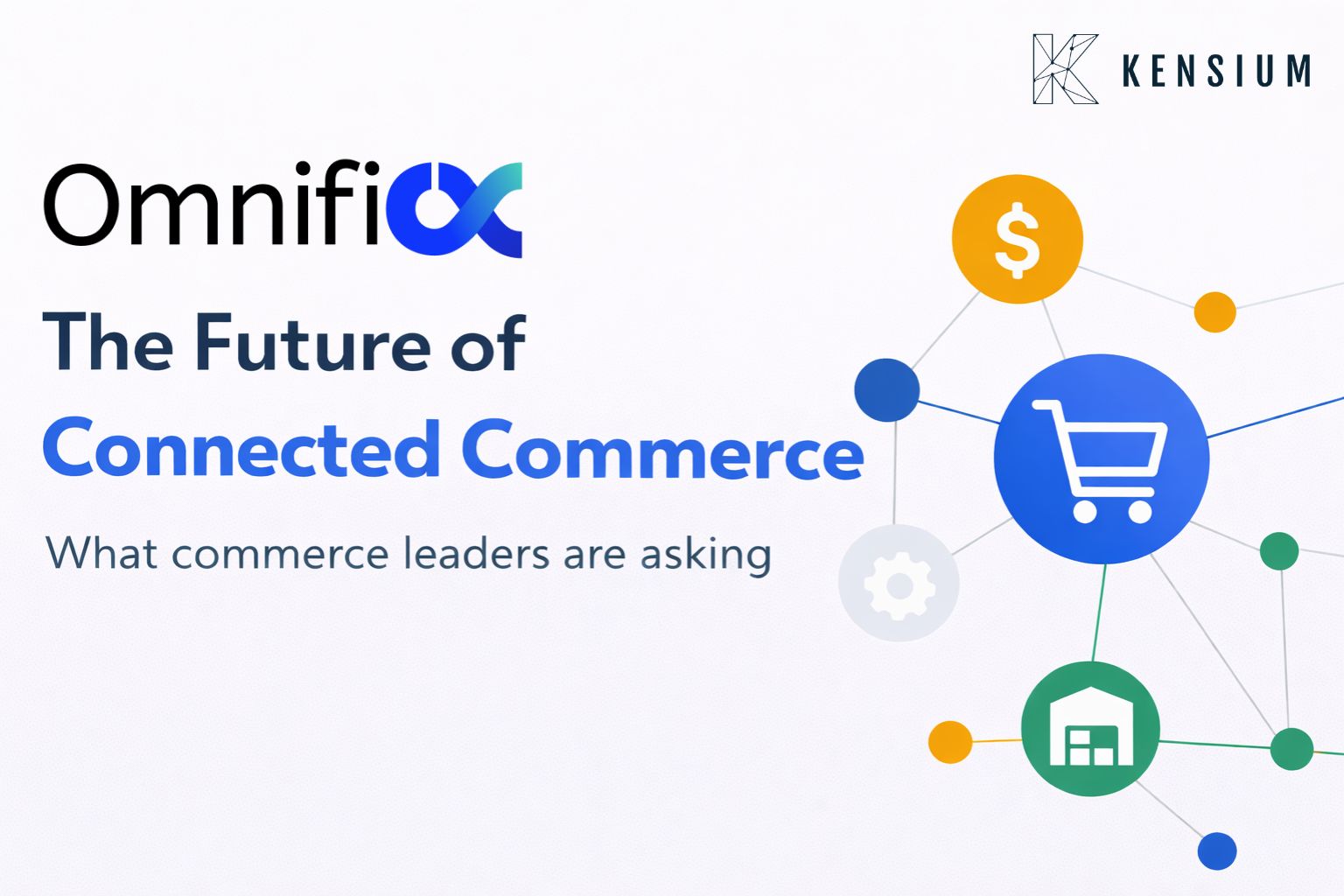
OmnifiCX by Kensium – future of connected commerce architecture connecting ecommerce, payments, and systems

Executive summary

Commerce leaders rarely struggle because a single system fails.

More often, the friction shows up between systems. Inventory doesn’t match across channels. Orders need manual reconciliation. Pricing appears different depending on where someone looks. Customer records multiply across platforms. Reporting requires exports and spreadsheets before anyone can trust the numbers.

These are the kinds of operational challenges that surfaced during Kensium’s recent webinar on connected commerce and the OmnifiCX platform. As the discussion moved into the live Q&A, attendees began asking the practical questions that matter to leadership teams:

  • What happens when we upgrade ERP or ecommerce?
  • How do we prevent duplicate customer records?
  • Can our internal teams operate this platform?
  • What does pricing look like as order volume grows?

If you missed the session, you can review the full discussion in the webinar recap here:  Webinar Recap: The Future of Connected Commerce with OmnifiCX

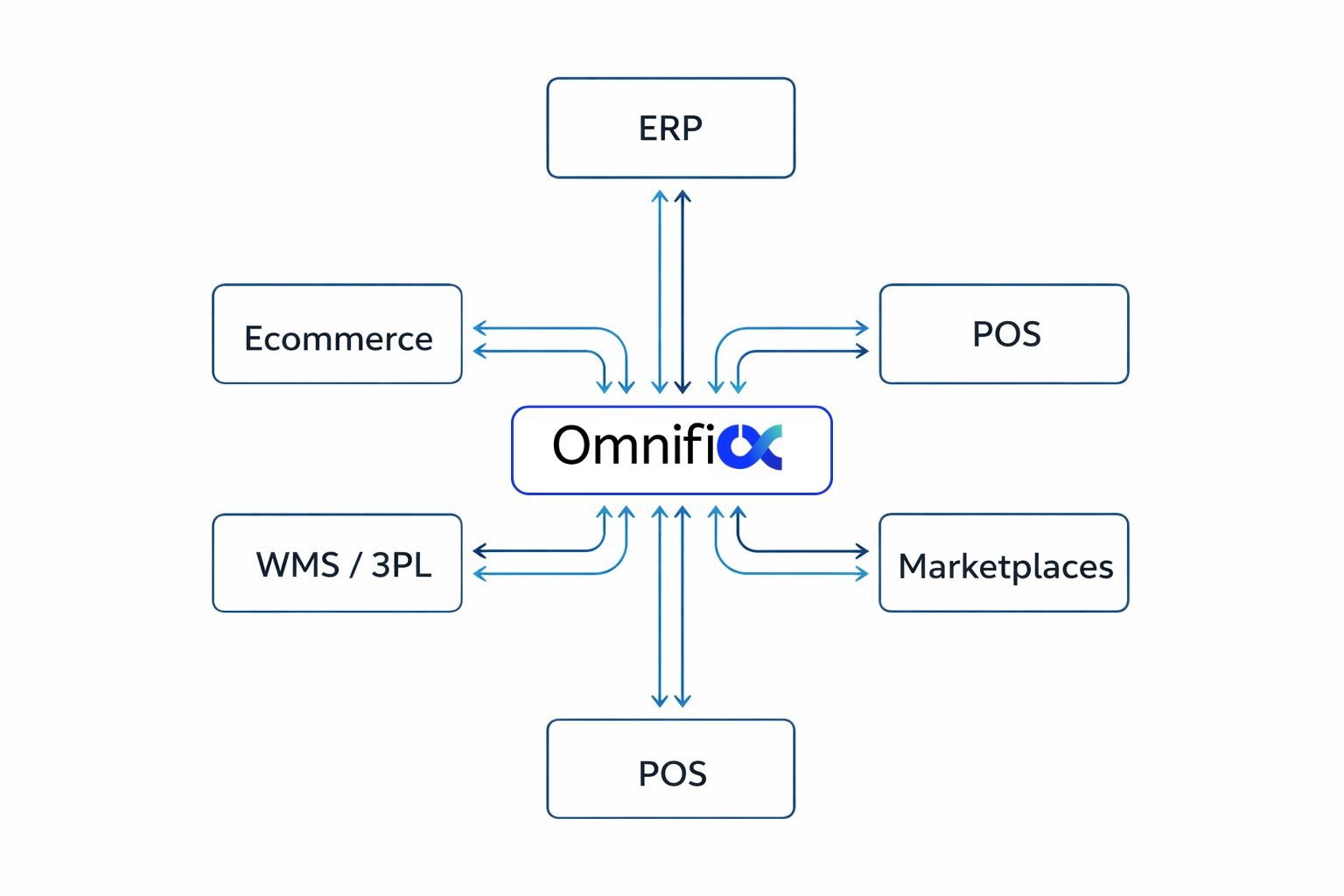
What became clear in that conversation is that many integration problems are not caused by the systems themselves. They come from the architecture connecting them. Instead of adding more point-to-point connectors, OmnifiCX introduces a governed hub and canonical commerce data model that sits between ERP, ecommerce, POS, marketplaces, and fulfillment systems, allowing those platforms to operate from a shared operational foundation.

The questions that followed reveal how commerce leaders are beginning to rethink the architecture behind their commerce operations.

Traditional integrations versus a hub-based model

Traditional middleware and connector strategies often begin with a single integration and grow into a web of dependencies. In Kensium’s recap, “traditional middleware” commonly leans on point-to-point connectors, custom scripts, complex ETL pipelines, and heavy engineering cycles for every change. [4]

OmnifiCX positions a different center of gravity: a unified commerce foundation with a canonical model for core commerce entities, real-time and batch synchronization options, and master-data governance controls intended to normalize and align data across the ecosystem. [3]

OmnifiCX also emphasizes “prebuilt commerce models” with governance and integrated master data management, aiming to deliver analytics and operations together rather than reporting that sits downstream of mismatched operational data. [6]

The platform’s marketplace highlights the intended breadth of connectivity, with featured integrations including Shopify[7], Acumatica[8], ShipStation, and Walmart, plus additional commerce and ERP options listed in categories. [9]

Comparison table
Feature Traditional point-to-point / iPaaS OmnifiCX hub-based approach
Upgrade complexity Changes in one system can ripple through many connectors; upgrades frequently require multi-integration regression checks. Systems communicate through a shared layer so alignment focuses on affected integration surfaces rather than every cross-connection.
Data completeness Often limited to what both endpoints can represent; teams end up reconciling “system A vs system B” answers. Canonical commerce model plus governed data layer aims for consistent entities across systems as a single operational picture.
Cost model Common risk areas include per-connection pricing, consultant-heavy change cycles, and licensing surprises as usage scales. Positioned as scale-based with transparent per-run overages plus no per-connection fees.
Implementation time Frequently stretches as each interface and exception path is built and tested across pairs of systems. Most customers implement and go live within 2–4 weeks supported by onboarding templates.
Customization effort Custom logic tends to live in scripts and connector glue, making ownership and upgrades harder as requirements evolve. Mapping, transformation, and orchestration are core platform concepts with reusable patterns.

Top Questions Answered

If we upgrade our ERP or ecommerce platform, what changes do we need to make inside OmnifiCX?

The hub-based model is designed so upgrades do not force you into a “change everything” cycle. The practical approach described in the webinar is to create or update the relevant connection for the upgraded system, refresh the system documents, and then adjust only what actually changed, usually specific mappings or flows if fields or APIs were added, removed, or modified. Other systems connected to the hub are not expected to require rework simply because one endpoint upgraded. [3]

Operationally, the webinar also emphasized testability: validate the integration behavior in a lower environment, re-run transactions for a representative sync, and only then promote updates. This aligns with the platform’s inclusion of multiple environments and guided onboarding as part of its packaging. [15]

How easy is it for internal teams to operate OmnifiCX? Is it an end-user tool?

The premise is that internal teams can operate the platform because configuration and operations are organized around standardized integration assets (flows, mappings, and orchestration patterns) rather than bespoke code scattered across connectors. The webinar recap notes that the platform provides visual tools for configuring integrations, flows, and mappings, but still requires a methodical understanding of workflows and architecture. [16]

For organizations that want internal ownership, the expectation set in the session was enablement and training. For organizations that prefer to focus on the business and outsource integration changes, the webinar described partner support as an option, which is consistent with Kensium’s positioning around ERP integration delivery and ongoing support services. [17]

How does pricing work if order volume fluctuates seasonally?

The webinar described pricing as transactional and flexible for seasonal volume patterns: if you anticipate a sustained increase, you can move to a higher plan; if the spike is short-lived, overages cover the temporary uplift. [4]

The OmnifiCX pricing page reinforces that structure in concrete terms, describing plan tiers based on orders, SKUs, and customers, plus transparent per-unit overage rates and usage alerts when you approach thresholds. [11]

How can OmnifiCX help reduce duplicate customer records or messy data?

The webinar answer focused on identity discipline and governance. Instead of inventing a new global numbering sequence that can conflict with ERP and ecommerce identity schemes, the hub maintains references to each source system’s identifiers and links them through external ID relationships. That structure makes it easier to recognize when two records represent the same real-world customer and reduces the likelihood of accidental duplicates created by mismatched numbering schemes. [4]

This fits the broader platform narrative: a single governed foundation for commerce entities, designed to replace reconciliation work with a shared operational model that stays consistent across ecosystems. [18]

Can OmnifiCX support custom fields and user-defined fields in systems like Acumatica, BigCommerce, or Shopify?

The webinar response was yes: the platform can retrieve and map custom attributes including metafields and user-defined fields, store them in the hub, and map them to other systems as needed. [4]

At an architectural level, this aligns with OmnifiCX’s stated goal of a canonical model and governed data foundation that can keep records consistent and “audit-ready” across systems, rather than losing critical attributes to lowest-common-denominator mappings. [6]

What is the process for adding a new system that does not have a prebuilt connector?

The webinar described two paths. First, use prebuilt integrations (often described as subscriptions) when available. Second, for a specialized system (for example, a niche 3PL), create a custom integration by defining the system contract and building the integration flows. In the recap, this is described as uploading the system API specifications and defining the flows themselves, so specialized platforms can still connect into the hub model. [4]

The OmnifiCX marketplace reinforces that this integration strategy is meant to expand by ecosystem coverage, with multiple commerce, ERP, fulfillment, and marketplace options enumerated as possible endpoints. [9]

Does OmnifiCX support bidirectional syncing?

Yes, with an important clarification: synchronization is bidirectional, but it is hub-routed. Each system syncs into OmnifiCX and receives updates back from OmnifiCX, rather than systems syncing directly to each other. This is the architectural mechanism that isolates systems, reduces cross-system coupling, and supports simpler upgrades over time. [3]

The platform’s packaging also supports this operationally through real-time sync mechanisms (webhooks and schedulers) and governance plus alerting to keep cross-system updates visible and controlled. [15]

Turning Connected Commerce Into an Operational Advantage

If your commerce stack is growing faster than your integrations can keep up, a hub-based foundation is worth evaluating, especially if your pain shows up as reconciliation work, upgrade risk, and inconsistent “system truth.” [3]

To see how OmnifiCX would map to your ERP, ecommerce, fulfillment, and marketplace environment, book a one-on-one demo or contact the team to review your current architecture and operating constraints. [19]

[1][2][3][4][7][8][16] How OmnifiCX Unifies Commerce Operations: Webinar | Kensium

https://www.kensium.com/blog/connected-commerce-omnificx-webinar-recap

[5] Why are there so many awful Salesforce integrations?

https://www.reddit.com/r/salesforce/comments/1jdkuuj/why_are_there_so_many_awful_salesforce/

[6][18] OmnifiCX Commerce Intelligence Platform | One Truth Data

https://omnificx.com/

[9] OmnifiCX Integrations Marketplace | Connect Commerce Systems

https://www.omnificx.com/marketplace

[10][14] Evaluating Celigo vs other integration platforms : r/Netsuite

https://www.reddit.com/r/Netsuite/comments/1o2vx5n/evaluating_celigo_vs_other_integration_platforms/

[11][12][15] OmnifiCX Pricing | Transparent Commerce Intelligence

https://www.omnificx.com/pricing

[13] Data Integration Developers

https://www.kensium.com/careers/data-integration-developer

[17] Ecommerce ERP Integration for Magento, Shopify & ...

https://www.kensium.com/enterprise-integrations

[19] Contact OmnifiCX | Talk to Commerce Intelligence Experts

https://www.omnificx.com/contact-us

Share this on
Black Facebook social media logo icon on transparent background.Twitter bird logo in light blue on a transparent background.LinkedIn social media platform icon in blue and white.
Written by
Kensium’s OmnifiCX Team
The OmnifiCX Team at Kensium brings together commerce architects, integration experts, and data strategists dedicated to building unified, AI-ready commerce foundations. With extensive experience across ERP, ecommerce, POS, and marketplace systems, the team focuses on eliminating fragmentation and enabling intelligent, scalable operations.
Left-pointing chevron arrow icon.
Back to Blogs

Top Questions Commerce Leaders Are Asking About the Future of Connected Commerce

Ecommerce
Reading Time:
3
min
Published on:
March 16, 2026
Updated on:
March 16, 2026
OmnifiCX by Kensium – future of connected commerce architecture connecting ecommerce, payments, and systems
Our Editorial Team
Kensium’s OmnifiCX Team
Ready to Solve Your Challenges?

Share your goals - we’ll match you with the right Kensium specialist to explore the best path forward.

Schedule a Consultation
Share this article

Executive summary

Commerce leaders rarely struggle because a single system fails.

More often, the friction shows up between systems. Inventory doesn’t match across channels. Orders need manual reconciliation. Pricing appears different depending on where someone looks. Customer records multiply across platforms. Reporting requires exports and spreadsheets before anyone can trust the numbers.

These are the kinds of operational challenges that surfaced during Kensium’s recent webinar on connected commerce and the OmnifiCX platform. As the discussion moved into the live Q&A, attendees began asking the practical questions that matter to leadership teams:

  • What happens when we upgrade ERP or ecommerce?
  • How do we prevent duplicate customer records?
  • Can our internal teams operate this platform?
  • What does pricing look like as order volume grows?

If you missed the session, you can review the full discussion in the webinar recap here:  Webinar Recap: The Future of Connected Commerce with OmnifiCX

What became clear in that conversation is that many integration problems are not caused by the systems themselves. They come from the architecture connecting them. Instead of adding more point-to-point connectors, OmnifiCX introduces a governed hub and canonical commerce data model that sits between ERP, ecommerce, POS, marketplaces, and fulfillment systems, allowing those platforms to operate from a shared operational foundation.

The questions that followed reveal how commerce leaders are beginning to rethink the architecture behind their commerce operations.

Traditional integrations versus a hub-based model

Traditional middleware and connector strategies often begin with a single integration and grow into a web of dependencies. In Kensium’s recap, “traditional middleware” commonly leans on point-to-point connectors, custom scripts, complex ETL pipelines, and heavy engineering cycles for every change. [4]

OmnifiCX positions a different center of gravity: a unified commerce foundation with a canonical model for core commerce entities, real-time and batch synchronization options, and master-data governance controls intended to normalize and align data across the ecosystem. [3]

OmnifiCX also emphasizes “prebuilt commerce models” with governance and integrated master data management, aiming to deliver analytics and operations together rather than reporting that sits downstream of mismatched operational data. [6]

The platform’s marketplace highlights the intended breadth of connectivity, with featured integrations including Shopify[7], Acumatica[8], ShipStation, and Walmart, plus additional commerce and ERP options listed in categories. [9]

Comparison table

Feature Traditional point-to-point / iPaaS OmnifiCX hub-based approach
Upgrade complexity Changes in one system can ripple through many connectors; upgrades frequently require multi-integration regression checks. Systems communicate through a shared layer so alignment focuses on affected integration surfaces rather than every cross-connection.
Data completeness Often limited to what both endpoints can represent; teams end up reconciling “system A vs system B” answers. Canonical commerce model plus governed data layer aims for consistent entities across systems as a single operational picture.
Cost model Common risk areas include per-connection pricing, consultant-heavy change cycles, and licensing surprises as usage scales. Positioned as scale-based with transparent per-run overages plus no per-connection fees.
Implementation time Frequently stretches as each interface and exception path is built and tested across pairs of systems. Most customers implement and go live within 2–4 weeks supported by onboarding templates.
Customization effort Custom logic tends to live in scripts and connector glue, making ownership and upgrades harder as requirements evolve. Mapping, transformation, and orchestration are core platform concepts with reusable patterns.

Top Questions Answered

If we upgrade our ERP or ecommerce platform, what changes do we need to make inside OmnifiCX?

The hub-based model is designed so upgrades do not force you into a “change everything” cycle. The practical approach described in the webinar is to create or update the relevant connection for the upgraded system, refresh the system documents, and then adjust only what actually changed, usually specific mappings or flows if fields or APIs were added, removed, or modified. Other systems connected to the hub are not expected to require rework simply because one endpoint upgraded. [3]

Operationally, the webinar also emphasized testability: validate the integration behavior in a lower environment, re-run transactions for a representative sync, and only then promote updates. This aligns with the platform’s inclusion of multiple environments and guided onboarding as part of its packaging. [15]

How easy is it for internal teams to operate OmnifiCX? Is it an end-user tool?

The premise is that internal teams can operate the platform because configuration and operations are organized around standardized integration assets (flows, mappings, and orchestration patterns) rather than bespoke code scattered across connectors. The webinar recap notes that the platform provides visual tools for configuring integrations, flows, and mappings, but still requires a methodical understanding of workflows and architecture. [16]

For organizations that want internal ownership, the expectation set in the session was enablement and training. For organizations that prefer to focus on the business and outsource integration changes, the webinar described partner support as an option, which is consistent with Kensium’s positioning around ERP integration delivery and ongoing support services. [17]

How does pricing work if order volume fluctuates seasonally?

The webinar described pricing as transactional and flexible for seasonal volume patterns: if you anticipate a sustained increase, you can move to a higher plan; if the spike is short-lived, overages cover the temporary uplift. [4]

The OmnifiCX pricing page reinforces that structure in concrete terms, describing plan tiers based on orders, SKUs, and customers, plus transparent per-unit overage rates and usage alerts when you approach thresholds. [11]

How can OmnifiCX help reduce duplicate customer records or messy data?

The webinar answer focused on identity discipline and governance. Instead of inventing a new global numbering sequence that can conflict with ERP and ecommerce identity schemes, the hub maintains references to each source system’s identifiers and links them through external ID relationships. That structure makes it easier to recognize when two records represent the same real-world customer and reduces the likelihood of accidental duplicates created by mismatched numbering schemes. [4]

This fits the broader platform narrative: a single governed foundation for commerce entities, designed to replace reconciliation work with a shared operational model that stays consistent across ecosystems. [18]

Can OmnifiCX support custom fields and user-defined fields in systems like Acumatica, BigCommerce, or Shopify?

The webinar response was yes: the platform can retrieve and map custom attributes including metafields and user-defined fields, store them in the hub, and map them to other systems as needed. [4]

At an architectural level, this aligns with OmnifiCX’s stated goal of a canonical model and governed data foundation that can keep records consistent and “audit-ready” across systems, rather than losing critical attributes to lowest-common-denominator mappings. [6]

What is the process for adding a new system that does not have a prebuilt connector?

The webinar described two paths. First, use prebuilt integrations (often described as subscriptions) when available. Second, for a specialized system (for example, a niche 3PL), create a custom integration by defining the system contract and building the integration flows. In the recap, this is described as uploading the system API specifications and defining the flows themselves, so specialized platforms can still connect into the hub model. [4]

The OmnifiCX marketplace reinforces that this integration strategy is meant to expand by ecosystem coverage, with multiple commerce, ERP, fulfillment, and marketplace options enumerated as possible endpoints. [9]

Does OmnifiCX support bidirectional syncing?

Yes, with an important clarification: synchronization is bidirectional, but it is hub-routed. Each system syncs into OmnifiCX and receives updates back from OmnifiCX, rather than systems syncing directly to each other. This is the architectural mechanism that isolates systems, reduces cross-system coupling, and supports simpler upgrades over time. [3]

The platform’s packaging also supports this operationally through real-time sync mechanisms (webhooks and schedulers) and governance plus alerting to keep cross-system updates visible and controlled. [15]

Turning Connected Commerce Into an Operational Advantage

If your commerce stack is growing faster than your integrations can keep up, a hub-based foundation is worth evaluating, especially if your pain shows up as reconciliation work, upgrade risk, and inconsistent “system truth.” [3]

To see how OmnifiCX would map to your ERP, ecommerce, fulfillment, and marketplace environment, book a one-on-one demo or contact the team to review your current architecture and operating constraints. [19]

[1][2][3][4][7][8][16] How OmnifiCX Unifies Commerce Operations: Webinar | Kensium

https://www.kensium.com/blog/connected-commerce-omnificx-webinar-recap

[5] Why are there so many awful Salesforce integrations?

https://www.reddit.com/r/salesforce/comments/1jdkuuj/why_are_there_so_many_awful_salesforce/

[6][18] OmnifiCX Commerce Intelligence Platform | One Truth Data

https://omnificx.com/

[9] OmnifiCX Integrations Marketplace | Connect Commerce Systems

https://www.omnificx.com/marketplace

[10][14] Evaluating Celigo vs other integration platforms : r/Netsuite

https://www.reddit.com/r/Netsuite/comments/1o2vx5n/evaluating_celigo_vs_other_integration_platforms/

[11][12][15] OmnifiCX Pricing | Transparent Commerce Intelligence

https://www.omnificx.com/pricing

[13] Data Integration Developers

https://www.kensium.com/careers/data-integration-developer

[17] Ecommerce ERP Integration for Magento, Shopify & ...

https://www.kensium.com/enterprise-integrations

[19] Contact OmnifiCX | Talk to Commerce Intelligence Experts

https://www.omnificx.com/contact-us

Our Editorial Team
Kensium’s OmnifiCX Team

Explore Related Blogs

caret right
OmnifiCX by Kensium – future of connected commerce architecture connecting ecommerce, payments, and systems
Ecommerce
Future of Connected Commerce: Key Leader Questions
Acumatica and BigCommerce eliminating spreadsheet dependency
Ecommerce
Acumatica BigCommerce Integration Without Spreadsheets
Ecommerce
ERP
Who Can Actually Integrate Acumatica with Ecommerce, POS, and Warehouse Systems?
Ecommerce
Keeping Your Adobe Commerce Site Secure: Why Regular Patches and Upgrades Matter
Ecommerce
Why Growth Breaks Without Integration and Tax Compliance
Ecommerce
ERP
Why Most ERP–Ecommerce Integrations Fail at Scale: A System Architecture Autopsy
Ecommerce
Which Ecommerce Platform Is Right for Your Business?
Ecommerce
2026 Ecommerce Trends Forecast: What’s Next for B2B & B2C
Ecommerce
B2B Buyer Portals: Empowering U.S. Businesses in the Digital Age
Ecommerce
Here’s What IDC Found About BigCommerce B2B Edition
Shopify
ERP
Ecommerce
Shopify, Adobe Commerce & BigCommerce: ERP Integration Guide
How B2B Ecommerce ERP Integration Boosts Sales
ERP
Ecommerce
B2B Ecommerce ERP Integration for Wholesale Sales Growth Pro
Seamless Workspace Transformation – Integrating ERP and Ecommerce for Efficiency
Ecommerce
ERP
Distribution Needs eCommerce ERP Integration: 5 Signs
Ecommerce Optimization Dashboard – Data-Driven Insights for Shopify Merchants
Ecommerce
Marketing
eCommerce CRO Checklist & Playbook for Higher Conversions
Ecommerce
E-Commerce Growth Playbook: Holiday Shopping 2025
Ecommerce
Integrating eCommerce Platforms with NetSuite
Ecommerce
B2B Ecommerce Customization Framework: How Kensium Maximizes ROI & Avoids Costly Pitfalls
B2B eCommerce Strategy Guide to Generative Engine Optimization by Kensium
Ecommerce
Generative Engine Optimization for B2B eCommerce in 2026| Kensium
Ecommerce
Cost-Cutting Strategies for eCommerce Growth in 2025
Ecommerce
Behavioral Economics in E-commerce: 10 Proven Tactics That Convert
Artificial Intelligence (AI)
Ecommerce
10 AI Strategies That Actually Drive B2B Ecommerce Growth
Ecommerce
Is Your B2B Store Costing You Sales? UX Fixes D2C Brands Already Use
Ecommerce
Amazon Prime Day 2025: Record Sales, AI Chatbots, and Key Takeaways for Sellers
Ecommerce
News & Update
Shopify
Embrace the Future: USDC Payments on Shopify via Coinbase & Stripe – Powered by Kensium
Ecommerce
How E-commerce Brands Can Profit from US Tariffs: A Complete Guide
Unlocking the Power of Shopify Magic: AI-Driven Commerce for the Modern B2B Merchant
Ecommerce
Artificial Intelligence (AI)
Shopify
Unlocking the Power of Shopify Magic: AI-Driven Commerce for the Modern B2B Merchant
Ecommerce
Your Website Is Not a Brochure: 5 Upgrades That Convert B2B Traffic
Ecommerce
7 Signs Your B2B eCommerce Platform Is Dying
Ecommerce
Customized B2B eCommerce Solutions: Max ROI, Avoid Templates
Ecommerce
Retrieving data. Wait a few seconds and try to cut or copy again.
Ecommerce
Marketing
How Tech & Analytics Elevate eCommerce Marketing
Ecommerce
The Vanishing Product: Don’t Let End-of-Life Cost You Loyal Customers
Ecommerce
The Delivery Deadline Doom: Are Late Shipments Killing Your Brand?
Ecommerce
Click to Convert: Mastering CTAs for Maximum Ecommerce Success
Ecommerce Shipping Delays: Impact, Causes & Solutions by kensium
Ecommerce
Ecommerce Shipping Delays: How Delivery Issues Hurt Brands
Ecommerce
The Abandoned Cart Cemetery: Revive Your Lost Sales
Ecommerce
Unlock the Potential of Your Adobe Commerce Store with Adobe App Builder
Ecommerce
The Holiday Hangover: Don't Let Lost Sales Haunt You All Year
Ecommerce
Is it Time to Refresh Your Company’s Website?
Ecommerce
how-omnichannel-ecommerce-will-drive-b2b-sales-in-2025-insights-from-mckinseys-latest-survey
Ecommerce
The Rise of Composable Commerce: How Adobe Commerce is Leading the Charge
Ecommerce
Sustainable E-Commerce: How BigCommerce Supports Eco-Friendly Practices
Ecommerce
The Power of User-Generated Content: Boosting Engagement on Shopify Stores
Ecommerce
The Rise of Conversational Commerce: Revolutionizing Customer Support and Boosting Conversion Rates
Ecommerce
Upgrading to Magento 2.4.7 and PHP 8.3
Ecommerce
Managing Multi-Channel Inventory with Ease on Shopify
Ecommerce
Why Every Ecommerce Business Needs an ERP
Ecommerce
The Power of PunchOut Integrations: How They Revolutionize B2B Transactions
Ecommerce
How Shopify Merchants Can Dominate with Dynamic Pricing
Ecommerce
Unifying B2B and B2C Experiences with Headless Commerce: How Kensium Leads the Charge
Ecommerce
Solo but Strong: My Experience as the Only Woman in Kensium's Sales Team
Ecommerce
Unlocking Success: Essential Ecommerce Metrics Every Business Should Track
Ecommerce
Ecommerce Predictions in 2024: Reimagining Customer Experience with Hyper-Personalization
Ecommerce
Exploring the Potential of the Metaverse to Revolutionize Ecommerce Businesses
Ecommerce
Top 20 Best Practices to Protect your Magento Store from Cyber Attacks
Ecommerce
Top 8 Cyber Resilience Strategies to Safeguard your Magento Store
Ecommerce
Harnessing the Power of ChatGPT for Ecommerce Transformation
Ecommerce
Composable Commerce: Understanding its Significance
Ecommerce
Picking right Adobe Commerce (Magento) trends
Ecommerce
How ChatGPT Transforms Ecommerce & Cybersecurity
Ecommerce
How to Increase Ecommerce Average Order Value (AOV)?
Ecommerce
Navigating the New Adobe Commerce Lifecycle Policy with Kensium's Support
Ecommerce
BigCommerce Unveils Powerful Features for B2B Edition. How can Kensium Help you Leverage Them?
Ecommerce
Simplify Online Shopping with Quick Checkout by Bolt for Adobe
Ecommerce
Amazon Buy with Prime
Ecommerce
Headless vs Composable vs PWA
Ecommerce
Allparts - Support Case Study
Ecommerce
Boost Your E-commerce Sales with BigCommerce's BOPIS Feature
Ecommerce
Stay Ahead of the Game with Adobe Magento 2.4.6's Improved Functionality
Ecommerce
How To Choose The Right Ecommerce Platform
Ecommerce
How To Drive Ecommerce Platform Adoption
Ecommerce
Customized Ecommerce Platform Or Out-Of-The-Box - Which Is Better?
Ecommerce
What You Need To Know About Upgrading To Magento 2.4.4+
Ecommerce
BigCommerce Launches #BigHackathon And Kensium Rises To The Challenge
Ecommerce
How To Be Ready To Update Your Ecommerce Analytics to GA4
Ecommerce
Progressive Web Apps vs. Responsive Websites - Which Is Better?
Ecommerce
Finding The Right Ecommerce Technology Stack
Ecommerce
How To Beat Stress At Work And At Home
Ecommerce
How Developing A PWA Is Unique From Traditional Web Apps
Ecommerce
What You Need To Know About Progressive Web Apps
Ecommerce
Unite Omnichannel Sales Through BigCommerce Channel Manager
Ecommerce
The BigDev Bootcamp Is Can't-Miss For BigCommerce Developers
Ecommerce
Green Monday - The Greatest Shopping Day You've Never Heard Of
Ecommerce
Magento 1 End of Life: Extend with Nexcess Safe Harbor
Ecommerce
Home Science Tools Helps Your Kids Learn From Home While You Work From Home
Ecommerce
Dekra-Lite Creates Extraordinary Decor For Any Occasion
Ecommerce
ParkingZone Thinks Outside The Lines Of The Parking Industry
Ecommerce
Adobe Summit 2020 Breakout Session: How To Integrate Magento With External Systems
Ecommerce
Real Street Performance Turbocharges Average Order Value Using Adobe Commerce
Ecommerce
Why Personalization Has Become An ECommerce Necessity In 2020
Ecommerce
The Differences Between Magento Open Source And Magento Commerce
Ecommerce
Fight Back Against Fraud: How To Prepare For Holiday ECommerce Scams In 2020
Ecommerce
Resources For ECommerce Businesses During The COVID-19 Pandemic
Ecommerce
Magento 1 Reaches Its End-Of-Life This Month: Here Are Your Options
Ecommerce
The Exceptional Value Of Referral Marketing In ECommerce
Ecommerce
Deploy Magento 2 In As Little As 6-8 Weeks
Ecommerce
Ecommerce Options For Volusion Customers Post-Bankruptcy
Ecommerce
Build The Next Great Promotional Campaign Using Magento Discounts
Ecommerce
How To Plan For 2021 And Hit The Ground Running
Ecommerce
How Mobile-First Magento Layouts Benefit Businesses And Customers