Left-pointing white chevron arrow on a transparent background.
Back to article listing
Articles

What Is Quick Commerce — and How Kensium Enables It at Scale

December 22, 2025
By-

Quick commerce (q-commerce) is the new frontier of ecommerce, promising ultra-fast delivery of orders—often within 10–30 minutes—by using local micro-warehouses and on-demand fleets[1]. This lightning-fast model started with food and grocery but now spans everything from medicines to electronics—and increasingly, B2B “need-it-now” categories like maintenance parts, jobsite supplies, safety equipment, medical replenishment, and local trade inventory[2]. As q-commerce surges (the global market is projected to jump from ~$74B in 2026 to over $580B by 2032[3]), North American merchants and distributors face a new kind of pressure: deliver faster without blowing up margins, accuracy, or compliance.
Here’s the key reality for North American B2B leaders: you don’t need to promise 10-minute delivery everywhere to feel q-commerce’s impact. The real shift is that buyers—consumers and businesses—are being trained to expect near-immediate fulfillment, tighter ETAs, and real-time inventory confidence. When the competition can deliver parts “today,” “within 2 hours,” or “before the next shift,” traditional fulfillment starts to look slow.

Kensium is uniquely positioned to enable efficient, profitable q-commerce operations by integrating the entire commerce ecosystem—from ecommerce storefronts to ERP back-ends and marketplace channels—into one seamless, real-time system.

Quick Commerce Trends: Why North America Is Feeling the Heat (Even If Others Matured First)

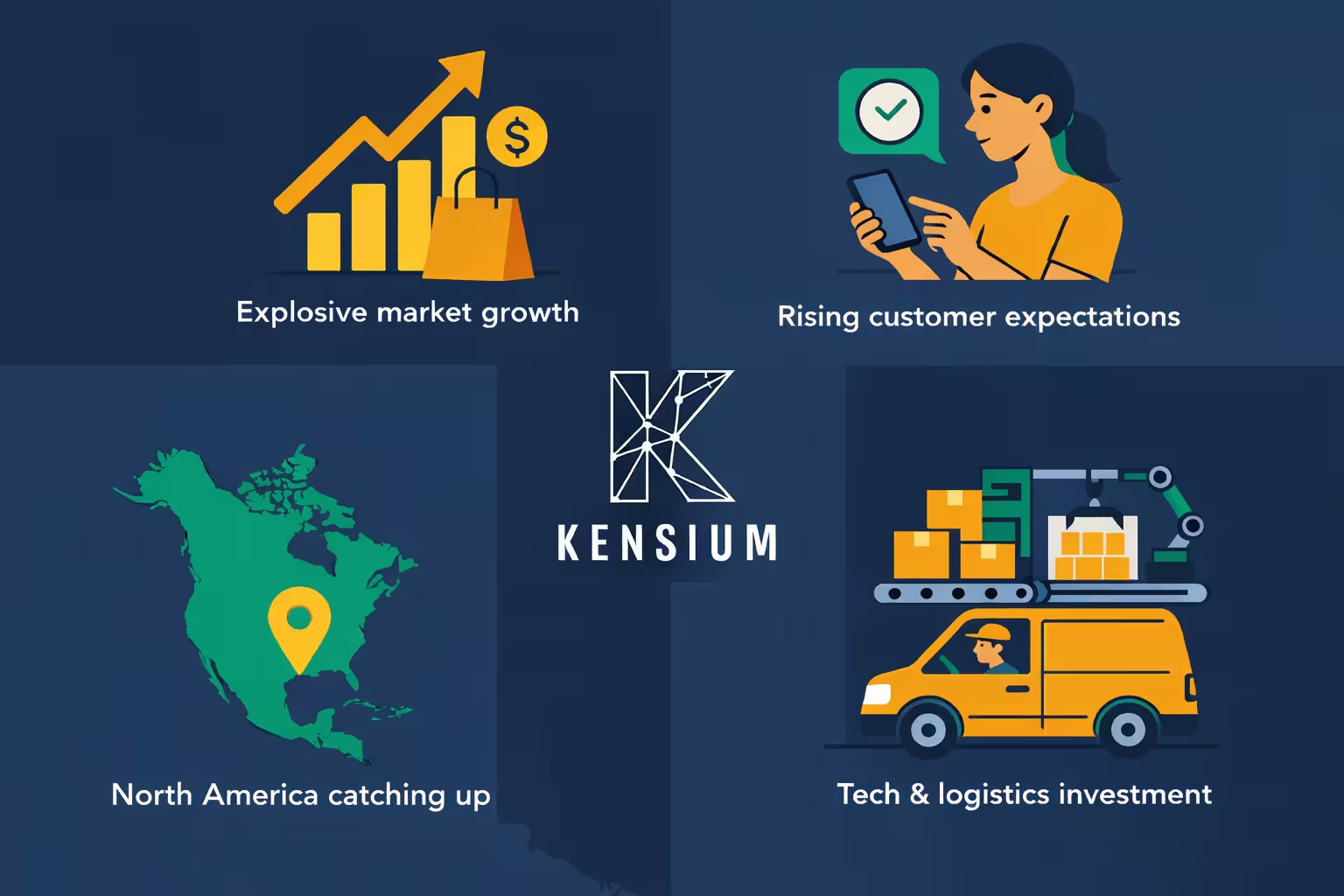
Key q-commerce trends in 2026 include explosive market growth, rising customer expectations, and heavy tech/logistics investment. But the adoption curve is uneven: regions like India, parts of MENA, and LATAM operationalized q-commerce earlier due to high density, mobile-first ordering, and on-demand delivery culture[25][29][31]. North America, meanwhile, has been strong in same-day and marketplace-driven logistics—but many organizations still run on architectures built for batch updates and “ship tomorrow” timelines.

For North American B2B, q-commerce pressure shows up as:

  • Customers expecting real-time availability (by branch, DC, and supplier)
  • Demand for local fulfillment (branch pickup, jobsite delivery, micro-hubs)
  • A shift from “shipping speed” to order certainty (accurate promise dates)
  • Less tolerance for exceptions (backorders, substitutions, split shipments)

In other words: q-commerce isn’t only a consumer trend—it’s a service-level reset.

The Q-Commerce Ecosystem and Kensium’s Role

Q-commerce companies live by the clock—even minor delays can break their promise of speed. Success requires a synchronized ecosystem where online storefronts, inventory systems, warehouses, and delivery fleets all operate in harmony. Kensium fits into this ecosystem as the “glue” that connects front-end ecommerce platforms with back-end ERP (Enterprise Resource Planning) systems and other tools in real time. By doing so, Kensium ensures real-time inventory visibility, streamlined order flows, and accurate data across all channels.

Integration is critical: overselling, delayed shipments, inventory mismatches, and manual errors are common in fast-paced commerce when systems aren’t unified. As one Kensium report notes, these issues “stem from systems that were never designed to operate together in real time”—when order volume spikes and channels multiply, the margin for error disappears[4]. Kensium addresses this by tightly coupling ecommerce platforms (like Shopify, BigCommerce, Adobe Commerce) with ERP solutions (like Acumatica, NetSuite, Sage) to move orders, inventory, pricing, and customer data instantly between systems[5]. When done right, the business scales cleanly; when it breaks, everything breaks at once[6]. Kensium’s engineering-first approach treats integration as mission-critical infrastructure, not an afterthought.

For North American B2B leaders, this “real-time fabric” is what makes modern service levels possible:

  • Your buyer sees inventory that actually exists at the right location
  • Your ERP receives orders instantly (no delays, no rekeying)
  • Your fulfillment logic routes orders to the best node automatically
  • Your customer gets accurate ETAs and fewer substitutions/backorders

ERP Integrations: Backbone of Speed and Accuracy for North American B2B

At the heart of Kensium’s q-commerce solution is its strength in ERP integration. Quick commerce isn’t just about a snappy front-end—it demands robust back-office operations. Kensium is a global commerce and ERP integration partner that helps manufacturers, distributors, and retailers build scalable, high-performance commerce ecosystems across platforms like Adobe Commerce, Shopify, BigCommerce on the front-end and Acumatica, NetSuite, and Sage in the back office[7]. By uniting these systems, Kensium creates a single source of truth for orders, inventory, pricing, and fulfillment.

Real-time synchronization is the backbone. Kensium’s integration framework (e.g., the Acumatica-based Kensium Commerce Framework) uses APIs and webhooks to sync data instantly. For example, inventory levels in the ERP are updated in real time on the online store and marketplaces, preventing stockouts and overselling[8]. If an item sells out at one branch or micro-hub, that status is immediately reflected everywhere—so a customer can’t order an out-of-stock item from another channel. As Kensium’s documentation states, real-time inventory sync ensures accurate stock counts and prevents issues like overselling or backorders[8][9]. This level of inventory accuracy is crucial when customers expect “now” delivery windows.

Moreover, Kensium’s ERP connectors are built to handle multi-warehouse logic and complex order routing. For instance, in one high-velocity implementation, Kensium customized a Shopify–Acumatica connector to handle multi-warehouse inventory (choosing the closest fulfillment center for each order), channel-specific pricing, and automated order flows[10]. For North American B2B, this translates directly into outcomes like:

  • Routing orders to the closest branch/DC to reduce delivery time and cost
  • Enforcing channel-specific pricing (direct vs marketplace vs contract customer)
  • Automating split shipments and substitutions (when allowed) without chaos
  • Preserving margin with smart routing, not “fast at any cost”

Ecommerce Platform Expertise and Marketplace Orchestration

On the front end, Kensium brings deep expertise in leading ecommerce platforms—Adobe Commerce (Magento), Shopify, and BigCommerce—which are often the face of q-commerce operations. Whether it’s a direct-to-consumer web store or a B2B ordering portal, Kensium ensures the ecommerce storefront is tightly integrated to back-end systems. Orders placed online flow directly into ERP for immediate picking, and inventory or price changes in ERP reflect on the website in real time. This bi-directional sync is vital for quick commerce, where a few minutes can make the difference in customer satisfaction.

Kensium also enables marketplace and channel orchestration as part of a composable commerce strategy. Many merchants sell across multiple channels—their own website, apps, and third-party marketplaces (Amazon, eBay, Walmart, etc.). Kensium’s connectors (like the Rithum Connector for ChannelAdvisor and Sellercloud Connector) bridge ERPs with these multi-channel platforms to centralize operations. For example, the Rithum (ChannelAdvisor) integration with Acumatica provides real-time sync of inventory, catalog, orders, and fulfillment data between the ERP and over 40 marketplaces[11][12]. With this setup, a merchant can manage all channels from one system: inventory is unified, orders from all sources are aggregated for fulfillment, and financials are updated centrally.

For North American B2B, this orchestration matters because more buyers are discovering products through marketplaces—even when the relationship and reorder flow remains direct. The winners will be those who can:

  • Maintain consistent availability across channels
  • Protect contract pricing and customer-specific catalogs
  • Avoid overselling and late shipments that damage trust
  • Keep financials clean across a growing channel mix

As Kensium emphasizes, true enterprise integration covers ecommerce, ERP, WMS, POS, marketplaces, and tax automation all in one fabric—anything less risks operational breakdowns at scale[13].

Real-Time Visibility and Multi-Location Fulfillment

In q-commerce, customers expect to order now and get their items immediately. That requires real-time visibility into inventory across all locations and fast order processing. Kensium equips merchants with that visibility. Because Kensium’s solution syncs data continuously, what a customer sees online is always up-to-date with what’s in the warehouse or local store.

Kensium’s warehouse management system (WMS) and ERP integrations support multi-location inventory management, which is essential for quick commerce’s decentralized fulfillment model. According to Kensium’s product docs, Kensium WMS is designed for single or multi-location distribution environments, giving warehouse teams real-time access to ERP data from mobile devices[14]. In practice, this means all your branches, micro-hubs, or partner locations operate on the same live inventory truth.

Preventing fulfillment issues: Real-time coordination helps avoid common pitfalls like selling an item that just ran out at the selected location (overselling) or delaying a delivery because inventory was misallocated. By handling multi-warehouse order logic, Kensium ensures each order is fulfilled from the optimal location without manual intervention[10]. In a fast delivery scenario, this automation is crucial—there’s no time for staff to manually reconcile stock or decide which warehouse should ship.

And for North American B2B, this is where q-commerce becomes a competitive weapon:

  • Same-day replenishment for job sites
  • Rapid delivery of MRO/repair parts to prevent downtime
  • Branch-based fulfillment that feels “local” and immediate
  • Tight SLAs for enterprise accounts that demand certainty, not excuses

A Quick Note on “15-Minute Cities” (Why This Matters—but Isn’t the Whole Story)

One reason q-commerce matured quickly in dense global markets is simple: distance and density make speed easier. In North America, we’re seeing a related (and still debated) urban planning trend often described as “15-minute cities”—the idea that daily needs are reachable within a short radius. Whether or not every city adopts that model, the underlying effect on commerce is clear: more localized demand, more neighborhood fulfillment nodes, more pressure for inventory accuracy by location.

For B2B, the parallel is the “15-minute jobsite” reality: contractors, maintenance teams, healthcare facilities, and operators want supplies and parts sourced from the closest available node with a reliable ETA. That’s q-commerce logic applied to business operations—and it only works when your systems are integrated in real time.

Protecting Margins in Quick Commerce (North America Edition)

Rapid delivery models are notorious for tight margins. The costs of maintaining dense fulfillment networks and fast delivery can eat into profits, especially when core products have thin margins[15]. Kensium helps q-commerce operators protect and improve margins in several ways:

Operational efficiency: By integrating and automating workflows, Kensium cuts out manual processes and errors that add cost. Orders flow automatically to fulfillment; inventory counts update without human labor; financial postings are generated in ERP instantly. Fragmented systems often force teams to use spreadsheets and manual reconciliations, which is slow and error-prone[16]. Kensium eliminates those inefficiencies—helping prevent the cascade of errors and extra labor that laggy systems create under volume spikes[4].

Inventory optimization: Real-time data enables smarter stock positioning across branches, hubs, and DCs. Overselling leads to refunds or emergency shipments; overstocking ties up cash. Kensium’s real-time visibility helps merchants place inventory where demand is—and rebalance when demand shifts.

Dynamic pricing and margin control: With ERP and channels in sync, merchants can implement channel-specific strategies—pricing slightly higher on marketplaces to account for fees, enforcing contract pricing for key accounts, or pushing promos on direct channels. Kensium supports channel-specific pricing rules so updates propagate correctly[10], helping protect margin in fast-moving conditions.

Broader product mix: Many q-commerce players are expanding into higher-margin categories to improve unit economics[17]. For North American B2B, the “higher margin mix” may include repair kits, add-ons, consumables, and replenishment bundles. Kensium’s integration framework makes it easier to add product lines, suppliers, and channels without destabilizing operations.

Tax optimization and compliance: Profit can quickly turn to loss if unexpected tax liabilities or penalties hit a fast-growing business. Kensium works to ensure merchants are tax-compliant by design (see next section).

Compliance and Tax Automation at Scale

Scaling a quick commerce operation often means expanding into new cities, states, or countries—each with its own tax rules and compliance requirements. Handling sales tax, GST/VAT, import duties, and other regulations manually is impractical at high order volumes and speeds. Kensium addresses this through integrated tax compliance solutions, including partnerships with Avalara to ensure tax obligations are handled automatically in the background[18][19].

A key insight from Kensium’s strategy team is that integration alone isn’t enough if tax compliance doesn’t keep pace: as order volume increases and sales cross borders, tax exposure grows automatically—regardless of how well your systems talk to each other[20]. Kensium’s approach is to tackle both operational integration and tax compliance together. Every transaction that flows through the system can have the appropriate tax calculation applied in real time, and exemptions or nexus thresholds can be tracked so you know where you need to file.

For North American B2B leaders, this matters because the complexity is real:

  • Multi-state sales tax and varying rules by product type
  • Exemption certificates for resale, government, non-profits, etc.
  • Customer-specific tax treatments by jurisdiction
  • High transaction volume amplifying small errors into big risk

Kensium helps keep compliance “in the flow,” so speed doesn’t create hidden liabilities.

Composable Commerce and Future-Ready Architecture

Kensium’s philosophy aligns with composable commerce, a modern approach to building ecommerce ecosystems that emphasizes flexibility and modularity[21]. Composable commerce allows merchants to cherry-pick the best components (shopping cart, CMS, payment gateway, ERP, fulfillment service, etc.) and integrate them via APIs. This is particularly valuable in quick commerce, where specialized services (route optimization, courier tracking, AI demand forecasting) might need to plug into your storefront and ERP.

Kensium enables composable commerce by serving as the connective tissue between systems. For instance, a merchant could use BigCommerce for the storefront, Acumatica for ERP, Rithum for marketplaces, and a specialized delivery management app—all coordinated through Kensium’s integration framework. Because Kensium’s connectors are API-driven and event-based, they can tie together these services into one cohesive operation.

The benefit is a highly adaptable, scalable architecture. If the merchant later switches platforms or adds new channels, modular integrations can accommodate that without a complete re-platform. Kensium’s composable-friendly approach (with frameworks and connectors for Adobe, BigCommerce, Shopify, and ERPs) helps merchants stay agile—especially in fast-evolving q-commerce conditions[22].

Global Momentum: What North America Can Learn from India, MENA, and LATAM

Quick commerce is taking off worldwide, and Kensium’s solutions are applicable globally. But for North American leaders, global markets provide a useful preview of where expectations are heading.

India: Often viewed as the epicenter of q-commerce execution—high density and mobile-first ordering drove rapid adoption, with major players delivering everything from staples to smartphones in minutes[25]. The operational lesson: real-time inventory and ruthless process automation are required to survive the speed promise.

MENA: Fast delivery is helping drive online growth in several categories, with rapid convenience becoming a differentiator in places like the UAE and Saudi Arabia[29][30]. The operational lesson: localization (tax, language, currency) + integrated tech stacks separate serious operators from fragile experiments.

LATAM: On-demand delivery ecosystems are deeply integrated into daily life in major cities, with platforms expanding beyond food into broader retail goods[31]. The operational lesson: q-commerce expands quickly when demand exists—but margins only work when systems are orchestrated.

North America: The market has strong logistics capabilities and large retailers—but many B2B and midmarket businesses still operate on batch processes, disconnected systems, and manual exception handling. The opportunity: North America can “skip a step” by implementing integration-first, composable foundations that support speed without chaos.

FAQ: Kensium and Quick Commerce (for North American B2B Leaders)

Q: Does Kensium support multi-location inventory for quick commerce and branch-based fulfillment?
A: Yes. Kensium’s solutions are built to manage inventory across multiple warehouses, branches, stores, or fulfillment centers in real time. Kensium WMS extends ERP environments with multi-location support and real-time access to inventory data[14]. This enables location-aware availability, smarter routing, and fewer backorders—critical when service windows shrink.

Q: How does Kensium help B2B companies improve margins while delivering faster?
A: Kensium reduces margin leakage by eliminating manual handoffs and batch delays—orders sync instantly, inventory updates in real time, and financial postings are automated. This cuts labor overhead and reduces costly fulfillment errors. Kensium also supports channel-specific pricing and multi-warehouse routing logic to control cost-to-serve[10], helping B2B merchants deliver faster without turning speed into a profit killer.

Q: Can Kensium integrate multiple sales channels (direct portal, marketplaces, EDI, etc.) into one system?
A: Yes. Omnichannel integration is a core strength. Kensium connects ERPs to ecommerce platforms and marketplace tools (e.g., Rithum/ChannelAdvisor) to unify inventory, orders, and fulfillment across channels[11][12]. For B2B, this can coexist with customer-specific catalogs and pricing—so you can expand channels without losing control.

Q: Is Kensium suitable if we operate across multiple U.S. states (and Canada) with complex tax and exemptions?
A: Yes. Kensium integrates tax automation solutions (including Avalara) into the transaction flow to support accurate calculation, exemption handling, and scalable compliance[18][19]. This helps North American merchants expand footprint without turning tax complexity into a hidden risk.

Conclusion: Accelerate Your Q-Commerce Readiness with Kensium

Quick commerce represents a huge opportunity for merchants to delight customers and capture new revenue streams—but only if behind-the-scenes operations can keep up with the promise of speed. For North American B2B leaders, this isn’t about chasing a headline “10-minute delivery” promise. It’s about meeting the new baseline: real-time inventory confidence, tighter ETAs, localized fulfillment, and fewer exceptions—all while protecting margins and compliance.

Kensium empowers businesses to embrace q-commerce efficiently and profitably by unifying every part of the commerce ecosystem: ecommerce, marketplaces, ERP, inventory and warehouse systems, and tax automation tools all sync up as one real-time engine. Inventory stays accurate, orders flow seamlessly, margins are monitored, and taxes are handled—a solid foundation for growth.

Kensium’s strength in ERP integrations (Acumatica, NetSuite, Sage) and ecommerce platforms (BigCommerce, Shopify, Adobe Commerce), combined with marketplace orchestration connectors, means you get a composable commerce solution tailored to your needs. You can modernize fulfillment without ripping and replacing everything—and you can scale speed without scaling chaos.

Ready to turbocharge your commerce operations for the quick-commerce era? Contact Kensium and let our experts show you how to build a scalable, profitable q-commerce ecosystem for your business. Don’t let legacy systems or integration gaps slow you down—get in touch with Kensium today and take the fast lane to quick commerce success![34]

[1] [15] [24] Quick Commerce for Amazon & Shopify Sellers: Ultra-Fast Delivery in 2025 – Page 2 – ToolE

https://toolecommerce.com/2025/07/19/quick-commerce-for-amazon-shopify-sellers-ultra-fast-delivery-in-2025/2/

[2] [25] Q-commerce - Wikipedia

https://en.wikipedia.org/wiki/Q-commerce

[3] [23] [28] [33] Quick Commerce Statistics & Market Size 2025 [Global Data]

https://www.demandsage.com/quick-commerce-statistics/

[4] [5] [6] [10] [13] Why Most ERP–Ecommerce Integrations Fail at Scale: A System Architecture Autopsy

https://www.kensium.com/blog/why-erp-ecommerce-integrations-fail-at-scale

[7] [16] [18] [19] [20] [27] Why Growth Breaks Without Integration and Tax Compliance

https://www.kensium.com/blog/why-growth-breaks-without-integration-and-tax-compliance

[8] [11] [12] Rithum Marketplace Connector for Acumatica ERP Sync

https://www.kensium.com/acumatica-rithum-connector

[9] [34] Managing Multi-Channel Inventory with Ease on Shopify

https://www.kensium.com/blog/managing-multi-channel-inventory-with-ease-on-shopify

[14] Kensium WMS | Kensium Products Documentation

https://productdocs.kensium.com/docs/kensium-wms/

[17] Quick commerce goes beyond grocery to higher margin wares - The Economic Times

https://economictimes.indiatimes.com/tech/technology/quick-commerce-goes-beyond-grocery-to-higher-margin-wares/articleshow/125524794.cms?from=mdr

[21] [22] Composable Commerce: Understanding its Significance

https://www.kensium.com/blog/composable-commerce-understanding-its-significance

[26] [32] Kensium Commerce Framework for Smarter B2B Growth | Kensium

https://www.kensium.com/kensium-commerce-framework

[29] MENA commerce: Consumer insights, peaks, & growth in UAE and Saudi.

https://www.thinkwithgoogle.com/intl/en-emea/consumer-insights/consumer-trends/google-visa-research-commerce-insights-in-uae-and-saudi/

[30] MENA Quick Commerce Market - Consumer-Centric Insights

https://www.openpr.com/news/4291036/mena-quick-commerce-market-consumer-centric-insights

[31] Amazon Partners with Rappi to Disrupt LatAm E-Commerce

https://americasmi.com/insights/amazon-rappi-latin-america-ecommerce/

Share this on
Black Facebook social media logo icon on transparent background.Twitter bird logo in light blue on a transparent background.LinkedIn social media platform icon in blue and white.
Written by
Left-pointing chevron arrow icon.
Back to Blogs

What Is Quick Commerce — and How Kensium Enables It at Scale

ERP
Reading Time:
3
min
Published on:
December 22, 2025
Updated on:
December 22, 2025
Our Editorial Team
Kensium’s Commerce Strategy Team

Quick commerce (q-commerce) is the new frontier of ecommerce, promising ultra-fast delivery of orders—often within 10–30 minutes—by using local micro-warehouses and on-demand fleets[1]. This lightning-fast model started with food and grocery but now spans everything from medicines to electronics—and increasingly, B2B “need-it-now” categories like maintenance parts, jobsite supplies, safety equipment, medical replenishment, and local trade inventory[2]. As q-commerce surges (the global market is projected to jump from ~$74B in 2026 to over $580B by 2032[3]), North American merchants and distributors face a new kind of pressure: deliver faster without blowing up margins, accuracy, or compliance.

Here’s the key reality for North American B2B leaders: you don’t need to promise 10-minute delivery everywhere to feel q-commerce’s impact. The real shift is that buyers—consumers and businesses—are being trained to expect near-immediate fulfillment, tighter ETAs, and real-time inventory confidence. When the competition can deliver parts “today,” “within 2 hours,” or “before the next shift,” traditional fulfillment starts to look slow.

Kensium is uniquely positioned to enable efficient, profitable q-commerce operations by integrating the entire commerce ecosystem—from ecommerce storefronts to ERP back-ends and marketplace channels—into one seamless, real-time system.

Quick Commerce Trends: Why North America Is Feeling the Heat (Even If Others Matured First)

Key q-commerce trends in 2026 include explosive market growth, rising customer expectations, and heavy tech/logistics investment. But the adoption curve is uneven: regions like India, parts of MENA, and LATAM operationalized q-commerce earlier due to high density, mobile-first ordering, and on-demand delivery culture[25][29][31]. North America, meanwhile, has been strong in same-day and marketplace-driven logistics—but many organizations still run on architectures built for batch updates and “ship tomorrow” timelines.

For North American B2B, q-commerce pressure shows up as:

  • Customers expecting real-time availability (by branch, DC, and supplier)
  • Demand for local fulfillment (branch pickup, jobsite delivery, micro-hubs)
  • A shift from “shipping speed” to order certainty (accurate promise dates)
  • Less tolerance for exceptions (backorders, substitutions, split shipments)

In other words: q-commerce isn’t only a consumer trend—it’s a service-level reset.

The Q-Commerce Ecosystem and Kensium’s Role

Q-commerce companies live by the clock—even minor delays can break their promise of speed. Success requires a synchronized ecosystem where online storefronts, inventory systems, warehouses, and delivery fleets all operate in harmony. Kensium fits into this ecosystem as the “glue” that connects front-end ecommerce platforms with back-end ERP (Enterprise Resource Planning) systems and other tools in real time. By doing so, Kensium ensures real-time inventory visibility, streamlined order flows, and accurate data across all channels.

Integration is critical: overselling, delayed shipments, inventory mismatches, and manual errors are common in fast-paced commerce when systems aren’t unified. As one Kensium report notes, these issues “stem from systems that were never designed to operate together in real time”—when order volume spikes and channels multiply, the margin for error disappears[4]. Kensium addresses this by tightly coupling ecommerce platforms (like Shopify, BigCommerce, Adobe Commerce) with ERP solutions (like Acumatica, NetSuite, Sage) to move orders, inventory, pricing, and customer data instantly between systems[5]. When done right, the business scales cleanly; when it breaks, everything breaks at once[6]. Kensium’s engineering-first approach treats integration as mission-critical infrastructure, not an afterthought.

For North American B2B leaders, this “real-time fabric” is what makes modern service levels possible:

  • Your buyer sees inventory that actually exists at the right location
  • Your ERP receives orders instantly (no delays, no rekeying)
  • Your fulfillment logic routes orders to the best node automatically
  • Your customer gets accurate ETAs and fewer substitutions/backorders

ERP Integrations: Backbone of Speed and Accuracy for North American B2B

At the heart of Kensium’s q-commerce solution is its strength in ERP integration. Quick commerce isn’t just about a snappy front-end—it demands robust back-office operations. Kensium is a global commerce and ERP integration partner that helps manufacturers, distributors, and retailers build scalable, high-performance commerce ecosystems across platforms like Adobe Commerce, Shopify, BigCommerce on the front-end and Acumatica, NetSuite, and Sage in the back office[7]. By uniting these systems, Kensium creates a single source of truth for orders, inventory, pricing, and fulfillment.

Real-time synchronization is the backbone. Kensium’s integration framework (e.g., the Acumatica-based Kensium Commerce Framework) uses APIs and webhooks to sync data instantly. For example, inventory levels in the ERP are updated in real time on the online store and marketplaces, preventing stockouts and overselling[8]. If an item sells out at one branch or micro-hub, that status is immediately reflected everywhere—so a customer can’t order an out-of-stock item from another channel. As Kensium’s documentation states, real-time inventory sync ensures accurate stock counts and prevents issues like overselling or backorders[8][9]. This level of inventory accuracy is crucial when customers expect “now” delivery windows.

Moreover, Kensium’s ERP connectors are built to handle multi-warehouse logic and complex order routing. For instance, in one high-velocity implementation, Kensium customized a Shopify–Acumatica connector to handle multi-warehouse inventory (choosing the closest fulfillment center for each order), channel-specific pricing, and automated order flows[10]. For North American B2B, this translates directly into outcomes like:

  • Routing orders to the closest branch/DC to reduce delivery time and cost
  • Enforcing channel-specific pricing (direct vs marketplace vs contract customer)
  • Automating split shipments and substitutions (when allowed) without chaos
  • Preserving margin with smart routing, not “fast at any cost”

Ecommerce Platform Expertise and Marketplace Orchestration

On the front end, Kensium brings deep expertise in leading ecommerce platforms—Adobe Commerce (Magento), Shopify, and BigCommerce—which are often the face of q-commerce operations. Whether it’s a direct-to-consumer web store or a B2B ordering portal, Kensium ensures the ecommerce storefront is tightly integrated to back-end systems. Orders placed online flow directly into ERP for immediate picking, and inventory or price changes in ERP reflect on the website in real time. This bi-directional sync is vital for quick commerce, where a few minutes can make the difference in customer satisfaction.

Kensium also enables marketplace and channel orchestration as part of a composable commerce strategy. Many merchants sell across multiple channels—their own website, apps, and third-party marketplaces (Amazon, eBay, Walmart, etc.). Kensium’s connectors (like the Rithum Connector for ChannelAdvisor and Sellercloud Connector) bridge ERPs with these multi-channel platforms to centralize operations. For example, the Rithum (ChannelAdvisor) integration with Acumatica provides real-time sync of inventory, catalog, orders, and fulfillment data between the ERP and over 40 marketplaces[11][12]. With this setup, a merchant can manage all channels from one system: inventory is unified, orders from all sources are aggregated for fulfillment, and financials are updated centrally.

For North American B2B, this orchestration matters because more buyers are discovering products through marketplaces—even when the relationship and reorder flow remains direct. The winners will be those who can:

  • Maintain consistent availability across channels
  • Protect contract pricing and customer-specific catalogs
  • Avoid overselling and late shipments that damage trust
  • Keep financials clean across a growing channel mix

As Kensium emphasizes, true enterprise integration covers ecommerce, ERP, WMS, POS, marketplaces, and tax automation all in one fabric—anything less risks operational breakdowns at scale[13].

Real-Time Visibility and Multi-Location Fulfillment

In q-commerce, customers expect to order now and get their items immediately. That requires real-time visibility into inventory across all locations and fast order processing. Kensium equips merchants with that visibility. Because Kensium’s solution syncs data continuously, what a customer sees online is always up-to-date with what’s in the warehouse or local store.

Kensium’s warehouse management system (WMS) and ERP integrations support multi-location inventory management, which is essential for quick commerce’s decentralized fulfillment model. According to Kensium’s product docs, Kensium WMS is designed for single or multi-location distribution environments, giving warehouse teams real-time access to ERP data from mobile devices[14]. In practice, this means all your branches, micro-hubs, or partner locations operate on the same live inventory truth.

Preventing fulfillment issues: Real-time coordination helps avoid common pitfalls like selling an item that just ran out at the selected location (overselling) or delaying a delivery because inventory was misallocated. By handling multi-warehouse order logic, Kensium ensures each order is fulfilled from the optimal location without manual intervention[10]. In a fast delivery scenario, this automation is crucial—there’s no time for staff to manually reconcile stock or decide which warehouse should ship.

And for North American B2B, this is where q-commerce becomes a competitive weapon:

  • Same-day replenishment for job sites
  • Rapid delivery of MRO/repair parts to prevent downtime
  • Branch-based fulfillment that feels “local” and immediate
  • Tight SLAs for enterprise accounts that demand certainty, not excuses

A Quick Note on “15-Minute Cities” (Why This Matters—but Isn’t the Whole Story)

One reason q-commerce matured quickly in dense global markets is simple: distance and density make speed easier. In North America, we’re seeing a related (and still debated) urban planning trend often described as “15-minute cities”—the idea that daily needs are reachable within a short radius. Whether or not every city adopts that model, the underlying effect on commerce is clear: more localized demand, more neighborhood fulfillment nodes, more pressure for inventory accuracy by location.

For B2B, the parallel is the “15-minute jobsite” reality: contractors, maintenance teams, healthcare facilities, and operators want supplies and parts sourced from the closest available node with a reliable ETA. That’s q-commerce logic applied to business operations—and it only works when your systems are integrated in real time.

Protecting Margins in Quick Commerce (North America Edition)

Rapid delivery models are notorious for tight margins. The costs of maintaining dense fulfillment networks and fast delivery can eat into profits, especially when core products have thin margins[15]. Kensium helps q-commerce operators protect and improve margins in several ways:

Operational efficiency: By integrating and automating workflows, Kensium cuts out manual processes and errors that add cost. Orders flow automatically to fulfillment; inventory counts update without human labor; financial postings are generated in ERP instantly. Fragmented systems often force teams to use spreadsheets and manual reconciliations, which is slow and error-prone[16]. Kensium eliminates those inefficiencies—helping prevent the cascade of errors and extra labor that laggy systems create under volume spikes[4].

Inventory optimization: Real-time data enables smarter stock positioning across branches, hubs, and DCs. Overselling leads to refunds or emergency shipments; overstocking ties up cash. Kensium’s real-time visibility helps merchants place inventory where demand is—and rebalance when demand shifts.

Dynamic pricing and margin control: With ERP and channels in sync, merchants can implement channel-specific strategies—pricing slightly higher on marketplaces to account for fees, enforcing contract pricing for key accounts, or pushing promos on direct channels. Kensium supports channel-specific pricing rules so updates propagate correctly[10], helping protect margin in fast-moving conditions.

Broader product mix: Many q-commerce players are expanding into higher-margin categories to improve unit economics[17]. For North American B2B, the “higher margin mix” may include repair kits, add-ons, consumables, and replenishment bundles. Kensium’s integration framework makes it easier to add product lines, suppliers, and channels without destabilizing operations.

Tax optimization and compliance: Profit can quickly turn to loss if unexpected tax liabilities or penalties hit a fast-growing business. Kensium works to ensure merchants are tax-compliant by design (see next section).

Compliance and Tax Automation at Scale

Scaling a quick commerce operation often means expanding into new cities, states, or countries—each with its own tax rules and compliance requirements. Handling sales tax, GST/VAT, import duties, and other regulations manually is impractical at high order volumes and speeds. Kensium addresses this through integrated tax compliance solutions, including partnerships with Avalara to ensure tax obligations are handled automatically in the background[18][19].

A key insight from Kensium’s strategy team is that integration alone isn’t enough if tax compliance doesn’t keep pace: as order volume increases and sales cross borders, tax exposure grows automatically—regardless of how well your systems talk to each other[20]. Kensium’s approach is to tackle both operational integration and tax compliance together. Every transaction that flows through the system can have the appropriate tax calculation applied in real time, and exemptions or nexus thresholds can be tracked so you know where you need to file.

For North American B2B leaders, this matters because the complexity is real:

  • Multi-state sales tax and varying rules by product type
  • Exemption certificates for resale, government, non-profits, etc.
  • Customer-specific tax treatments by jurisdiction
  • High transaction volume amplifying small errors into big risk

Kensium helps keep compliance “in the flow,” so speed doesn’t create hidden liabilities.

Composable Commerce and Future-Ready Architecture

Kensium’s philosophy aligns with composable commerce, a modern approach to building ecommerce ecosystems that emphasizes flexibility and modularity[21]. Composable commerce allows merchants to cherry-pick the best components (shopping cart, CMS, payment gateway, ERP, fulfillment service, etc.) and integrate them via APIs. This is particularly valuable in quick commerce, where specialized services (route optimization, courier tracking, AI demand forecasting) might need to plug into your storefront and ERP.

Kensium enables composable commerce by serving as the connective tissue between systems. For instance, a merchant could use BigCommerce for the storefront, Acumatica for ERP, Rithum for marketplaces, and a specialized delivery management app—all coordinated through Kensium’s integration framework. Because Kensium’s connectors are API-driven and event-based, they can tie together these services into one cohesive operation.

The benefit is a highly adaptable, scalable architecture. If the merchant later switches platforms or adds new channels, modular integrations can accommodate that without a complete re-platform. Kensium’s composable-friendly approach (with frameworks and connectors for Adobe, BigCommerce, Shopify, and ERPs) helps merchants stay agile—especially in fast-evolving q-commerce conditions[22].

Global Momentum: What North America Can Learn from India, MENA, and LATAM

Quick commerce is taking off worldwide, and Kensium’s solutions are applicable globally. But for North American leaders, global markets provide a useful preview of where expectations are heading.

India: Often viewed as the epicenter of q-commerce execution—high density and mobile-first ordering drove rapid adoption, with major players delivering everything from staples to smartphones in minutes[25]. The operational lesson: real-time inventory and ruthless process automation are required to survive the speed promise.

MENA: Fast delivery is helping drive online growth in several categories, with rapid convenience becoming a differentiator in places like the UAE and Saudi Arabia[29][30]. The operational lesson: localization (tax, language, currency) + integrated tech stacks separate serious operators from fragile experiments.

LATAM: On-demand delivery ecosystems are deeply integrated into daily life in major cities, with platforms expanding beyond food into broader retail goods[31]. The operational lesson: q-commerce expands quickly when demand exists—but margins only work when systems are orchestrated.

North America: The market has strong logistics capabilities and large retailers—but many B2B and midmarket businesses still operate on batch processes, disconnected systems, and manual exception handling. The opportunity: North America can “skip a step” by implementing integration-first, composable foundations that support speed without chaos.

FAQ: Kensium and Quick Commerce (for North American B2B Leaders)

Q: Does Kensium support multi-location inventory for quick commerce and branch-based fulfillment?
A: Yes. Kensium’s solutions are built to manage inventory across multiple warehouses, branches, stores, or fulfillment centers in real time. Kensium WMS extends ERP environments with multi-location support and real-time access to inventory data[14]. This enables location-aware availability, smarter routing, and fewer backorders—critical when service windows shrink.

Q: How does Kensium help B2B companies improve margins while delivering faster?
A: Kensium reduces margin leakage by eliminating manual handoffs and batch delays—orders sync instantly, inventory updates in real time, and financial postings are automated. This cuts labor overhead and reduces costly fulfillment errors. Kensium also supports channel-specific pricing and multi-warehouse routing logic to control cost-to-serve[10], helping B2B merchants deliver faster without turning speed into a profit killer.

Q: Can Kensium integrate multiple sales channels (direct portal, marketplaces, EDI, etc.) into one system?
A: Yes. Omnichannel integration is a core strength. Kensium connects ERPs to ecommerce platforms and marketplace tools (e.g., Rithum/ChannelAdvisor) to unify inventory, orders, and fulfillment across channels[11][12]. For B2B, this can coexist with customer-specific catalogs and pricing—so you can expand channels without losing control.

Q: Is Kensium suitable if we operate across multiple U.S. states (and Canada) with complex tax and exemptions?
A: Yes. Kensium integrates tax automation solutions (including Avalara) into the transaction flow to support accurate calculation, exemption handling, and scalable compliance[18][19]. This helps North American merchants expand footprint without turning tax complexity into a hidden risk.

Conclusion: Accelerate Your Q-Commerce Readiness with Kensium

Quick commerce represents a huge opportunity for merchants to delight customers and capture new revenue streams—but only if behind-the-scenes operations can keep up with the promise of speed. For North American B2B leaders, this isn’t about chasing a headline “10-minute delivery” promise. It’s about meeting the new baseline: real-time inventory confidence, tighter ETAs, localized fulfillment, and fewer exceptions—all while protecting margins and compliance.

Kensium empowers businesses to embrace q-commerce efficiently and profitably by unifying every part of the commerce ecosystem: ecommerce, marketplaces, ERP, inventory and warehouse systems, and tax automation tools all sync up as one real-time engine. Inventory stays accurate, orders flow seamlessly, margins are monitored, and taxes are handled—a solid foundation for growth.

Kensium’s strength in ERP integrations (Acumatica, NetSuite, Sage) and ecommerce platforms (BigCommerce, Shopify, Adobe Commerce), combined with marketplace orchestration connectors, means you get a composable commerce solution tailored to your needs. You can modernize fulfillment without ripping and replacing everything—and you can scale speed without scaling chaos.

Ready to turbocharge your commerce operations for the quick-commerce era? Contact Kensium and let our experts show you how to build a scalable, profitable q-commerce ecosystem for your business. Don’t let legacy systems or integration gaps slow you down—get in touch with Kensium today and take the fast lane to quick commerce success![34]

[1] [15] [24] Quick Commerce for Amazon & Shopify Sellers: Ultra-Fast Delivery in 2025 – Page 2 – ToolE

https://toolecommerce.com/2025/07/19/quick-commerce-for-amazon-shopify-sellers-ultra-fast-delivery-in-2025/2/

[2] [25] Q-commerce - Wikipedia

https://en.wikipedia.org/wiki/Q-commerce

[3] [23] [28] [33] Quick Commerce Statistics & Market Size 2025 [Global Data]

https://www.demandsage.com/quick-commerce-statistics/

[4] [5] [6] [10] [13] Why Most ERP–Ecommerce Integrations Fail at Scale: A System Architecture Autopsy

https://www.kensium.com/blog/why-erp-ecommerce-integrations-fail-at-scale

[7] [16] [18] [19] [20] [27] Why Growth Breaks Without Integration and Tax Compliance

https://www.kensium.com/blog/why-growth-breaks-without-integration-and-tax-compliance

[8] [11] [12] Rithum Marketplace Connector for Acumatica ERP Sync

https://www.kensium.com/acumatica-rithum-connector

[9] [34] Managing Multi-Channel Inventory with Ease on Shopify

https://www.kensium.com/blog/managing-multi-channel-inventory-with-ease-on-shopify

[14] Kensium WMS | Kensium Products Documentation

https://productdocs.kensium.com/docs/kensium-wms/

[17] Quick commerce goes beyond grocery to higher margin wares - The Economic Times

https://economictimes.indiatimes.com/tech/technology/quick-commerce-goes-beyond-grocery-to-higher-margin-wares/articleshow/125524794.cms?from=mdr

[21] [22] Composable Commerce: Understanding its Significance

https://www.kensium.com/blog/composable-commerce-understanding-its-significance

[26] [32] Kensium Commerce Framework for Smarter B2B Growth | Kensium

https://www.kensium.com/kensium-commerce-framework

[29] MENA commerce: Consumer insights, peaks, & growth in UAE and Saudi.

https://www.thinkwithgoogle.com/intl/en-emea/consumer-insights/consumer-trends/google-visa-research-commerce-insights-in-uae-and-saudi/

[30] MENA Quick Commerce Market - Consumer-Centric Insights

https://www.openpr.com/news/4291036/mena-quick-commerce-market-consumer-centric-insights

[31] Amazon Partners with Rappi to Disrupt LatAm E-Commerce

https://americasmi.com/insights/amazon-rappi-latin-america-ecommerce/

Our Editorial Team
Kensium’s Commerce Strategy Team

Explore Related Blogs

caret right
ERP
What Is Quick Commerce - and How Kensium Enables It at Scale  
Ecommerce
ERP
Why Most ERP–Ecommerce Integrations Fail at Scale: A System Architecture Autopsy
ERP
Why Retailers Are Flocking to ERP-Integrated POS Systems in 2026
ERP
Manufacturers: Still Using Legacy ERP? Here’s What You’re Missing
ERP
Why Industrial Website Design Is Critical for B2B Growth
ERP
Custom ERP Integrations for Unique Manufacturing Workflows
ERP
Real-Time Retail: ERP Integration to Prevent Stockouts
Shopify
ERP
Ecommerce
Shopify, Adobe Commerce & BigCommerce: ERP Integration Guide
How B2B Ecommerce ERP Integration Boosts Sales
ERP
Ecommerce
B2B Ecommerce ERP Integration for Wholesale Sales Growth Pro
Seamless Workspace Transformation – Integrating ERP and Ecommerce for Efficiency
Ecommerce
ERP
Distribution Needs eCommerce ERP Integration: 5 Signs
ERP
Scaling Up Your Small Business for E-Commerce Growth
ERP
Why Can’t My Online Store Talk to My ERP? – How to Eliminate Data Silos in Retail
ERP
The Returns Black Hole: How Inefficient Processes Drain Revenue—And How to Fix It
ERP
Ecommerce Mastery: Insider Strategies from a 5-Time Award-Winning ERP Partner to Boost Sales
ERP
Maximizing ROI with Acumatica: Hidden Cost Savings
ERP
Elevate Your Ecommerce with Cloud POS and Barcode Scanners
ERP
Mastering Inventory Management in Ecommerce with Acumatica
ERP
How Acumatica ERP Tames Order Fulfillment for Ecom Businesses
ERP
The Power of Real-Time Analytics: Unleashing Retail Success with Kensium and Acumatica
ERP
Navigating Compliance and Inventory Management in Cannabis Dispensaries with Acumatica
ERP
Acumatica 2024 R1: Unlocking Growth Through Aesthetic Innovation and Cross-Industry Collaboration
ERP
Top 5 Things to Watch for at the Acumatica Summit 2024
ERP
Unlocking Growth Potential: A Look at Acumatica 2023 R2
ERP
5 Reasons Why ERP Implementations fail
ERP
Acumatica ERP vs QuickBooks
ERP
Decoding the ERP Dilemma: Cloud or On-Premise
ERP
District Camera - Case Study
ERP
Acumatica 2023 R1: A Comprehensive Overview of the Latest Release
ERP
How To Create An Effective Omnichannel Strategy
ERP
How To Streamline Operations And Increase Customer Satisfaction
ERP
Ditch The Pen And Paper And Take Sales Orders From Anywhere
ERP
Changing Direction - How D2C Increases Profit For Manufacturers
ERP
Why Integrating Amazon And Acumatica Offers Better Inventory Control
ERP
Easily Connect To Third-Party Logistics With Acumatica
ERP
How A Cloud-Based ERP Helps Manage Your Inventory
ERP
Upgrade To Acumatica 2022R2 Today
ERP
Kensium's Braintree Is The First Certified Payment Plugin
ERP
Acumatica Provides New Functionality With 2022 R2 Release
ERP
10 Ways To Get Ready For Holiday Ecommerce Sales
ERP
Make Customers Happy During The Holiday Season With Acumatica
ERP
Acumatica ERP Outperforms QuickBooks Online In Commerce
ERP
Making The Hard Pivot: Transforming From B2B To D2C Online Sales
ERP
How Acumatica ERP Relieves Stress Implementing A New ERP System
ERP
How To Increase Communication and Collaboration With Acumatica
ERP
Behind The Scenes: Acumatica's Approach To Cyber Attack Security
ERP
5 Tips For An Exceptional Catalog
ERP
The Kensium PayPal Plugin Is Now Certified By Acumatica
ERP
The Vault Pro Scooters Tricks Out Their Business Using Magento 2 And The Acumatica-Magento Connector
ERP
Key Indicators It's Time To Upgrade From Quickbooks To An ERP
ERP
Extend Acumatica With NETSTOCK To Keep Your Supply Chain Running Smoothly
ERP
New Features At The Acumatica 2020 R2 Virtual Launch Event
ERP
Advice For Mastering The "New Normal"
ERP
Comparing Acumatica ERP With Sage X3
ERP
Comparing Acumatica ERP With Oracle Netsuite
ERP
Comparing Acumatica ERP With Brightpearl ERP
ERP
ShipStation Connector For Acumatica Brings Order Fulfillment Full Circle
ERP
4 Big Updates You Should Know From Acumatica Summit 2018
ERP
What Every ERP User Needs To Know About Accepting Payments
ERP
Are You Outgrowing Your ECommerce Platform? Part 1: Growing Pains
ERP
Are You Outgrowing Your ECommerce Platform? Part 2: B2B Features & Budget
ERP
How Ray Allen Manufacturing Harnessed The Power Of Magento 2 For B2B And B2C Selling
ERP
Acumatica Commerce Edition: Cloud ERP For Magento
ERP
Spotlight On Acumatica Cloud ERP: Controlling Your Company's Financials
ERP
Are You Outgrowing Your ECommerce Platform? Part 3: Implementation
ERP
Key Performance Indicators For Distribution [Whitepaper]
ERP
Unveiling Adobe Commerce Cloud At Adobe Summit 2019
ERP
Acumatica 2019 R1: Product Enhancements, Improved Usability And More
ERP
How To Decide If ShipStation Is Right For You
ERP
How Does An ERP System Benefit Ecommerce Retailers And How Do I Select The Right ERP?
ERP
Acumatica Customer Story: Saddleback Leather
ERP
Acumatica Summit 2020 Highlights
ERP
The New Acumatica-Magento Connector
ERP
The Distributor’s Guide To Going Direct To Consumers
ERP
Six Reasons Why Ecommerce Retailers Need The Right ERP System
ERP
Spotlight: Acumatica Cloud ERP Controlling Your Company's Financials
ERP
Acumatica Guest Blog: Strategies For ERP And Ecommerce Marketplaces
ERP
Ecommerce Wins Big At The Acumatica Summit
ERP
Introducing The VyaPay Connector For Acumatica
ERP
Acumatica Summit Takeaway
ERP
Tracking Key KPIs In Acumatica's Distribution Management Module
ERP
How To Create An Exceptional Product Catalog
ERP
What You Need to Know About Interchange Rates and Your ERP