Left-pointing white chevron arrow on a transparent background.
Back to article listing
Articles

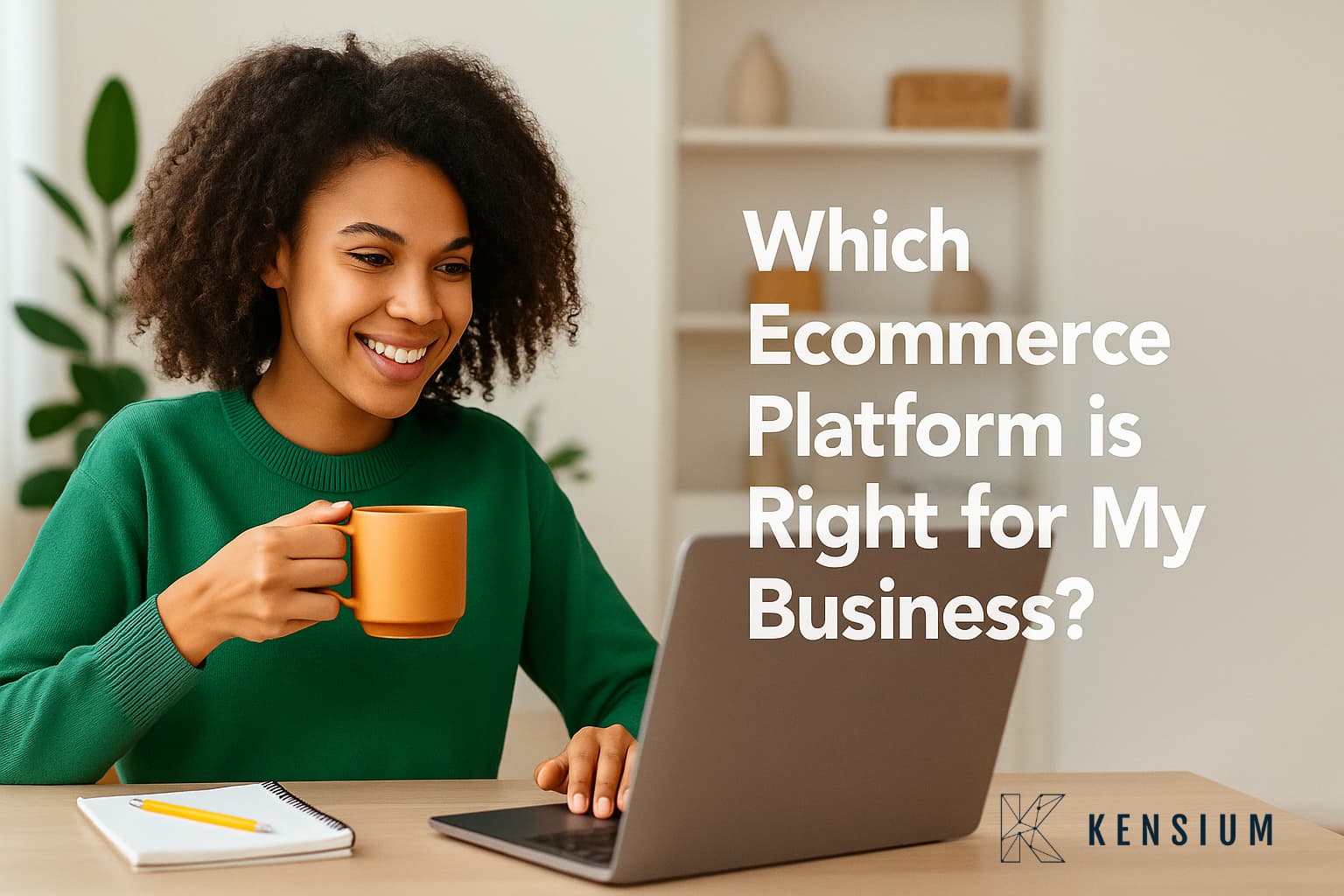
Which Ecommerce Platform Is Right for Your Business?

December 2, 2025
By-
Kensium’s Commerce Strategy Team

Choosing an ecommerce platform can feel overwhelming – especially with major options like Shopify Plus, BigCommerce, and Adobe Commerce (Magento) on the table. The key is to match the platform to your business needs, scale, and technical resources. Below, we break down these platforms (and how they integrate with ERP systems like Acumatica, NetSuite, Sage, and Microsoft Dynamics 365 Business Central) to help businesses find their best fit. We’ll also explore real-world use cases, from startup retailers to growing B2B companies, and how a solid ERP integration can supercharge your online store.

Shopify Plus – Enterprise-Grade Simplicity for High-Growth Brands

Shopify Plus is Shopify’s enterprise-tier ecommerce platform, built for high-growth, high-volume B2C and emerging B2B businesses that want scale without infrastructure complexity. Unlike standard Shopify plans, Shopify Plus provides advanced automation, deeper customization, higher API limits, and enterprise support, while maintaining Shopify’s core advantage: ease of use.

Shopify Plus is commonly used by fast-scaling direct-to-consumer brands, global retailers, and digitally native manufacturers that prioritize speed-to-market, conversion optimization, and global expansion without managing hosting or backend infrastructure.

Ideal for

High-growth DTC brands, global B2C retailers, hybrid B2C/B2B companies, and manufacturers launching direct sales channels that need enterprise scale without enterprise IT overhead. It’s especially strong for brands with high order volumes, flash sales, and international storefront needs.

Strengths

  • Enterprise Automation & Customization: Shopify Plus unlocks Shopify Flow, Launchpad, and custom checkout extensibility, allowing brands to automate promotions, order routing, fraud rules, and complex workflows.
  • High-Volume Performance: Designed to handle thousands of transactions per minute, including major flash sales and peak events.
  • Global Commerce Enablement: Built-in support for multi-currency, multi-language, localized experiences, and global payments.
  • Best-in-Class App Ecosystem: Full access to Shopify’s enterprise-grade app ecosystem for marketing, CRO, subscriptions, POS, and logistics.
  • Omnichannel Ready: Native Shopify POS allows seamless online-to-in-store experiences from the same commerce engine.
  • Strong API & Headless Support: Supports headless storefronts, custom front ends, and composable commerce architectures.

Limitations

  • Still App-Dependent for Advanced B2B: While Shopify Plus offers a growing B2B feature set, complex wholesale pricing, nested account hierarchies, and advanced quoting often still require third-party apps, unlike BigCommerce or Adobe Commerce which provide deeper native B2B functionality.
  • Multi-Store Complexity: Each storefront still runs as a separate Shopify instance, which can become operationally heavy for brands managing many regions or brands.
  • Transaction Fees: Shopify Plus merchants may incur transaction fees when not using Shopify Payments, impacting total cost at scale.

ERP Integration

Shopify Plus integrates tightly with major ERPs through native and partner-certified connectors:

  • Microsoft Dynamics 365 Business Central: Official Shopify Connector enables bi-directional sync of products, inventory, customers, and orders.
  • Acumatica: Native Shopify integration supports real-time sync of orders, inventory, pricing, and customers without middleware.
  • NetSuite: NetSuite Connector provides automated synchronization of Shopify Plus data into the ERP as the system of record.
  • Sage: Certified third-party connectors support Shopify Plus integration with Sage 100, Sage X3, and Sage Intacct.

These integrations allow Shopify Plus to operate as the front-end commerce engine, while the ERP manages financials, fulfillment, taxation, and inventory at scale—eliminating reconciliation delays and manual data entry.  

BigCommerce – Built-In Features and B2B Muscle for Scaling Businesses

BigCommerce is an “Open SaaS” platform geared towards fast-growing B2C and B2B brands. It offers more functionality out-of-the-box than many competitors, making it attractive if you want robust features without relying on too many apps. BigCommerce supports both customizable experiences (through open APIs and a headless-friendly architecture) and easy plug-and-play setups for non-technical users[19].

  • Ideal for: Mid-market businesses and B2B/B2C hybrids that need scalable performance, complex catalog support, or advanced selling features. It’s also used by enterprises (BigCommerce Enterprise) and tech-savvy smaller businesses that plan to grow into a more advanced platform[20].
  • Strengths: Powerful native features reduce the need for third-party apps. BigCommerce has native multi-storefront capabilities, an advanced promotions engine (70+ promo types), and a robust discounting and customer group system suited for wholesale pricing[21][22]. It imposes no additional transaction fees on external payment gateways, which can save high-volume sellers a lot of money[6]. BigCommerce is also well-regarded for its native B2B toolkit (especially with the B2B Edition add-on) – features like customer-specific pricing, bulk order form, and company accounts are available natively, whereas Shopify might require multiple apps for equivalent B2B functionality[21][23]. Additionally, BigCommerce’s open API and “headless” support allow for custom front-end experiences and integrations without abandoning the SaaS convenience. It’s a highly scalable platform – one analysis found the average BigCommerce customer achieved payback on their investment in just 8 months with 211% ROI in 3 years[24][25] (a nod to its effectiveness for growth-minded merchants).
  • Limitations: The richer feature set means BigCommerce can have a steeper learning curve than Shopify for newcomers[26][27]. Small businesses with very basic needs might find BigCommerce “too much platform” if they won’t utilize its advanced features[28]. Its theme selection, while modern, is more limited than Shopify’s expansive theme marketplace[29].
  • ERP integration: BigCommerce was designed with integration in mind. It provides a robust API and even native connectors for certain ERPs. For instance, Acumatica Cloud ERP includes a built-in BigCommerce connector that allows real-time, bi-directional syncing of orders, inventory, product info, and more[32][15]. This means when an order is placed on your BigCommerce store, it can automatically create a corresponding sales order in Acumatica, update stock levels, and later push shipment tracking back to BigCommerce – no manual re-entry needed. NetSuite users can also rejoice: Oracle’s NetSuite Connector supports BigCommerce integration, syncing products, customers, inventory, and orders between the two systems[17]. And for the Sage ERP family, there are third-party solutions (like Sage eCommerce E-Link and others) to connect Sage 100/300 or Sage X3 with BigCommerce for a unified data flow[33][34]. In practice, integrating BigCommerce with your ERP can greatly enhance efficiency – for example, accurate inventory across channels and faster order processing. One BigCommerce merchant noted that because their ERP inventory is tied to the website, customers can see what’s in stock and get their orders faster, improving the overall experience[35].

Adobe Commerce (Magento) – Unlimited Customization for Complex Needs

Adobe Commerce, formerly Magento, is an open-source eCommerce platform renowned for its flexibility and rich feature set. Unlike the SaaS solutions above, Adobe Commerce gives you full control over the code and hosting (you can self-host or use Adobe’s managed cloud). It’s often chosen by businesses that need highly tailored shopping experiences or integration of eCommerce deeply into their own infrastructure.

  • Ideal for: Large enterprises or niche mid-market businesses with complex requirements – such as extensive product catalogs, multiple storefronts/brands, or specialized B2B workflows. It’s also a fit for organizations that want total control over the platform and have the IT/development resources to support that. If your business demands features or integrations that off-the-shelf platforms can’t handle, Magento’s open architecture lets developers build exactly what you need.
  • Strengths: Unlimited customization. Because you can modify any aspect of the platform, Adobe Commerce can be molded to fit almost any business process or design vision[36][37]. It has robust multi-store capabilities – you can run multiple stores (e.g. different country sites, B2C and B2B storefronts, or brand microsites) from one backend, a huge plus for companies managing several brands or channels[38][39]. Adobe Commerce also comes with advanced features out-of-the-box, especially for B2B commerce (the Adobe Commerce B2B module offers features like company accounts, custom catalogs, quote management, etc., built right in[40]). Additionally, the Magento ecosystem is large: there’s a robust partner network and marketplace of extensions to further enhance functionality[41]. If you already leverage other Adobe products (Analytics, Experience Manager, etc.), Adobe Commerce integrates with those tools, which can be a strategic advantage for a full Adobe stack user[42].
  • Limitations: The flip side of freedom is complexity and cost. Running Adobe Commerce requires a development team (or experienced agency partner) to implement and maintain the site[43][44]. The total cost of ownership can be high – not only do you potentially pay licensing (Adobe Commerce starts around $22,000/year on-premises, or ~$40,000/year for Adobe’s cloud PaaS hosting[45]), but you also have ongoing expenses for developers, hosting (if self-hosted), and support. For smaller businesses, this cost is often prohibitive for what you need. Moreover, with self-hosted software, you’re responsible for applying security patches and updates regularly[44]. If updates aren’t managed carefully, custom code can break during upgrades, possibly causing downtime[46]. Unlike Shopify or BigCommerce, there’s no 24/7 vendor support included; you rely on community forums, third-party providers, or your in-house team for troubleshooting[47][48]. In short, Adobe Commerce is powerful but requires commitment – it’s best utilized when you truly need its unparalleled flexibility.
  • ERP integration: Adobe Commerce’s open architecture means you can integrate it deeply with ERP and other systems – either through custom API work or pre-built connectors. Many ERP vendors and integration partners provide connectors for Magento. For example, Acumatica offers an Adobe Commerce–Acumatica connector that can be purchased to sync data between Magento and the ERP[49]. Oracle NetSuite’s integration toolset also supports Adobe Commerce (listed as a supported B2C ecommerce connector) to automatically pass data like orders, inventory, customer info, etc.[17]. Sage ERP users have options too – one popular integration is “E-Link”, which creates a two-way sync between Sage 100 and Magento, ensuring web orders and ERP records stay aligned[50]. With Adobe Commerce, some businesses even opt for a middleware approach (using an integration platform or message broker between Magento and the ERP) to handle complex data transformations. The goal of any integration is the same: make your eCommerce storefront and back-office act as one system. When done right, this yields real-time inventory accuracy, streamlined order fulfillment, and single-source reporting. (Imagine your online and offline orders all flowing into one ERP and your ERP pushing inventory updates and product info back to the site – that’s the unified commerce Adobe Commerce can achieve with a solid ERP connection[18][15].)

How ERP Integration Enhances Your E-Commerce Platform

No matter which platform you choose, connecting your online store with an ERP (Enterprise Resource Planning) system can be a game-changer. An ERP like Acumatica, NetSuite, Sage, or Microsoft Dynamics 365 centralizes your inventory, orders, customer data, and financials – integrating it with your eCommerce ensures both systems stay in lockstep. Here’s how ERP integration benefits eCommerce businesses:

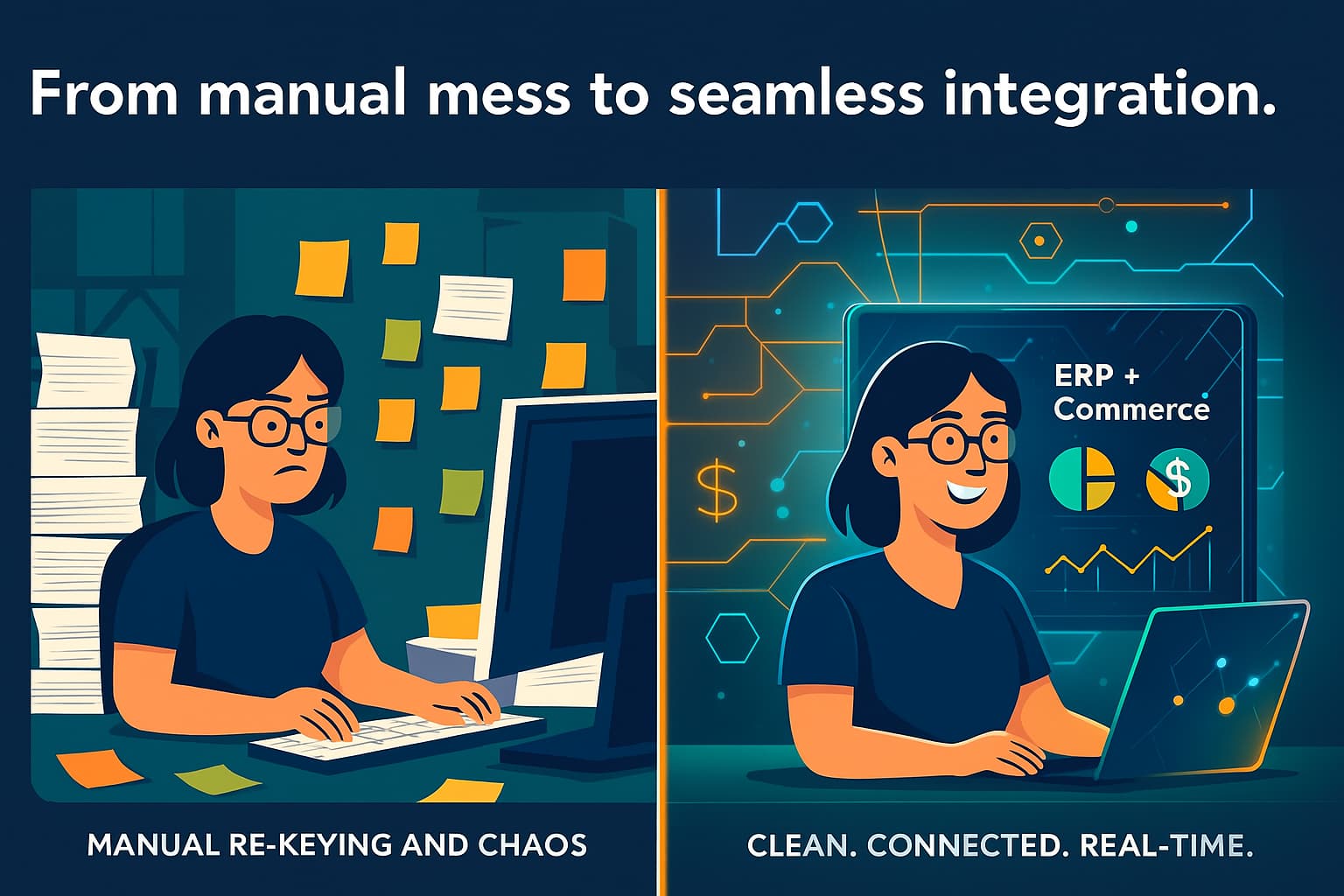
  • Unified Data & Time Savings: A successful integration will synchronize orders, inventory, customer info, and more between the eCommerce front-end and the ERP back-end, eliminating manual data entry[18]. This means when a product stock level changes or an order is placed, that update need only happen once and both systems know about it. Staff no longer have to export orders or re-key them into the ERP – saving hours and preventing human errors.
  • Real-Time Inventory & Avoiding Stockouts: With ERP integration, your website can display real-time inventory availability pulled from the ERP’s stock data[51]. This prevents the dreaded scenario of selling an item that isn’t actually in stock. For example, if your ERP shows 5 units available, your online store will reflect that; if an order comes in, both the ERP and site inventory will decrement immediately. Many modern shoppers (and B2B buyers) expect accurate stock on the site – integration delivers that, improving customer trust. As one operations manager put it, “Because our inventory is tied to our eCommerce site, a customer can now see what’s available... If you’re in Florida, you no longer must wait five, six days... It’s going to be two days, which is amazing,” highlighting how transparency and speed improve with a tightly integrated system[35].
  • Speedy Order Fulfillment & Customer Updates: When an order from the online store automatically appears in the ERP, your fulfillment process kicks off faster. The ERP can then generate shipping labels or allocate from inventory immediately. Once shipped, an integrated setup can send the tracking info and status back to the eCommerce platform to notify the customer that their order is on the way[52]. This end-to-end data flow keeps customers happy and internal teams efficient.
  • Single Source of Truth: By integrating, you maintain your ERP as the single source of truth for financials and inventory while leveraging the eCommerce platform for what it does best (online selling and user experience)[16][53]. Sales, whether online or offline, all funnel into one system (ERP), so your accounting and reporting are always complete and up-to-date. The ERP can also feed product info (descriptions, specs, pricing updates) to the site so that you manage data in one place and publish everywhere.
  • Examples of ERP–Platform Integrations: Each major ERP offers integration solutions for eCommerce:
  • Acumatica: Native connectors for Shopify and BigCommerce are included (and a Magento connector is available), enabling real-time, bi-directional data exchange without additional software[54]. It essentially turns your eCommerce site into an extension of the ERP – part of Acumatica’s integrated Retail-Commerce Edition.
  • NetSuite: The Oracle NetSuite Connector has prebuilt integrations for Shopify, BigCommerce, and Adobe Commerce among others[17]. These connectors map products, customers, orders, and fulfillment data between NetSuite and the storefront. With minimal setup, a NetSuite user can automate their Shopify/BigCommerce/Magento operations and avoid error-prone manual workflows[16][55].
  • Sage: Depending on the Sage product (Sage 100, 300, X3, or Sage Intacct), there are solutions like E-Link for Sage 100 (integrating with Magento, Shopify)[50] and others for BigCommerce[33]. These connectors keep the Sage ERP in sync with online orders and web customers. The benefit is a fully connected order-to-cash process – web orders flow into Sage for invoicing and inventory decrement, and any changes in Sage (e.g. price updates or inventory) can flow back to the site.
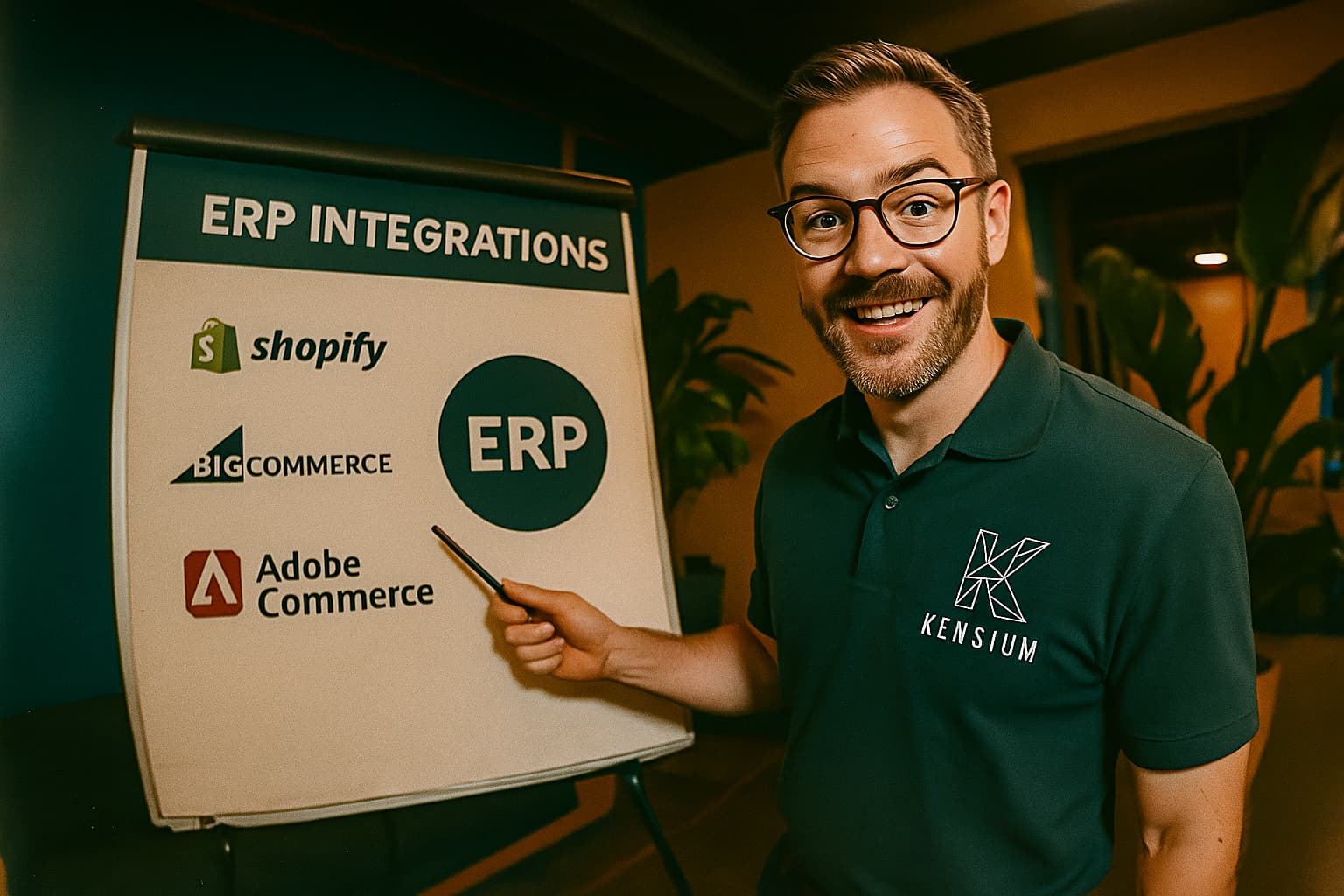
  • Dynamics 365 Business Central: Microsoft has a built-in Shopify connector for Business Central, born from a direct partnership with Shopify[56][13]. It supports syncing of items (with images and attributes), inventory levels, customers, and orders between Shopify and Business Central[57][58]. This native integration underscores how important unified commerce is – it lets a Business Central user manage ERP and Shopify store data in one place, fulfilling orders faster and serving customers better with synchronized information[13].

In short, integrating your eCommerce platform with an ERP streamlines operations and fuels growth. You’ll spend less time juggling spreadsheets or correcting errors, and more time focusing on sales and customer experience. As modern commerce leaders advise: treat your online store and ERP as parts of one unified system, not separate silos[59][60]. The right platform plus the right integration approach sets you up for scalable success.

Shopify Plus vs BigCommerce B2B Edition vs Adobe Commerce

(At a Glance)

Category Shopify Plus BigCommerce B2B Edition Adobe Commerce (Magento)
Best For High-growth DTC, Omnichannel, Global B2C/B2B Mid-market & industrial B2B Large enterprise, complex operations
Hosting Model Fully hosted SaaS Open SaaS Self-hosted or Adobe Cloud
B2B Capabilities App-driven, Plus B2B module Native advanced B2B tools Enterprise-grade native B2B
Multi-Storefront Separate instances Native multi-storefront Native multi-storefront
Customization Depth Moderate (API + checkout extensibility) High (API + headless support) Unlimited (full code control)
ERP Integration Native + partner connectors Native + partner connectors Partner + custom integrations
Global Commerce Built-in multi-currency & localization Built-in multi-currency Fully customizable globals
Infrastructure Mgmt Shopify managed BigCommerce managed (Distribution, wholesale, manufacturing) Customer or Adobe managed
Typical Buyer High-volume retail brand Manufacturing & distribution businesses Enterprise IT-driven organizations
Cost Model Subscription + app ecosystem Subscription tiered by GMV License + hosting + dev resources

Conclusion – Find Your Best-Fit Platform (and Get Expert Help)

The “right” ecommerce platform isn’t about which brand is biggest — it’s about which platform best aligns with your business model, scale, and operational maturity.

  • Shopify Plus is ideal for high-growth DTC brands and hybrid B2C/B2B sellers that prioritize speed, conversion optimization, global expansion, and omnichannel experiences with minimal IT overhead.
  • BigCommerce (B2B Edition) is best suited for mid-market and industrial B2B organizations that require complex pricing, account hierarchies, and native wholesale functionality without heavy development investment.
  • Adobe Commerce (Magento) remains the platform of choice for large enterprises with complex architectures, multi-brand operations, and highly customized workflows that demand full control over code and infrastructure.

Your existing ERP ecosystem also plays a key role. Businesses running Acumatica, NetSuite, Sage, or Microsoft Dynamics 365 Business Central should select the commerce platform that offers the most native, low-friction integration with their financials, inventory, and fulfillment operations.

At Kensium, we specialize in helping organizations select, implement, and integrate the right ecommerce platform based on real operational needs — not platform bias. Whether you’re launching your first online storefront or replatforming for enterprise scale, our team ensures your commerce platform and ERP function as a single unified system.

Ready to move forward? Explore Kensium’s eCommerce services to see how we can help you implement the right platform and integrate it for maximum efficiency. From initial strategy to development, integration, and ongoing support – Kensium has you covered in your eCommerce journey.

FAQ: Common Platform Selection Questions

Q: Shopify Plus vs. BigCommerce — which is better for a growing business?

A: Both platforms scale extremely well, but they serve different growth paths. Shopify Plus excels for high-growth DTC and omnichannel retail brands that prioritize speed, marketing agility, and conversion optimization. It’s especially strong for flash sales, subscriptions, and international retail expansion.

BigCommerce, on the other hand, is often the better fit for mid-market B2B and hybrid businesses that require native wholesale pricing, account management, and multi-storefront control with fewer third-party apps.

In general:

  • Shopify Plus → retail-driven growth
  • BigCommerce → operationally complex B2B growth

Q: What about Adobe Commerce (Magento)? Is it too complex for us?

A: Adobe Commerce is ideal for enterprises that require deep customization, multi-brand architectures, and complex integrations. It offers unmatched flexibility but requires dedicated development resources and a higher total cost of ownership.

If your business depends on unique workflows, proprietary integrations, or extreme scale, Adobe Commerce is often the right choice. However, for most fast-growing brands seeking speed and lower IT dependency, Shopify Plus or BigCommerce will deliver faster ROI with significantly less maintenance burden.

Q: Can I switch platforms later if I make the wrong choice?

A: Yes — replatforming is common, especially for businesses that start on Shopify Plus or BigCommerce and later move to Adobe Commerce as complexity grows. However, migrations involve data transfer, integration rebuilding, and operational downtime, so it’s best to select a platform that fits your 3–5 year growth horizon, not just today’s needs.

Kensium regularly supports clients through Shopify Plus ↔ BigCommerce ↔ Adobe Commerce migrations as business models mature.

Q: Do I need ERP integration from day one?

A: Not always. Early-stage ecommerce businesses can operate initially without ERP integration. However, once order volume, inventory complexity, or multi-channel fulfillment increases, ERP integration becomes essential.

If you already operate on Acumatica, NetSuite, Sage, or Business Central, integrating your ecommerce platform from day one avoids duplicate data entry, inventory mismatches, and accounting delays. Shopify Plus, BigCommerce, and Adobe Commerce all fully support ERP integration ecosystems, but the level of native support varies.

Q: How do ongoing costs compare between the platforms?

A:

  • Shopify Plus uses a predictable enterprise SaaS pricing model but may incur app and transaction-related costs at scale.
  • BigCommerce offers similar subscription pricing with fewer required add-ons and no transaction fees.
  • Adobe Commerce carries the highest total cost of ownership, including licensing, hosting, development, and support — but also delivers the greatest architectural control.

The right cost model is driven by operational complexity, not just monthly platform fees.

Selecting an eCommerce platform is a big decision, but with the right information and guidance, you can be confident in your choice. If you have more questions or need personalized advice, reach out to our team – we’re here to help you succeed online![18][20]

[1] [2] [3] [4] [5] [7] [8] [9] [10] [11] [12] [19] [20] [22] [24] [25] [27] [28] [29] [30] [31] [36] [37] [38] [39] [40] [41] [42] [43] [44] [45] [46] [47] [48] [61] 9 Best Ecommerce Platforms of 2025 (Know Your Options)

https://www.bigcommerce.com/articles/ecommerce/ecommerce-platforms/

[6] [21] [23] [26] Shopify vs BigCommerce – which fits mid-market retailers better? : r/bigcommerce

https://www.reddit.com/r/bigcommerce/comments/1o7jjnq/shopify_vs_bigcommerce_which_fits_midmarket/

[13] [56] [57] [58] Shopify Connector Overview - Business Central | Microsoft Learn

https://learn.microsoft.com/en-us/dynamics365/business-central/shopify/shopify-connector-overview

[14] [15] [32] [35] [49] [51] [54] Acumatica eCommerce Integrations | Commerce Connectors

https://www.acumatica.com/cloud-erp-software/commerce-connectors/

[16] [17] [53] [55] NetSuite Connector | NetSuite

https://www.netsuite.com/portal/products/connectors.shtml

[18] [52] Shopify, Adobe Commerce & BigCommerce: ERP Integration Guide

https://www.kensium.com/blog/shopify-adobe-commerce-bigcommerce-erp-integration-guide

[33] BigCommerce and Sage Integration - Sage Intacct Marketplace

https://marketplace.intacct.com/MPListing?lid=a2D6S00000hsPKmUAM

[34] IN-SYNCH E-Commerce Platform Integration - DSD Business Systems

https://www.dsdinc.com/software/sage-100-integration-with-in-synch/in-synch-e-commerce-platform-integration/

[50] E-Link eCommerce Integration | Sage US Marketplace

https://us-marketplace.sage.com/en-us/apps/89408/e-link-ecommerce-integration

[59] [60] B2B Ecommerce Integration: Build Real-Time Connected Commerce in 2025 - Shopify

https://www.shopify.com/enterprise/blog/b2b-ecommerce-integration

Share this on
Black Facebook social media logo icon on transparent background.Twitter bird logo in light blue on a transparent background.LinkedIn social media platform icon in blue and white.
Written by
Kensium’s Commerce Strategy Team
Kensium’s Commerce Strategy Team helps brands align strategy, technology, and operations to unlock growth across B2B and B2C channels. With expertise spanning customer experience, checkout optimization, marketing automation, ERP–eCommerce integration, and compliance, the team delivers holistic solutions that reduce friction, increase conversions, and scale digital commerce profitably.
Left-pointing chevron arrow icon.
Back to Blogs

Which Ecommerce Platform Is Right for Your Business?

Ecommerce
Reading Time:
3
min
Published on:
December 2, 2025
Updated on:
December 2, 2025
Our Editorial Team
Kensium’s Commerce Strategy Team

Choosing an ecommerce platform can feel overwhelming – especially with major options like Shopify Plus, BigCommerce, and Adobe Commerce (Magento) on the table. The key is to match the platform to your business needs, scale, and technical resources. Below, we break down these platforms (and how they integrate with ERP systems like Acumatica, NetSuite, Sage, and Microsoft Dynamics 365 Business Central) to help businesses find their best fit. We’ll also explore real-world use cases, from startup retailers to growing B2B companies, and how a solid ERP integration can supercharge your online store.

Shopify Plus – Enterprise-Grade Simplicity for High-Growth Brands

Shopify Plus is Shopify’s enterprise-tier ecommerce platform, built for high-growth, high-volume B2C and emerging B2B businesses that want scale without infrastructure complexity. Unlike standard Shopify plans, Shopify Plus provides advanced automation, deeper customization, higher API limits, and enterprise support, while maintaining Shopify’s core advantage: ease of use.

Shopify Plus is commonly used by fast-scaling direct-to-consumer brands, global retailers, and digitally native manufacturers that prioritize speed-to-market, conversion optimization, and global expansion without managing hosting or backend infrastructure.

Ideal for

High-growth DTC brands, global B2C retailers, hybrid B2C/B2B companies, and manufacturers launching direct sales channels that need enterprise scale without enterprise IT overhead. It’s especially strong for brands with high order volumes, flash sales, and international storefront needs.

Strengths

  • Enterprise Automation & Customization: Shopify Plus unlocks Shopify Flow, Launchpad, and custom checkout extensibility, allowing brands to automate promotions, order routing, fraud rules, and complex workflows.
  • High-Volume Performance: Designed to handle thousands of transactions per minute, including major flash sales and peak events.
  • Global Commerce Enablement: Built-in support for multi-currency, multi-language, localized experiences, and global payments.
  • Best-in-Class App Ecosystem: Full access to Shopify’s enterprise-grade app ecosystem for marketing, CRO, subscriptions, POS, and logistics.
  • Omnichannel Ready: Native Shopify POS allows seamless online-to-in-store experiences from the same commerce engine.
  • Strong API & Headless Support: Supports headless storefronts, custom front ends, and composable commerce architectures.

Limitations

  • Still App-Dependent for Advanced B2B: While Shopify Plus offers a growing B2B feature set, complex wholesale pricing, nested account hierarchies, and advanced quoting often still require third-party apps, unlike BigCommerce or Adobe Commerce which provide deeper native B2B functionality.
  • Multi-Store Complexity: Each storefront still runs as a separate Shopify instance, which can become operationally heavy for brands managing many regions or brands.
  • Transaction Fees: Shopify Plus merchants may incur transaction fees when not using Shopify Payments, impacting total cost at scale.

ERP Integration

Shopify Plus integrates tightly with major ERPs through native and partner-certified connectors:

  • Microsoft Dynamics 365 Business Central: Official Shopify Connector enables bi-directional sync of products, inventory, customers, and orders.
  • Acumatica: Native Shopify integration supports real-time sync of orders, inventory, pricing, and customers without middleware.
  • NetSuite: NetSuite Connector provides automated synchronization of Shopify Plus data into the ERP as the system of record.
  • Sage: Certified third-party connectors support Shopify Plus integration with Sage 100, Sage X3, and Sage Intacct.

These integrations allow Shopify Plus to operate as the front-end commerce engine, while the ERP manages financials, fulfillment, taxation, and inventory at scale—eliminating reconciliation delays and manual data entry.  

BigCommerce – Built-In Features and B2B Muscle for Scaling Businesses

BigCommerce is an “Open SaaS” platform geared towards fast-growing B2C and B2B brands. It offers more functionality out-of-the-box than many competitors, making it attractive if you want robust features without relying on too many apps. BigCommerce supports both customizable experiences (through open APIs and a headless-friendly architecture) and easy plug-and-play setups for non-technical users[19].

  • Ideal for: Mid-market businesses and B2B/B2C hybrids that need scalable performance, complex catalog support, or advanced selling features. It’s also used by enterprises (BigCommerce Enterprise) and tech-savvy smaller businesses that plan to grow into a more advanced platform[20].
  • Strengths: Powerful native features reduce the need for third-party apps. BigCommerce has native multi-storefront capabilities, an advanced promotions engine (70+ promo types), and a robust discounting and customer group system suited for wholesale pricing[21][22]. It imposes no additional transaction fees on external payment gateways, which can save high-volume sellers a lot of money[6]. BigCommerce is also well-regarded for its native B2B toolkit (especially with the B2B Edition add-on) – features like customer-specific pricing, bulk order form, and company accounts are available natively, whereas Shopify might require multiple apps for equivalent B2B functionality[21][23]. Additionally, BigCommerce’s open API and “headless” support allow for custom front-end experiences and integrations without abandoning the SaaS convenience. It’s a highly scalable platform – one analysis found the average BigCommerce customer achieved payback on their investment in just 8 months with 211% ROI in 3 years[24][25] (a nod to its effectiveness for growth-minded merchants).
  • Limitations: The richer feature set means BigCommerce can have a steeper learning curve than Shopify for newcomers[26][27]. Small businesses with very basic needs might find BigCommerce “too much platform” if they won’t utilize its advanced features[28]. Its theme selection, while modern, is more limited than Shopify’s expansive theme marketplace[29].
  • ERP integration: BigCommerce was designed with integration in mind. It provides a robust API and even native connectors for certain ERPs. For instance, Acumatica Cloud ERP includes a built-in BigCommerce connector that allows real-time, bi-directional syncing of orders, inventory, product info, and more[32][15]. This means when an order is placed on your BigCommerce store, it can automatically create a corresponding sales order in Acumatica, update stock levels, and later push shipment tracking back to BigCommerce – no manual re-entry needed. NetSuite users can also rejoice: Oracle’s NetSuite Connector supports BigCommerce integration, syncing products, customers, inventory, and orders between the two systems[17]. And for the Sage ERP family, there are third-party solutions (like Sage eCommerce E-Link and others) to connect Sage 100/300 or Sage X3 with BigCommerce for a unified data flow[33][34]. In practice, integrating BigCommerce with your ERP can greatly enhance efficiency – for example, accurate inventory across channels and faster order processing. One BigCommerce merchant noted that because their ERP inventory is tied to the website, customers can see what’s in stock and get their orders faster, improving the overall experience[35].

Adobe Commerce (Magento) – Unlimited Customization for Complex Needs

Adobe Commerce, formerly Magento, is an open-source eCommerce platform renowned for its flexibility and rich feature set. Unlike the SaaS solutions above, Adobe Commerce gives you full control over the code and hosting (you can self-host or use Adobe’s managed cloud). It’s often chosen by businesses that need highly tailored shopping experiences or integration of eCommerce deeply into their own infrastructure.

  • Ideal for: Large enterprises or niche mid-market businesses with complex requirements – such as extensive product catalogs, multiple storefronts/brands, or specialized B2B workflows. It’s also a fit for organizations that want total control over the platform and have the IT/development resources to support that. If your business demands features or integrations that off-the-shelf platforms can’t handle, Magento’s open architecture lets developers build exactly what you need.
  • Strengths: Unlimited customization. Because you can modify any aspect of the platform, Adobe Commerce can be molded to fit almost any business process or design vision[36][37]. It has robust multi-store capabilities – you can run multiple stores (e.g. different country sites, B2C and B2B storefronts, or brand microsites) from one backend, a huge plus for companies managing several brands or channels[38][39]. Adobe Commerce also comes with advanced features out-of-the-box, especially for B2B commerce (the Adobe Commerce B2B module offers features like company accounts, custom catalogs, quote management, etc., built right in[40]). Additionally, the Magento ecosystem is large: there’s a robust partner network and marketplace of extensions to further enhance functionality[41]. If you already leverage other Adobe products (Analytics, Experience Manager, etc.), Adobe Commerce integrates with those tools, which can be a strategic advantage for a full Adobe stack user[42].
  • Limitations: The flip side of freedom is complexity and cost. Running Adobe Commerce requires a development team (or experienced agency partner) to implement and maintain the site[43][44]. The total cost of ownership can be high – not only do you potentially pay licensing (Adobe Commerce starts around $22,000/year on-premises, or ~$40,000/year for Adobe’s cloud PaaS hosting[45]), but you also have ongoing expenses for developers, hosting (if self-hosted), and support. For smaller businesses, this cost is often prohibitive for what you need. Moreover, with self-hosted software, you’re responsible for applying security patches and updates regularly[44]. If updates aren’t managed carefully, custom code can break during upgrades, possibly causing downtime[46]. Unlike Shopify or BigCommerce, there’s no 24/7 vendor support included; you rely on community forums, third-party providers, or your in-house team for troubleshooting[47][48]. In short, Adobe Commerce is powerful but requires commitment – it’s best utilized when you truly need its unparalleled flexibility.
  • ERP integration: Adobe Commerce’s open architecture means you can integrate it deeply with ERP and other systems – either through custom API work or pre-built connectors. Many ERP vendors and integration partners provide connectors for Magento. For example, Acumatica offers an Adobe Commerce–Acumatica connector that can be purchased to sync data between Magento and the ERP[49]. Oracle NetSuite’s integration toolset also supports Adobe Commerce (listed as a supported B2C ecommerce connector) to automatically pass data like orders, inventory, customer info, etc.[17]. Sage ERP users have options too – one popular integration is “E-Link”, which creates a two-way sync between Sage 100 and Magento, ensuring web orders and ERP records stay aligned[50]. With Adobe Commerce, some businesses even opt for a middleware approach (using an integration platform or message broker between Magento and the ERP) to handle complex data transformations. The goal of any integration is the same: make your eCommerce storefront and back-office act as one system. When done right, this yields real-time inventory accuracy, streamlined order fulfillment, and single-source reporting. (Imagine your online and offline orders all flowing into one ERP and your ERP pushing inventory updates and product info back to the site – that’s the unified commerce Adobe Commerce can achieve with a solid ERP connection[18][15].)

How ERP Integration Enhances Your E-Commerce Platform

No matter which platform you choose, connecting your online store with an ERP (Enterprise Resource Planning) system can be a game-changer. An ERP like Acumatica, NetSuite, Sage, or Microsoft Dynamics 365 centralizes your inventory, orders, customer data, and financials – integrating it with your eCommerce ensures both systems stay in lockstep. Here’s how ERP integration benefits eCommerce businesses:

  • Unified Data & Time Savings: A successful integration will synchronize orders, inventory, customer info, and more between the eCommerce front-end and the ERP back-end, eliminating manual data entry[18]. This means when a product stock level changes or an order is placed, that update need only happen once and both systems know about it. Staff no longer have to export orders or re-key them into the ERP – saving hours and preventing human errors.
  • Real-Time Inventory & Avoiding Stockouts: With ERP integration, your website can display real-time inventory availability pulled from the ERP’s stock data[51]. This prevents the dreaded scenario of selling an item that isn’t actually in stock. For example, if your ERP shows 5 units available, your online store will reflect that; if an order comes in, both the ERP and site inventory will decrement immediately. Many modern shoppers (and B2B buyers) expect accurate stock on the site – integration delivers that, improving customer trust. As one operations manager put it, “Because our inventory is tied to our eCommerce site, a customer can now see what’s available... If you’re in Florida, you no longer must wait five, six days... It’s going to be two days, which is amazing,” highlighting how transparency and speed improve with a tightly integrated system[35].
  • Speedy Order Fulfillment & Customer Updates: When an order from the online store automatically appears in the ERP, your fulfillment process kicks off faster. The ERP can then generate shipping labels or allocate from inventory immediately. Once shipped, an integrated setup can send the tracking info and status back to the eCommerce platform to notify the customer that their order is on the way[52]. This end-to-end data flow keeps customers happy and internal teams efficient.
  • Single Source of Truth: By integrating, you maintain your ERP as the single source of truth for financials and inventory while leveraging the eCommerce platform for what it does best (online selling and user experience)[16][53]. Sales, whether online or offline, all funnel into one system (ERP), so your accounting and reporting are always complete and up-to-date. The ERP can also feed product info (descriptions, specs, pricing updates) to the site so that you manage data in one place and publish everywhere.
  • Examples of ERP–Platform Integrations: Each major ERP offers integration solutions for eCommerce:
  • Acumatica: Native connectors for Shopify and BigCommerce are included (and a Magento connector is available), enabling real-time, bi-directional data exchange without additional software[54]. It essentially turns your eCommerce site into an extension of the ERP – part of Acumatica’s integrated Retail-Commerce Edition.
  • NetSuite: The Oracle NetSuite Connector has prebuilt integrations for Shopify, BigCommerce, and Adobe Commerce among others[17]. These connectors map products, customers, orders, and fulfillment data between NetSuite and the storefront. With minimal setup, a NetSuite user can automate their Shopify/BigCommerce/Magento operations and avoid error-prone manual workflows[16][55].
  • Sage: Depending on the Sage product (Sage 100, 300, X3, or Sage Intacct), there are solutions like E-Link for Sage 100 (integrating with Magento, Shopify)[50] and others for BigCommerce[33]. These connectors keep the Sage ERP in sync with online orders and web customers. The benefit is a fully connected order-to-cash process – web orders flow into Sage for invoicing and inventory decrement, and any changes in Sage (e.g. price updates or inventory) can flow back to the site.
  • Dynamics 365 Business Central: Microsoft has a built-in Shopify connector for Business Central, born from a direct partnership with Shopify[56][13]. It supports syncing of items (with images and attributes), inventory levels, customers, and orders between Shopify and Business Central[57][58]. This native integration underscores how important unified commerce is – it lets a Business Central user manage ERP and Shopify store data in one place, fulfilling orders faster and serving customers better with synchronized information[13].

In short, integrating your eCommerce platform with an ERP streamlines operations and fuels growth. You’ll spend less time juggling spreadsheets or correcting errors, and more time focusing on sales and customer experience. As modern commerce leaders advise: treat your online store and ERP as parts of one unified system, not separate silos[59][60]. The right platform plus the right integration approach sets you up for scalable success.

Shopify Plus vs BigCommerce B2B Edition vs Adobe Commerce

(At a Glance)

Category Shopify Plus BigCommerce B2B Edition Adobe Commerce (Magento)
Best For High-growth DTC, Omnichannel, Global B2C/B2B Mid-market & industrial B2B Large enterprise, complex operations
Hosting Model Fully hosted SaaS Open SaaS Self-hosted or Adobe Cloud
B2B Capabilities App-driven, Plus B2B module Native advanced B2B tools Enterprise-grade native B2B
Multi-Storefront Separate instances Native multi-storefront Native multi-storefront
Customization Depth Moderate (API + checkout extensibility) High (API + headless support) Unlimited (full code control)
ERP Integration Native + partner connectors Native + partner connectors Partner + custom integrations
Global Commerce Built-in multi-currency & localization Built-in multi-currency Fully customizable globals
Infrastructure Mgmt Shopify managed BigCommerce managed (Distribution, wholesale, manufacturing) Customer or Adobe managed
Typical Buyer High-volume retail brand Manufacturing & distribution businesses Enterprise IT-driven organizations
Cost Model Subscription + app ecosystem Subscription tiered by GMV License + hosting + dev resources

Conclusion – Find Your Best-Fit Platform (and Get Expert Help)

The “right” ecommerce platform isn’t about which brand is biggest — it’s about which platform best aligns with your business model, scale, and operational maturity.

  • Shopify Plus is ideal for high-growth DTC brands and hybrid B2C/B2B sellers that prioritize speed, conversion optimization, global expansion, and omnichannel experiences with minimal IT overhead.
  • BigCommerce (B2B Edition) is best suited for mid-market and industrial B2B organizations that require complex pricing, account hierarchies, and native wholesale functionality without heavy development investment.
  • Adobe Commerce (Magento) remains the platform of choice for large enterprises with complex architectures, multi-brand operations, and highly customized workflows that demand full control over code and infrastructure.

Your existing ERP ecosystem also plays a key role. Businesses running Acumatica, NetSuite, Sage, or Microsoft Dynamics 365 Business Central should select the commerce platform that offers the most native, low-friction integration with their financials, inventory, and fulfillment operations.

At Kensium, we specialize in helping organizations select, implement, and integrate the right ecommerce platform based on real operational needs — not platform bias. Whether you’re launching your first online storefront or replatforming for enterprise scale, our team ensures your commerce platform and ERP function as a single unified system.

Ready to move forward? Explore Kensium’s eCommerce services to see how we can help you implement the right platform and integrate it for maximum efficiency. From initial strategy to development, integration, and ongoing support – Kensium has you covered in your eCommerce journey.

FAQ: Common Platform Selection Questions

Q: Shopify Plus vs. BigCommerce — which is better for a growing business?

A: Both platforms scale extremely well, but they serve different growth paths. Shopify Plus excels for high-growth DTC and omnichannel retail brands that prioritize speed, marketing agility, and conversion optimization. It’s especially strong for flash sales, subscriptions, and international retail expansion.

BigCommerce, on the other hand, is often the better fit for mid-market B2B and hybrid businesses that require native wholesale pricing, account management, and multi-storefront control with fewer third-party apps.

In general:

  • Shopify Plus → retail-driven growth
  • BigCommerce → operationally complex B2B growth

Q: What about Adobe Commerce (Magento)? Is it too complex for us?

A: Adobe Commerce is ideal for enterprises that require deep customization, multi-brand architectures, and complex integrations. It offers unmatched flexibility but requires dedicated development resources and a higher total cost of ownership.

If your business depends on unique workflows, proprietary integrations, or extreme scale, Adobe Commerce is often the right choice. However, for most fast-growing brands seeking speed and lower IT dependency, Shopify Plus or BigCommerce will deliver faster ROI with significantly less maintenance burden.

Q: Can I switch platforms later if I make the wrong choice?

A: Yes — replatforming is common, especially for businesses that start on Shopify Plus or BigCommerce and later move to Adobe Commerce as complexity grows. However, migrations involve data transfer, integration rebuilding, and operational downtime, so it’s best to select a platform that fits your 3–5 year growth horizon, not just today’s needs.

Kensium regularly supports clients through Shopify Plus ↔ BigCommerce ↔ Adobe Commerce migrations as business models mature.

Q: Do I need ERP integration from day one?

A: Not always. Early-stage ecommerce businesses can operate initially without ERP integration. However, once order volume, inventory complexity, or multi-channel fulfillment increases, ERP integration becomes essential.

If you already operate on Acumatica, NetSuite, Sage, or Business Central, integrating your ecommerce platform from day one avoids duplicate data entry, inventory mismatches, and accounting delays. Shopify Plus, BigCommerce, and Adobe Commerce all fully support ERP integration ecosystems, but the level of native support varies.

Q: How do ongoing costs compare between the platforms?

A:

  • Shopify Plus uses a predictable enterprise SaaS pricing model but may incur app and transaction-related costs at scale.
  • BigCommerce offers similar subscription pricing with fewer required add-ons and no transaction fees.
  • Adobe Commerce carries the highest total cost of ownership, including licensing, hosting, development, and support — but also delivers the greatest architectural control.

The right cost model is driven by operational complexity, not just monthly platform fees.

Selecting an eCommerce platform is a big decision, but with the right information and guidance, you can be confident in your choice. If you have more questions or need personalized advice, reach out to our team – we’re here to help you succeed online![18][20]

[1] [2] [3] [4] [5] [7] [8] [9] [10] [11] [12] [19] [20] [22] [24] [25] [27] [28] [29] [30] [31] [36] [37] [38] [39] [40] [41] [42] [43] [44] [45] [46] [47] [48] [61] 9 Best Ecommerce Platforms of 2025 (Know Your Options)

https://www.bigcommerce.com/articles/ecommerce/ecommerce-platforms/

[6] [21] [23] [26] Shopify vs BigCommerce – which fits mid-market retailers better? : r/bigcommerce

https://www.reddit.com/r/bigcommerce/comments/1o7jjnq/shopify_vs_bigcommerce_which_fits_midmarket/

[13] [56] [57] [58] Shopify Connector Overview - Business Central | Microsoft Learn

https://learn.microsoft.com/en-us/dynamics365/business-central/shopify/shopify-connector-overview

[14] [15] [32] [35] [49] [51] [54] Acumatica eCommerce Integrations | Commerce Connectors

https://www.acumatica.com/cloud-erp-software/commerce-connectors/

[16] [17] [53] [55] NetSuite Connector | NetSuite

https://www.netsuite.com/portal/products/connectors.shtml

[18] [52] Shopify, Adobe Commerce & BigCommerce: ERP Integration Guide

https://www.kensium.com/blog/shopify-adobe-commerce-bigcommerce-erp-integration-guide

[33] BigCommerce and Sage Integration - Sage Intacct Marketplace

https://marketplace.intacct.com/MPListing?lid=a2D6S00000hsPKmUAM

[34] IN-SYNCH E-Commerce Platform Integration - DSD Business Systems

https://www.dsdinc.com/software/sage-100-integration-with-in-synch/in-synch-e-commerce-platform-integration/

[50] E-Link eCommerce Integration | Sage US Marketplace

https://us-marketplace.sage.com/en-us/apps/89408/e-link-ecommerce-integration

[59] [60] B2B Ecommerce Integration: Build Real-Time Connected Commerce in 2025 - Shopify

https://www.shopify.com/enterprise/blog/b2b-ecommerce-integration

Our Editorial Team
Kensium’s Commerce Strategy Team

Explore Related Blogs

caret right
Ecommerce
Which Ecommerce Platform Is Right for Your Business?
Ecommerce
2026 Ecommerce Trends Forecast: What’s Next for B2B & B2C
Ecommerce
B2B Buyer Portals: Empowering U.S. Businesses in the Digital Age
Ecommerce
Here’s What IDC Found About BigCommerce B2B Edition
Shopify
ERP
Ecommerce
Shopify, Adobe Commerce & BigCommerce: ERP Integration Guide
Wholesale 2.0 – Next-Gen B2B Ecommerce Strategies on Shopify Plus by Kensium
ERP
Ecommerce
Boost B2B Sales with ERP–eCommerce Integration
Seamless Workspace Transformation – Integrating ERP and Ecommerce for Efficiency
Ecommerce
ERP
Distribution Needs eCommerce ERP Integration: 5 Signs
Ecommerce Optimization Dashboard – Data-Driven Insights for Shopify Merchants
Ecommerce
Marketing
eCommerce CRO Checklist & Playbook for Higher Conversions
Ecommerce
E-Commerce Growth Playbook: Holiday Shopping 2025
Ecommerce
Integrating eCommerce Platforms with NetSuite
Ecommerce
B2B Ecommerce Customization Framework: How Kensium Maximizes ROI & Avoids Costly Pitfalls
Ecommerce
The 2025 B2B eCommerce Strategy Guide to Generative Engine Optimization
Ecommerce
Cost-Cutting Strategies for eCommerce Growth in 2025
Ecommerce
Behavioral Economics in E-commerce: 10 Proven Tactics That Convert
Artificial Intelligence (AI)
Ecommerce
10 AI Strategies That Actually Drive B2B Ecommerce Growth
Ecommerce
Is Your B2B Store Costing You Sales? UX Fixes D2C Brands Already Use
Ecommerce
Amazon Prime Day 2025: Record Sales, AI Chatbots, and Key Takeaways for Sellers
Ecommerce
News & Update
Shopify
Shopify Now Accepts USDC via Coinbase & Stripe | Powered by Kensium
Ecommerce
How E-commerce Brands Can Profit from US Tariffs: A Complete Guide
Ecommerce
Artificial Intelligence (AI)
Shopify
Unlocking the Power of Shopify Magic: AI-Driven Commerce for the Modern B2B Merchant
Ecommerce
Your Website Is Not a Brochure: 5 Upgrades That Convert B2B Traffic
Ecommerce
7 Signs Your B2B eCommerce Platform Is Dying
Ecommerce
Customized B2B eCommerce Solutions: Max ROI, Avoid Templates
Ecommerce
Retrieving data. Wait a few seconds and try to cut or copy again.
Ecommerce
Marketing
How Tech & Analytics Elevate eCommerce Marketing
Ecommerce
The Vanishing Product: Don’t Let End-of-Life Cost You Loyal Customers
Ecommerce
The Delivery Deadline Doom: Are Late Shipments Killing Your Brand?
Ecommerce
Click to Convert: Mastering CTAs for Maximum Ecommerce Success
Ecommerce
Shipping Snafus: Are Delivery Delays Ruining Your Reputation?
Ecommerce
The Abandoned Cart Cemetery: Revive Your Lost Sales
Ecommerce
Unlock the Potential of Your Adobe Commerce Store with Adobe App Builder
Ecommerce
The Holiday Hangover: Don't Let Lost Sales Haunt You All Year
Ecommerce
Is it Time to Refresh Your Company’s Website?
Ecommerce
Omnichannel Ecommerce B2B Sales in 2025: McKinsey Insights
Ecommerce
Benefits of Composable Commerce with Adobe Commerce
Ecommerce
Sustainable E-Commerce: How BigCommerce Supports Eco-Friendly Practices
Ecommerce
The Power of User-Generated Content: Boosting Engagement on Shopify Stores
Ecommerce
The Rise of Conversational Commerce: Revolutionizing Customer Support and Boosting Conversion Rates
Ecommerce
Upgrading to Magento 2.4.7 and PHP 8.3
Ecommerce
Managing Multi-Channel Inventory with Ease on Shopify
Ecommerce
Why Every Ecommerce Business Needs an ERP
Ecommerce
The Power of PunchOut Integrations: How They Revolutionize B2B Transactions
Ecommerce
How Shopify Merchants Can Dominate with Dynamic Pricing
Ecommerce
Unifying B2B and B2C Experiences with Headless Commerce: How Kensium Leads the Charge
Ecommerce
Solo but Strong: My Experience as the Only Woman in Kensium's Sales Team
Ecommerce
Unlocking Success: Essential Ecommerce Metrics Every Business Should Track
Ecommerce
Ecommerce Predictions in 2024: Reimagining Customer Experience with Hyper-Personalization
Ecommerce
Exploring the Potential of the Metaverse to Revolutionize Ecommerce Businesses
Ecommerce
Top 20 Best Practices to Protect your Magento Store from Cyber Attacks
Ecommerce
Top 8 Cyber Resilience Strategies to Safeguard your Magento Store
Ecommerce
Harnessing the Power of ChatGPT for Ecommerce Transformation
Ecommerce
Composable Commerce: Understanding its Significance
Ecommerce
Picking right Adobe Commerce (Magento) trends
Ecommerce
How ChatGPT Transforms Ecommerce & Cybersecurity
Ecommerce
How to Increase Ecommerce Average Order Value (AOV)?
Ecommerce
Navigating the New Adobe Commerce Lifecycle Policy with Kensium's Support
Ecommerce
BigCommerce Unveils Powerful Features for B2B Edition. How can Kensium Help you Leverage Them?
Ecommerce
Simplify Online Shopping with Quick Checkout by Bolt for Adobe
Ecommerce
Amazon Buy with Prime
Ecommerce
Headless vs Composable vs PWA
Ecommerce
Allparts - Support Case Study
Ecommerce
Boost Your E-commerce Sales with BigCommerce's BOPIS Feature
Ecommerce
Stay Ahead of the Game with Adobe Magento 2.4.6's Improved Functionality
Ecommerce
How To Choose The Right Ecommerce Platform
Ecommerce
How To Drive Ecommerce Platform Adoption
Ecommerce
Customized Ecommerce Platform Or Out-Of-The-Box - Which Is Better?
Ecommerce
What You Need To Know About Upgrading To Magento 2.4.4+
Ecommerce
BigCommerce Launches #BigHackathon And Kensium Rises To The Challenge
Ecommerce
How To Be Ready To Update Your Ecommerce Analytics to GA4
Ecommerce
Progressive Web Apps vs. Responsive Websites - Which Is Better?
Ecommerce
Finding The Right Ecommerce Technology Stack
Ecommerce
How To Beat Stress At Work And At Home
Ecommerce
How Developing A PWA Is Unique From Traditional Web Apps
Ecommerce
What You Need To Know About Progressive Web Apps
Ecommerce
Unite Omnichannel Sales Through BigCommerce Channel Manager
Ecommerce
The BigDev Bootcamp Is Can't-Miss For BigCommerce Developers
Ecommerce
Green Monday - The Greatest Shopping Day You've Never Heard Of
Ecommerce
Magento 1 End of Life: Extend with Nexcess Safe Harbor
Ecommerce
Home Science Tools Helps Your Kids Learn From Home While You Work From Home
Ecommerce
Dekra-Lite Creates Extraordinary Decor For Any Occasion
Ecommerce
ParkingZone Thinks Outside The Lines Of The Parking Industry
Ecommerce
Adobe Summit 2020 Breakout Session: How To Integrate Magento With External Systems
Ecommerce
Real Street Performance Turbocharges Average Order Value Using Adobe Commerce
Ecommerce
Why Personalization Has Become An ECommerce Necessity In 2020
Ecommerce
The Differences Between Magento Open Source And Magento Commerce
Ecommerce
Fight Back Against Fraud: How To Prepare For Holiday ECommerce Scams In 2020
Ecommerce
Resources For ECommerce Businesses During The COVID-19 Pandemic
Ecommerce
Magento 1 Reaches Its End-Of-Life This Month: Here Are Your Options
Ecommerce
The Exceptional Value Of Referral Marketing In ECommerce
Ecommerce
Deploy Magento 2 In As Little As 6-8 Weeks
Ecommerce
Ecommerce Options For Volusion Customers Post-Bankruptcy
Ecommerce
Build The Next Great Promotional Campaign Using Magento Discounts
Ecommerce
How To Plan For 2021 And Hit The Ground Running
Ecommerce
How Mobile-First Magento Layouts Benefit Businesses And Customers
Ecommerce
Increase Efficiency And Sales With Magento 2
Ecommerce
The Future Of Web Development: Progressive Web Apps
Ecommerce
Ecommerce Conversion Rate Optimization 2019: Best Practices
Ecommerce
Nucleus Research: Acumatica Shows No Signs Of Slowing
Ecommerce
6 Mobile Trends That Could Change Commerce Forever
Ecommerce
The Impact of the COVID-19 Coronavirus on eCommerce