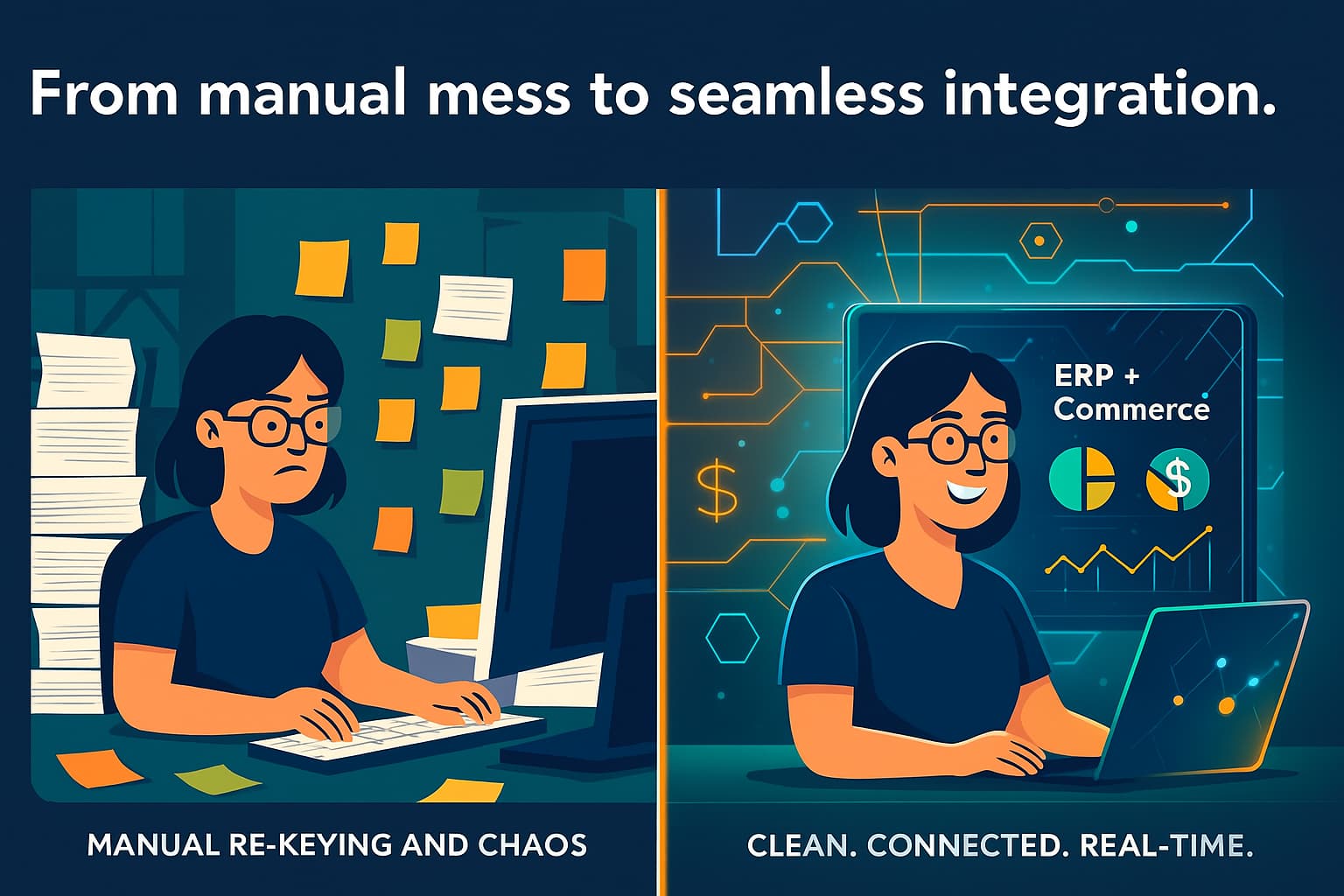
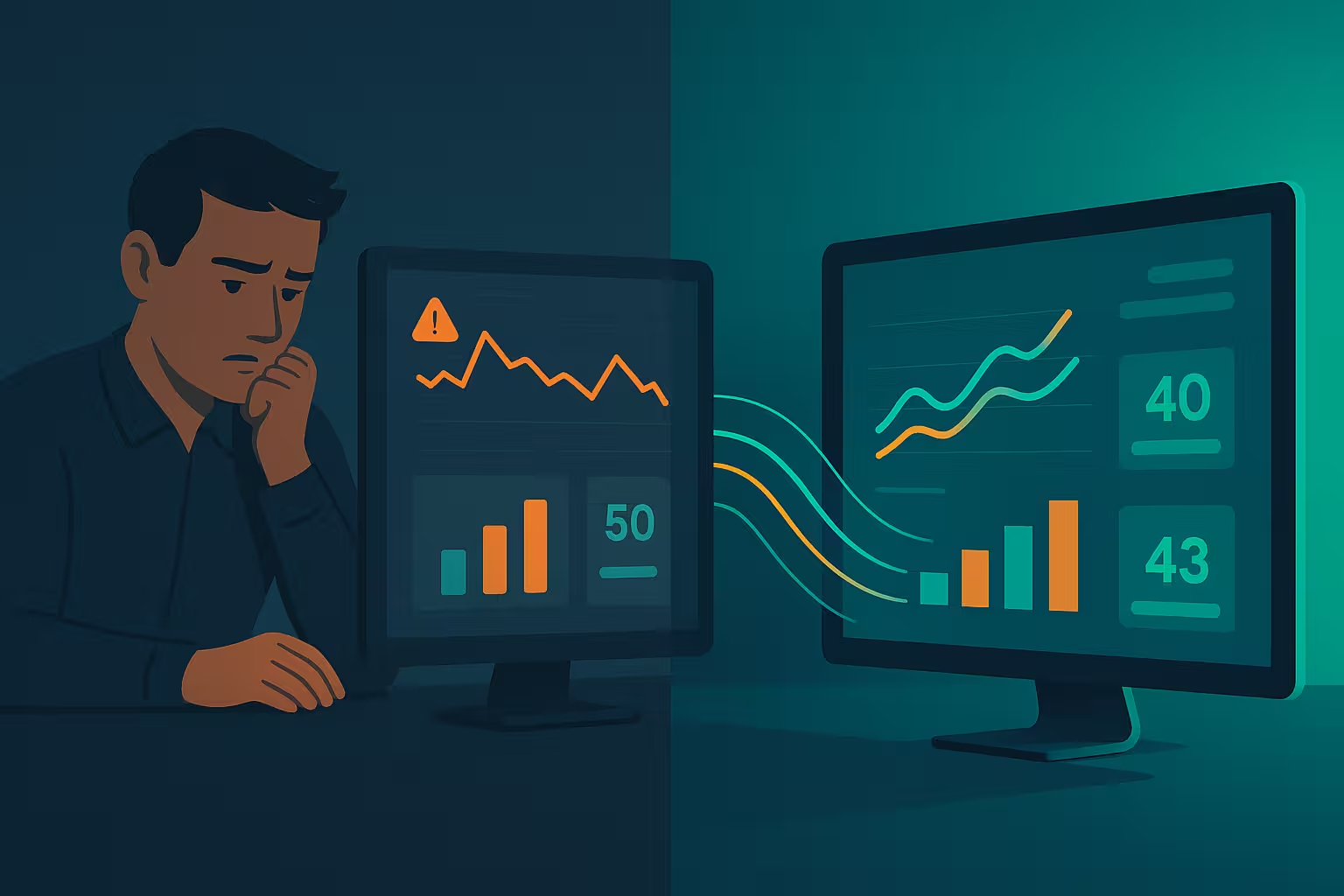
ERP–ecommerce integration is often sold as the cure for operational chaos. Connect the storefront to the ERP, eliminate manual work, synchronize inventory, and unlock growth. In theory, it works exactly that way. In practice, most integrations begin to fail precisely when the business starts to scale.
Industry research shows that the majority of ERP and digital transformation projects underperform or fail to achieve their expected return on investment. These failures rarely appear during early testing. They emerge when order volume spikes, when multiple sales channels are added, when warehouses multiply, and when real customers begin stressing the system at enterprise scale. What follows is not a software problem, but a system architecture failure.
This autopsy examines why ERP–ecommerce integrations collapse under growth and what engineering-first organizations do differently to avoid becoming another statistic.
The Hidden Risk at the Core of Digital Commerce
ERP–ecommerce integration sits at the center of revenue operations. It moves orders, inventory, pricing, taxes, customer data, fulfillment, and financial posting between systems. When it works, the business scales cleanly. When it breaks, everything breaks at once.
Overselling, delayed shipments, inventory mismatches, invoice errors, and manual re-entry all stem from a single root cause: systems that were never designed to operate together in real time. As businesses expand into omnichannel commerce, the margin for error disappears. A nightly batch sync that once worked at 100 orders per week becomes catastrophic at 5,000 orders per day.
At scale, integration is no longer a technical feature. It becomes a mission-critical infrastructure.

Where Integration Architecture Starts to Crack
Most failures begin with inadequate architectural planning. Many projects launch with vague goals such as “we need automation” or “we need our systems connected.” Without precise operational targets — real-time inventory, automated order-to-cash, synchronized pricing across channels — integrations drift, expand in scope, and delay value delivery.
Over time, customizations pile on. Stakeholders add new requirements late in the project. Workflows expand without a clear integration boundary. The result is a system that grows horizontally in complexity without growing vertically in stability.
At the same time, data quality often goes unaddressed. Legacy ERP data, inconsistent SKUs, duplicate customers, and mismatched inventory tables flow directly into the ecommerce platform. Integration does not correct bad data. It broadcasts it at machine speed. Dirty inputs produce enterprise-scale errors faster than any human process ever could.
Legacy systems further compound the problem. Older ERPs and on-prem environments rely on batch synchronization, rigid schemas, and brittle connectors. When modern ecommerce platforms demand real-time API communication, these legacy foundations introduce latency, failure points, and performance ceilings that no amount of customization can fully overcome.
The Architectural Pattern Behind Most Failures
At scale, the most common structural issue is what engineers call “spaghetti integration.” Systems are connected point-to-point with plugins, scripts, custom APIs, and file transfers. Each connection works in isolation but collapses under cumulative load.
Orders may move from ecommerce to ERP, but marketplace orders come in through spreadsheets. Inventory updates run once a day. Pricing updates lag behind promotions. Customer service checks multiple systems to answer a single question. Warehouses operate on different data than finance. Every disconnected workflow becomes a manual safety net.
This fragmented architecture cannot support enterprise throughput. It lacks centralized orchestration, transactional resilience, queuing, load distribution, and real-time error handling. When volume spikes, failures cascade instead of isolating.
Engineering-first integrations solve this with event-driven architecture, centralized orchestration layers, real-time messaging, and monitored data pipelines. Without that foundation, scale itself becomes the breaking force.
The Cost of Partial Integration
Many organizations integrate only the ecommerce platform and the ERP while leaving warehouse management systems, point-of-sale systems, and shipping automation disconnected. In the early stages, this appears functional. In growth stages, it becomes operationally dangerous.
Disconnected WMS data means inventory availability is no longer reliable. Disconnected POS data means in-store sales distort online stock. Disconnected shipping systems delay fulfillment visibility and customer communication. Every excluded system becomes a timing gap in financial reporting and customer experience.
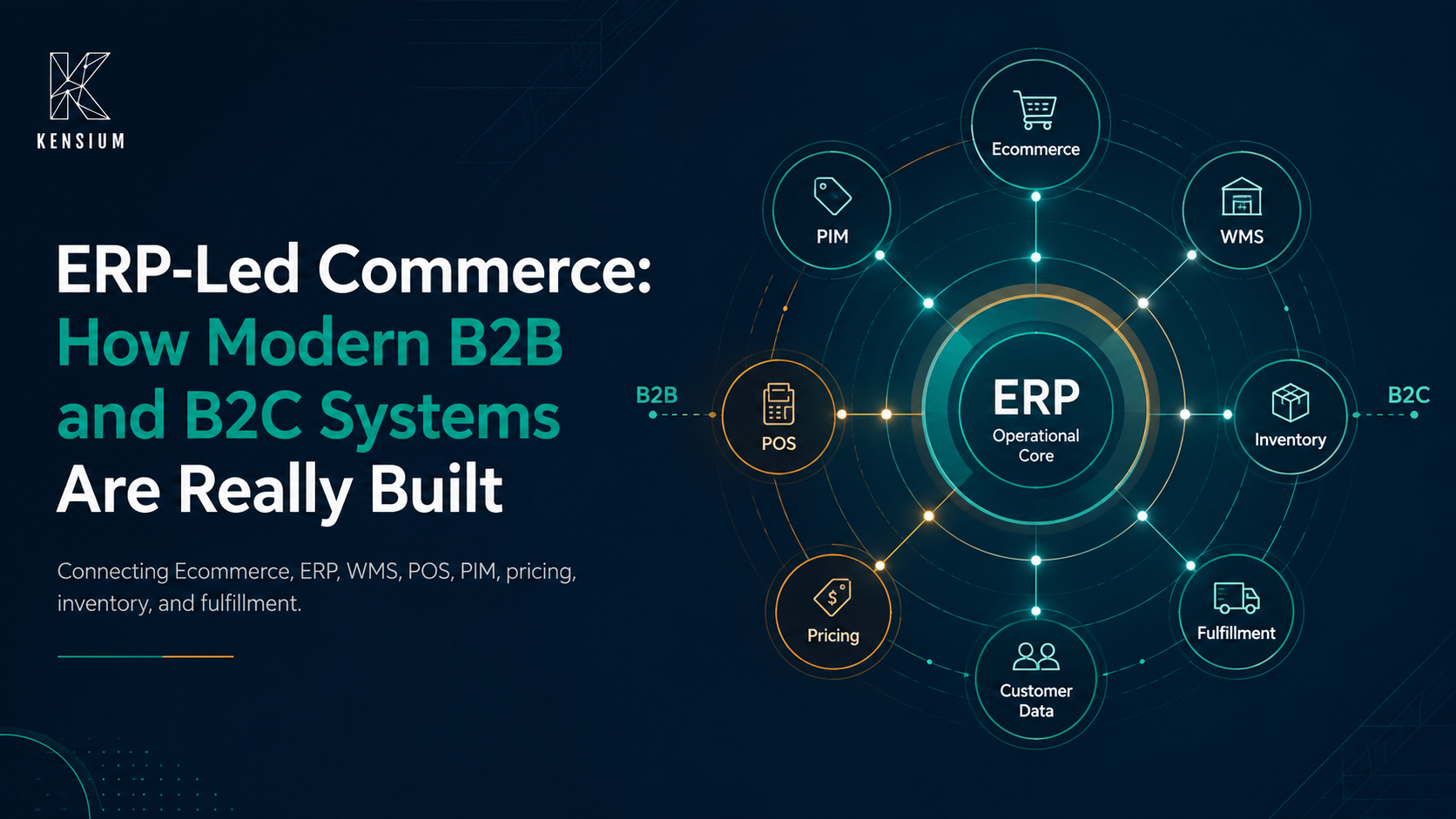
True enterprise integration must include ecommerce, ERP, WMS, POS, shipping, marketplaces, and tax automation inside one synchronized operational fabric. Anything less is only temporarily stable.
Why Integrations Degrade After Go-Live
Many failures occur not at launch, but months later. APIs change. Traffic grows. Promotions trigger load spikes. New warehouses come online. New tax rules apply. Without continuous monitoring, performance tuning, and connector maintenance, integrations slowly decay.
Testing is often insufficient. Systems that pass functional testing rarely undergo stress testing at real production volumes. Failure scenarios such as partial outages, duplicate messages, and API throttling remain unvalidated. When reality hits, the architecture is exposed.
This is why enterprise organizations increasingly treat integration as a managed system rather than a completed project. Long-term stability depends on constant oversight, not one-time deployment.
The Engineering Truth Behind Most Failures
When ERP–ecommerce integrations fail at scale, the technology itself is rarely the true cause. The actual reason is architectural under-engineering. Systems were built to connect, not to endure growth.
The successful organizations apply software engineering discipline to integration itself. They define measurable success metrics, enforce data governance, build real-time orchestration layers, integrate every operational system, and commit to long-term monitoring and optimization.
Integration success is not about which platform you choose. It is about how rigorously you engineer the system that connects them.
Real-World Proof of What Works at Scale: Shoebacca
The difference between integrations that collapse under scale and those that endure almost always comes down to architecture discipline and long-term engineering ownership. Shoebacca is a clear example of what happens when integration is treated as enterprise infrastructure rather than a short-term IT project.
Shoebacca operates one of the highest-velocity ecommerce environments in its segment, managing over one million SKUs and routinely processing more than 10,000 daily orders across direct-to-consumer, white-label partners, and multiple marketplaces. Their ecosystem includes Shopify for commerce, Acumatica as the ERP system of record, ChannelAdvisor for marketplace orchestration, and Loop Returns for post-purchase workflows. At this scale, even minor synchronization delays would immediately trigger overselling, financial mismatches, and fulfillment failures.

Rather than relying on point-to-point plugins or batch synchronization, Shoebacca’s entire commerce stack was engineered for real-time orchestration. Kensium built and customized the Shopify–Acumatica connector to handle multi-warehouse inventory logic, channel-specific pricing, and automated order flows. Real-time pipelines were established directly between Acumatica and ChannelAdvisor to power Amazon, eBay, and Walmart without manual intervention. Loop Returns was integrated at the ERP layer so refunds, exchanges, and inventory restocking remained financially and operationally synchronized.
Shoebacca’s recommerce division, BrownBox, introduced an additional architectural challenge: serialized, one-of-a-kind refurbished products that had to be treated as unique SKUs across marketplaces. Custom serialization logic and lifecycle synchronization were engineered directly into the integration layer to support this business model at scale—something that cannot be achieved with off-the-shelf connectors alone.
The outcome is a unified commerce backbone where Acumatica functions as the single source of truth, real-time inventory sync eliminated overselling across marketplaces, Shopify lowered total cost of ownership, and returns processing became fully automated. Most importantly, Shoebacca scaled daily transaction volume without introducing the operational chaos that characterizes most failed enterprise integrations.
Shoebacca’s executive team summarized it simply: Kensium didn’t just build connectors—they engineered around the business as it evolved. That is precisely the difference between integrations that fail at scale and those that become long-term growth infrastructure.
(Full case study: https://www.kensium.com/case-study/shoebacca)
Enterprise Integration Is Infrastructure, Not a Feature
ERP–ecommerce integration is no longer optional for growth-focused businesses. It is the operational backbone that determines whether scale accelerates profit or magnifies chaos.
If your organization experiences inventory inaccuracies, manual order handling, delayed fulfillment, financial mismatches, or system outages during peak demand, the integration architecture is already signaling risk. These are not software bugs. They are structural warnings.
Building a scalable, resilient integration requires enterprise-grade engineering, real-time orchestration, full-stack system connectivity, and continuous operational support. This is the difference between integration that merely works and integration that survives growth.
To see how enterprise organizations architect real-time ERP, ecommerce, WMS, POS, and shipping integrations the right way, explore Kensium’s enterprise integration framework:
https://www.kensium.com/enterprise-integrations
FAQ
Why do ERP–ecommerce integrations fail during growth but not at launch?
Because early testing rarely reflects real transaction volume, system complexity, and multi-channel concurrency. Architectural weaknesses surface only under sustained operational load.
Is real-time integration always necessary?
For modern omnichannel and B2B commerce, yes. Batch synchronization creates unavoidable latency, which leads directly to overselling, fulfillment errors, and financial mismatches.
What systems must be included in a true enterprise integration?
At a minimum: ecommerce platform, ERP, warehouse management system, point of sale, shipping automation, tax systems, and marketplaces.
Can middleware alone guarantee integration success?
No. Middleware must be deployed within a properly engineered orchestration framework that includes monitoring, queuing, retry logic, security, and load scaling.
Why do many integrations degrade after go-live?
Because APIs change, data volume increases, and business workflows evolve. Without ongoing monitoring and maintenance, integrations naturally deteriorate over time.
Sources:
5 Reasons Why ERP Implementations fail
https://www.kensium.com/blog/5-reasons-why-erp-implementations-fail
Ecommerce Integration: A Comprehensive Guide | NetSuite
https://www.netsuite.com/portal/resource/articles/ecommerce/ecommerce-integration.shtml
What is Overselling and How to Prevent It (2022) - Shopify
https://www.shopify.com/retail/overselling
ERP Integrations: Common Patterns and Methods + Best Practices
https://www.bigcommerce.com/articles/ecommerce/erp-integration/
ERP Integration: What It Is and How It Works (2025) - Shopify
https://www.shopify.com/enterprise/blog/erp-integration
Distribution Needs eCommerce ERP Integration: 5 Signs
https://www.kensium.com/blog/distribution-ecommerce-erp-integration-signs
Unified Commerce Solutions & ERP Integration | Kensium
How to create an e-commerce platform that helps a business operate more efficiently and scale faster? | Business Insider Africa
.png)