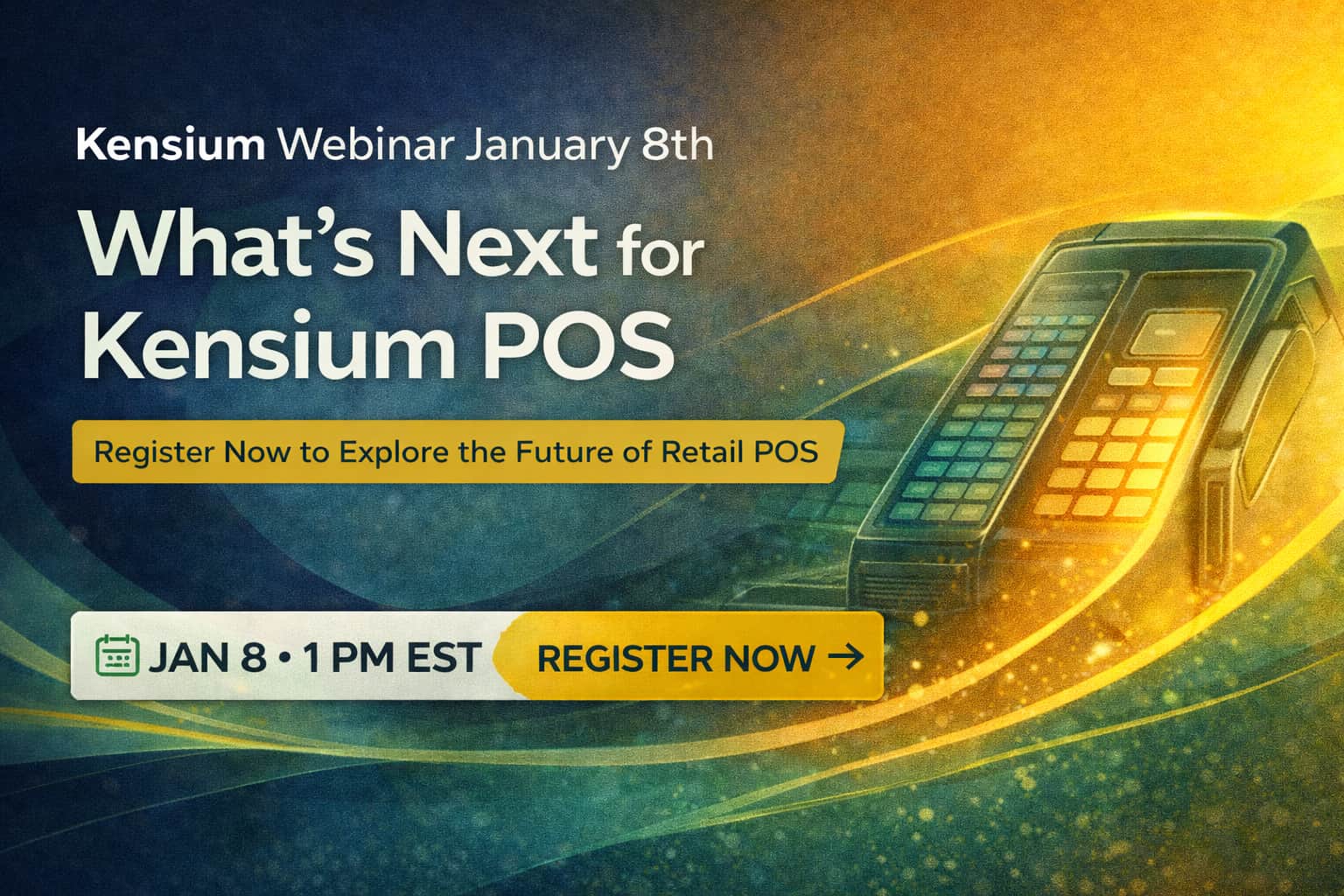
Kensium kicked off 2026 with a forward-looking webinar focused on the evolution of Kensium POS — not as a point solution, but as a long-term platform built for stability, scalability, and ERP-connected growth.
In “What’s Next for Kensium POS,” Kensium CEO Rahul Gedupudi was joined by moderator John Masi (VP, Client Experience) for a transparent walkthrough of where Kensium POS is today, why modernization is necessary, and how the platform is being re-architected to support the realities of modern retail and distribution.
Rather than a product pitch, the session was designed to help current and prospective customers understand what’s changing, why it matters, and how to plan confidently for 2026 and beyond.
Watch the Full Webinar
If you missed the live session, you can now watch the full recording and explore the roadmap at your own pace.
Don’t Miss the Next One
Stay ahead of what’s coming next in POS, ecommerce, ERP integration, and AI-driven retail technology.
Subscribe to Kensium’s newsletter to get:
- Early access to upcoming webinar invites
- Company updates and customer success stories
- Expert insights on digital commerce, POS modernization, and AI innovation
📩 Sign up to stay informed
Why POS Strategy Matters Right Now
POS systems sit at the center of retail operations — touching inventory, pricing, customer data, payments, loyalty, and fulfillment.
During the session, Rahul addressed a reality many mid-market retailers face today:
while popular POS platforms like Shopify POS, Square, and Lightspeed work well for SMBs, they often fall short for ERP-centric businesses that need deeper integration, offline resilience, and operational scale.
As businesses grow, common challenges begin to surface:
- Fragmented admin experiences
- Slow or unreliable data synchronization
- Limited offline functionality
- Non-standard ERP integrations
- Increasing deployment and maintenance complexity
These pressures were a key driver behind Kensium’s POS modernization strategy.
Why Kensium POS Is Built Differently
Kensium POS was designed specifically for mid-market manufacturers, distributors, and hybrid B2B/B2C organizations with complex operational needs.
During the webinar, the team outlined the core strengths that continue to define the platform:
- Native ERP integration (including Acumatica, Sage, and others)
- High-volume transaction handling across multiple locations
- True offline resilience to avoid downtime
- Centralized inventory, pricing, and customer data
- Support for advanced fulfillment models like BOPIS and BORIS
- Unified experience across POS, ERP, and eCommerce
This foundation allows retailers to scale without compromising reliability or control.
Inside the Modernization Effort
A major portion of the webinar focused on why Kensium is modernizing the POS architecture — and what that actually means for customers.
The team walked through challenges in the current system, including:
- A complex, multi-component architecture
- A legacy technology stack that slows innovation
- Lengthy data sync times for large datasets
- Fragmented administration tools
- Limited offline support for payments, gift cards, and tax calculations
From there, Rahul introduced the new architectural direction, designed to simplify deployment, improve performance, and create a more cohesive experience across the platform.
Key elements of the modernization include:
- A unified codebase and runtime
- Centralized administration
- Simplified deployment model
- Modern, browser-based UI
- True offline support for credit cards and taxes
- A future-ready foundation for thin-client and SaaS delivery models
A Look at the New Admin and Register Experience
Attendees also received an early look at:
- The new centralized admin experience, designed to reduce configuration friction and improve visibility
- A modernized cash register interface focused on speed, clarity, and usability
- Streamlined workflows for inventory, store management, and diagnostics
While visuals were shared during the session, the emphasis remained on operational impact — not cosmetic change.
The 2026 Roadmap: What’s Ahead
The webinar concluded with a clear view of what customers can expect in 2026, including:
- OmnifiCX integration
- Replacement of ASI with webhook-based integrations
- Expanded ERP support (including Sage X3, Infor, Epicor, Business Central, and NetSuite)
- Additional database options for SaaS flexibility
- A major communications overhaul
- Feature cleanup to improve maintainability
- Exploration of thin-client and PWA-based deployment models
The takeaway was simple: this evolution is about long-term resilience, not short-term change.
Questions from the Live Q&A
The session wrapped with a live Q&A focused on the real-world questions customers and partners are asking as they plan their POS strategy for 2026.
Rather than theory, these questions went straight to risk, differentiation, timing, and impact — and were addressed directly during the webinar.
Topics covered included:
- How Kensium POS handles offline credit card transactions — and what retailers should consider from a risk perspective
- The biggest differences between Kensium POS and mainstream platforms like Shopify or Square
- Which ERP systems are supported today and how that support expands in 2026
- When the modernized platform launches and how updates are phased
- What the migration process looks like for existing customers
- Whether the new platform requires new hardware investments
These are the questions that shape real POS decisions — and they were answered live.
Key Takeaways
- POS modernization is not optional — it’s foundational
- ERP-centric retailers need deeper integration, not bolt-ons
- Centralized admin and simplified architecture reduce risk at scale
- Offline resilience remains critical for real-world operations
- Kensium POS is being built for what comes next, not just what works today
Frequently Asked Questions
Are there any limitations on the number of locations and workstations? Will you be able to demo shared inventory and reservation functionality?
No, there are no limitations on the number of locations or workstations. We would be happy to get on a call to discuss the requirements in detail and review shared inventory and reservation scenarios.
Do POS transactions impact Acumatica’s license?
The number of registers, stores, or locations does not affect the Acumatica license count. For larger customers, additional concurrent API users may be required to prevent transaction throttling. It is important to review actual user counts, transaction volumes, and transaction types to determine the appropriate licensing needs.
We have a jewelry prospect that needs POS—can PSL perform POS demos for this use case?
Yes. PSL can perform POS demonstrations, as can the Kensium team. We are happy to assist in any way needed.
Does the solution support Spanish language and localization for Mexico and Central America?
Multilingual support is planned as a future phase. Everything currently being built is localization-ready, with a focus on core features and functionality. The platform is multilingual-capable, and additional languages will be addressed as the need arises.
We currently use the Café Menu. Will this still be available (or something similar) in the new POS system?
The current Café Menu deployment will remain unchanged in version 5.x but will evolve in a future phase of the new POS version. Support for the current version will continue through 2026 and most of 2027. Availability in the new POS version is expected in early 2027.
Is your POS multicurrency—specifically, can sales be processed in different currencies?
Yes. Both current and future POS deployments use the same configuration. A base currency is defined in POS, and customers manage the exchange rates associated with that base currency.
Does Kensium have the capability to create and confirm shipments within Acumatica for invoicing, or does this need to be done manually for each POS transaction?
The FI (carry-out invoice) transaction process automatically creates the shipment. Shipment confirmation can be scheduled using Acumatica’s native automation. FO orders that require shipping follow Acumatica’s standard process flow.
How are POS transactions stored in Acumatica ERP—are they stored individually or in batches, and how does this impact licensing?
Transactions can be stored in a one-to-one relationship, where each POS transaction becomes a transaction in Acumatica. For high-volume environments, roll-up posting can be implemented to combine up to 100 POS transactions into a single Acumatica invoice, including batch payments, to reduce transaction volume.
Can the system support an approved item list for customers (for example, restricting customers to purchasing only certain items)?
Not at this time. We would be interested in learning more about this requirement to determine an effective approach for handling it.
The Bottom Line
Kensium POS is evolving to meet the demands of modern retail — with a clear focus on stability, scalability, and intelligent integration.
For customers planning their 2026 roadmap, this session provided clarity on what’s changing, confidence in the direction, and a practical framework for preparing ahead — instead of reacting later.
If you missed the session, now’s the time to catch up.
.png)





.png)

.jpg)