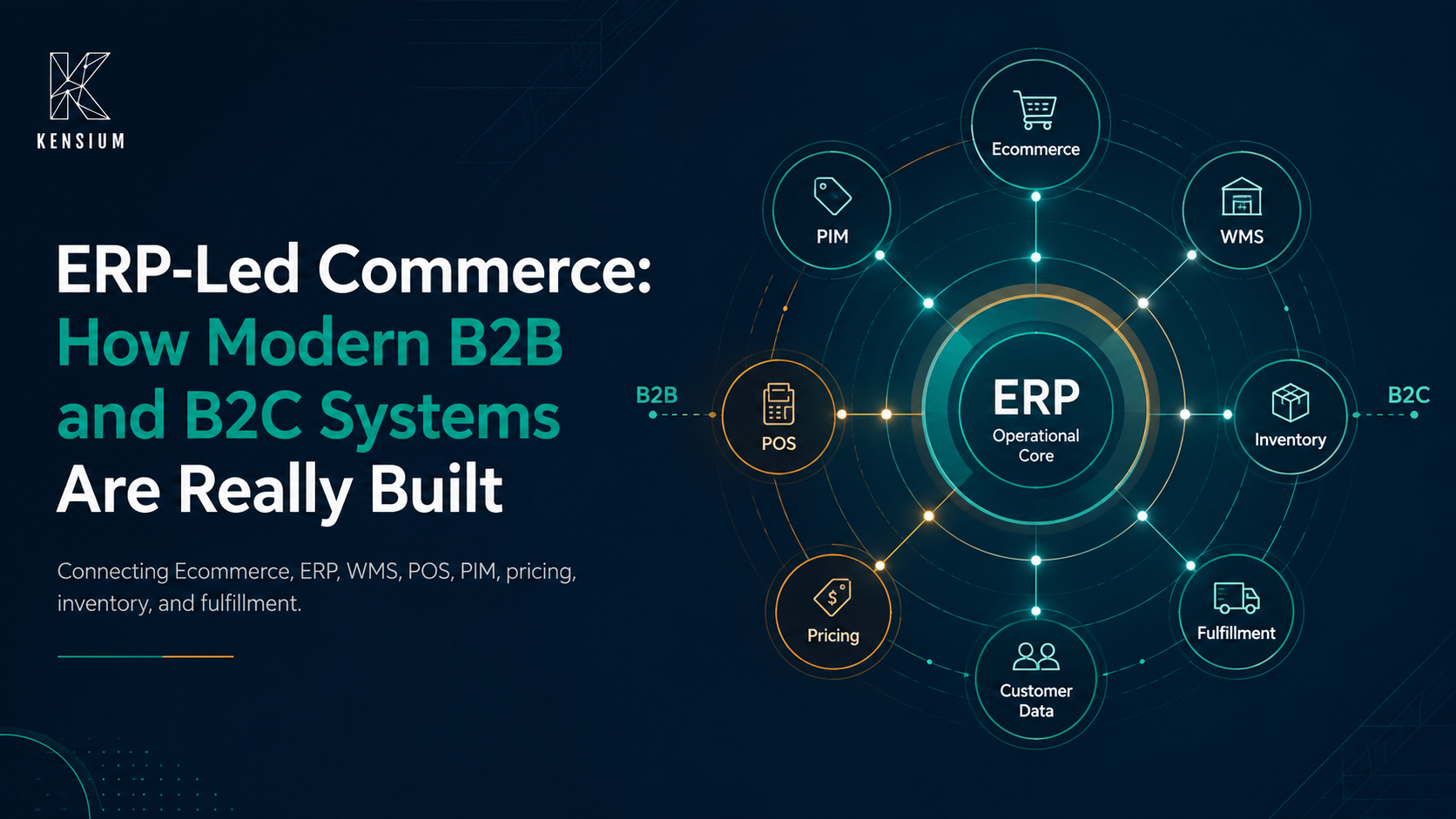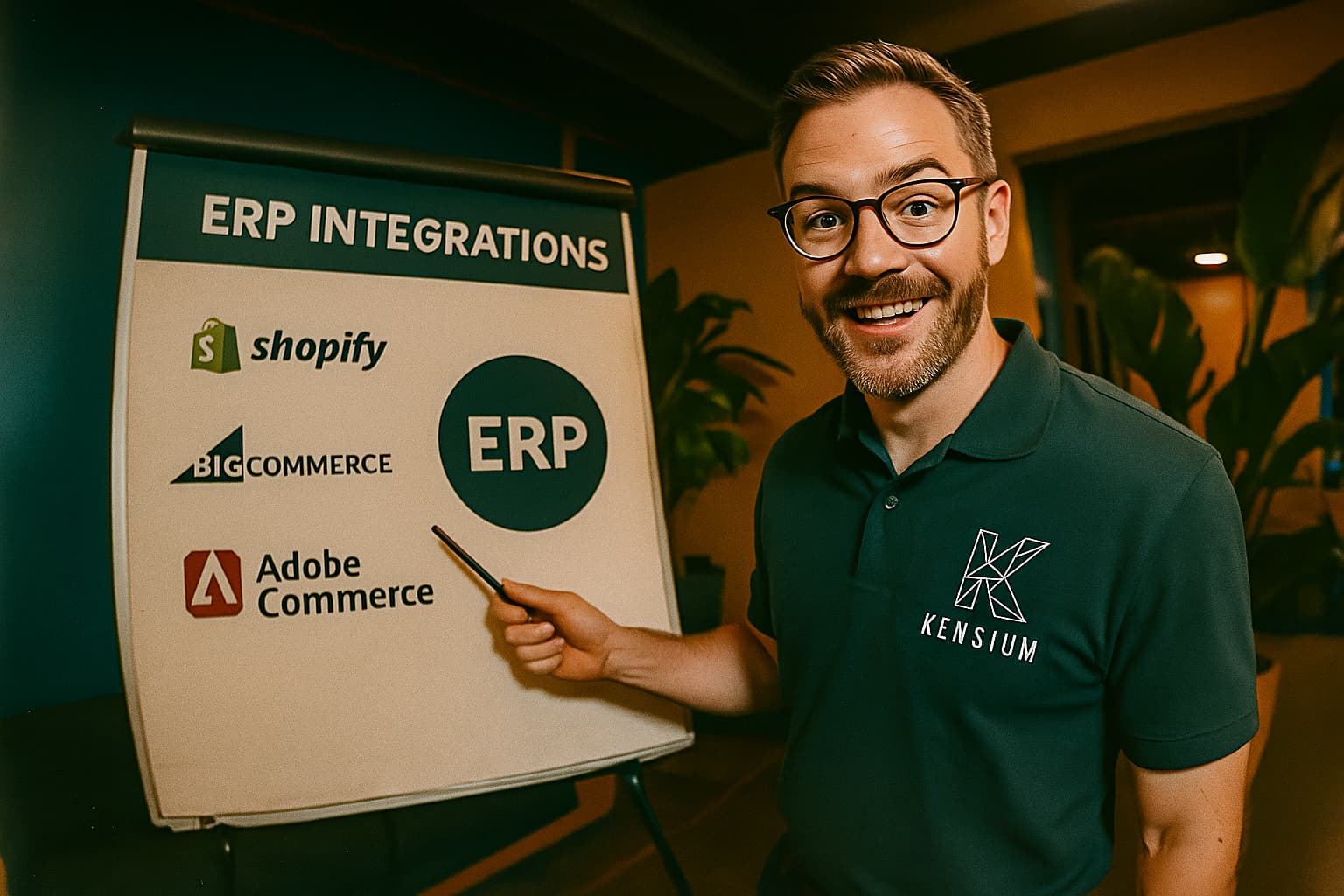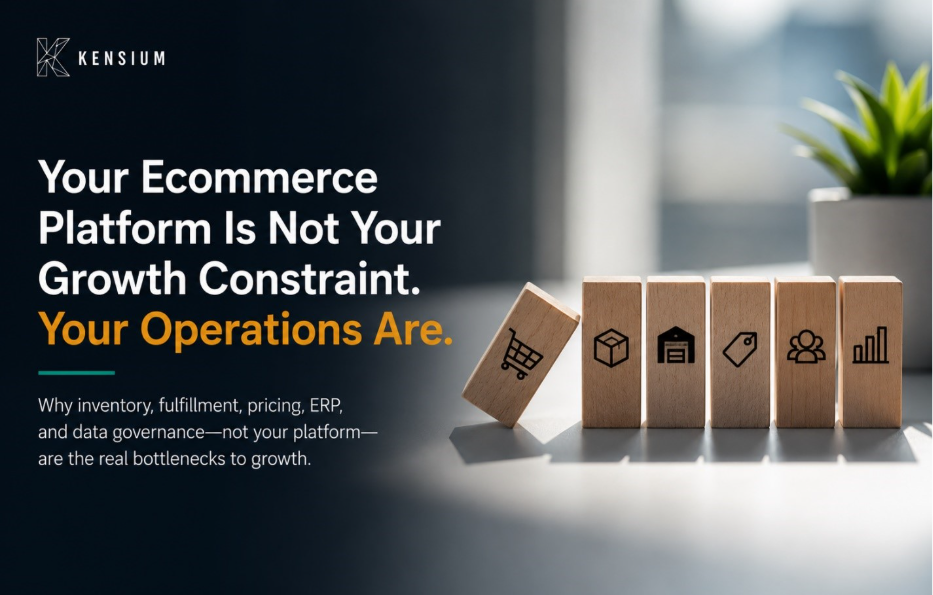
The easiest explanation for stalled ecommerce growth is usually, “our platform is holding us back.” It is also often the least accurate one. Shopify, BigCommerce, and Adobe Commerce all position their enterprise offerings around the same hard realities: ERP connectivity, inventory accuracy, order orchestration, fulfillment, pricing logic, and shared data. If those systems are misaligned, a replatform can make the website look newer without making the business run better.
The case studies tell the same story. Shopify highlights brands struggling with inventory syncing and clunky fulfillment workflows across ecommerce and POS. BigCommerce highlights brands that treat Acumatica or a legacy ERP as the system of record for pricing, inventory, and fulfillment. Adobe highlights companies that integrate ERP to remove manual steps for stock availability, special pricing, and order processing. The recurring theme is not “prettier storefront.” It is operating model.
Quick Answers: The Two Questions Behind This Article
Do I need to replatform my ecommerce site?
Usually not as the first move. Replatform only when the current stack is structurally unstable, for example separate ecommerce and POS systems creating overselling risk, legacy tools forcing paper-based workflows, or custom fulfillment logic that takes months to extend into a new market. If your platform can technically support ERP, inventory, and pricing integration but no one has built or maintained that integration, the fix is operational and architectural, not a new storefront.
Why is my ecommerce business not scaling?
In most mid-market and enterprise cases, growth stalls because of fragmented systems and undefined data ownership, not platform limitations. The recurring failure points are inventory and fulfillment accuracy, pricing and commercial logic spread across disconnected systems, and weak data governance between ecommerce, ERP, POS, and WMS. A new platform does not fix any of these on its own; it just gives the same fragmentation a newer interface.
The Contrarian Case
Replatforming is seductive because it feels decisive. A new storefront is visible. A new checkout is measurable. A new design gets everyone excited. But the enterprise materials from Shopify, BigCommerce, and Adobe keep pointing back to the same thing: commerce growth depends on how well storefronts connect to finance, inventory, procurement, fulfillment, B2B buying, POS, and customer data. That is not accidental marketing language. It is a clue about where complexity really lives.
The grounded inference is this: most mid-market and enterprise brands do not have a “platform category” problem first. They have a systems-and-workflows problem first. Shopify talks about a single real-time data model and shared order, inventory, and customer data. BigCommerce talks about open APIs, ERP, CRM, PIM, and WMS integration. Adobe talks about composable commerce, scalable operations, B2B optimization, and back-office connectivity. When all three major vendors sell operational alignment as a core value, the real battle is usually architecture, governance, and execution.
That does not mean platforms never matter. They do. Shopify’s own case study on Bared Footwear shows that a custom ecommerce site plus a separate POS stack created inventory syncing issues and clunky fulfillment workflows. BigCommerce’s ASA case study shows a legacy platform that forced paper-based workflows and manual correction. Shopify’s Mejuri example shows a custom-built fulfillment system that became a bottleneck as the business entered new markets. In other words, sometimes the platform is the bottleneck, but even then, the pain usually shows up in operations.
Shopify, BigCommerce, and Adobe Are Not the Same Problem
Shopify’s enterprise story is unified commerce. Its materials emphasize one real-time data model, shared customer, order, inventory, and fulfillment data, native POS sync, and faster store and market execution from a centralized back office. That makes Shopify especially strong when the business wants to reduce middleware sprawl, connect retail and ecommerce more tightly, and give operations teams one place to work.
BigCommerce’s enterprise story is openness with B2B depth. Its official site emphasizes open APIs, 600+ integrations, multi-storefront management, and direct connectivity to ERP, CRM, PIM, and WMS. Its B2B materials focus on account-specific pricing, quotes, approvals, hierarchies, invoices, and the ability to run B2B and B2C from one backend. That makes BigCommerce especially attractive when the business has complex buying logic, wants architectural flexibility, or needs to preserve key back-office systems rather than replace them.
Adobe’s enterprise story is composable scale plus deep back-office orchestration. Adobe Commerce emphasizes AI-driven merchandising, multi-site scalability, B2B self-service, API-first extensibility, and integration with ERP, CRM, PIM, WMS, and OMS. Adobe is usually strongest where brands need highly customized buying experiences, multi-brand or multi-region complexity, deep merchandising control, and enterprise-grade extensibility.
So yes, Shopify vs. BigCommerce vs. Adobe Commerce is a real decision. But it is not the same as asking why growth has stalled. A brand can outgrow a platform, but it can also keep a capable platform and still choke on inventory discrepancies, fulfillment delays, pricing conflicts, duplicate customer records, and disconnected store or warehouse workflows. BigCommerce’s The Crab Place case study makes this point clearly: the company did not need to replace a customized ERP that already powered inventory, fulfillment, pricing, and ordering; it needed a commerce platform flexible enough to integrate with it.
Which ERP Connects to Which Platform: A Quick Reference
Ecommerce, IT, and operations leaders evaluating a replatform or an ERP integration usually want a fast answer to one question: does our ERP work with the platform we are considering, and how mature is that connection? The honest answer is that all three platforms can connect to all five major mid-market ERPs below, but the depth, maturity, and typical implementation pattern vary.
“Native” connections are maintained or co-developed by the platform vendor or a certified partner; “middleware/iPaaS” connections route through a third-party integration layer and typically carry higher ongoing maintenance cost. Either pattern can work well, but the choice has direct implications for total cost of ownership, data latency, and who is accountable when something breaks.
Where Growth Actually Breaks
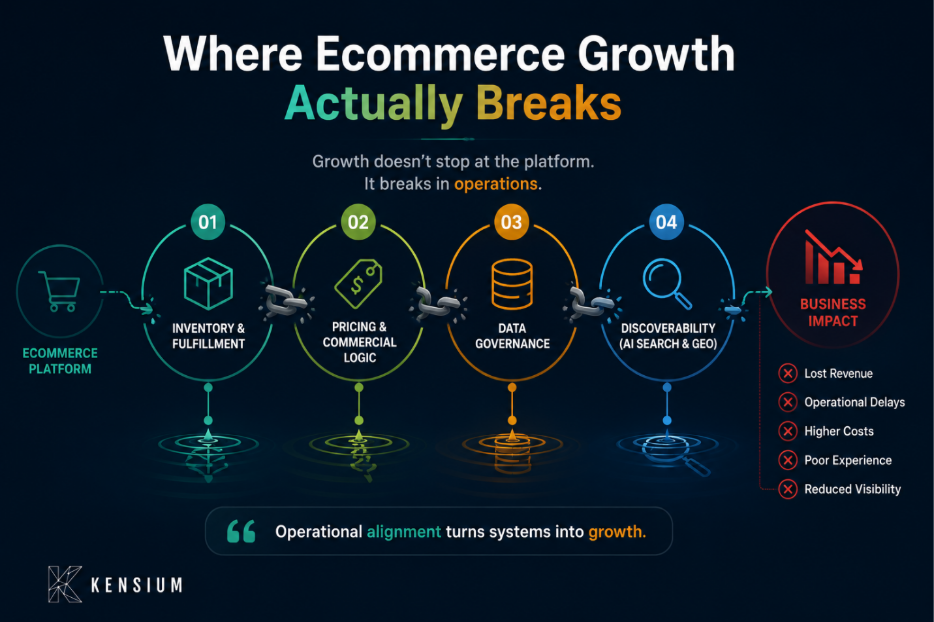
Inventory and fulfillment
Shopify’s master data guidance explicitly includes SKUs, pricing rules, customer identities, and fulfillment details. BigCommerce says a complete ERP integration should cover pricing, inventory, ordering, and financial alignment, including real-time stock across locations and fast syncing of quotes, orders, and invoices. Adobe makes the same case, arguing that ecommerce businesses juggle inventory management and accounts payable across separate systems, and that ERP integration streamlines the work.
Pricing and commercial logic
In B2B and hybrid commerce, pricing is rarely just a product-page field. It is contract pricing, account-based pricing, channel pricing, quote pricing, payment terms, approvals, and tax or fulfillment exceptions. BigCommerce is explicit that B2B brands need customer-specific pricing and contract-based discounts, and Adobe’s REDARC case study reports productivity gains from eliminating manual steps for stock availability and special pricing. If your price list lives in one system, your sales terms in another, and your storefront shows a third version of the truth, the website is not the problem. Governance is.
Data governance
Shopify’s enterprise materials on data integration challenges focus on silos, ERP complexity, risk, cost, and delays. On Reddit, operators describe the same pain in plain language: mismatched records across Shopify, Stripe, QuickBooks, and Excel; overselling across channels; wholesale orders that live in email and invoices instead of flowing cleanly into fulfillment. Those are not edge cases. They are what operational fragmentation looks like in the wild.
WMS and POS connectivity
Warehouse management and point-of-sale systems are often the weakest link precisely because they sit outside the ecommerce-ERP conversation until something breaks. A WMS that does not share real-time pick, pack, and ship status back to the storefront produces phantom inventory and overselling. A POS that is not synced to the same order and customer record as the website produces duplicate customer profiles, inconsistent loyalty balances, and reconciliation work for finance. Shopify's native POS sync and BigCommerce's and Adobe's WMS connector ecosystems both exist because this gap is common, not rare. The integration pattern matters less than whether one system is designated the source of truth for stock and order status, with every other system reading from it rather than maintaining its own parallel copy.
Broader business commentary points in the same direction. Inc argues that large retailers are prioritizing e-commerce acceleration, faster and more flexible fulfillment, AI-enabled productivity, and disciplined supply chains, and that operational weakness erodes trust. Another Inc piece notes that when brands expand into new channels, fulfillment, storage, carrier capability, and packaging complexity quickly become limiting factors. Forbes has likewise framed fulfillment as being at the epicenter of ecommerce enablement and has noted that Prime-era delivery expectations can become a logistical bottleneck in their own right.
There is also a newer consequence: discoverability. BigCommerce now tells merchants to enrich titles, descriptions, and metadata so the brand shows up in search and chat, and Adobe says Adobe Commerce includes built-in capabilities to optimize product discovery on LLMs. That means GEO and AI search visibility are no longer just content problems. They are product-data problems. If your catalog, pricing, and availability are unreliable across systems, your generative search performance will be unreliable too.
What the Vendor Case Studies Actually Show
Shopify’s operational case studies are revealing. Bared Footwear did not simply want a nicer website; it needed to stop inventory syncing issues between ecommerce and POS and eliminate the painful workarounds that forced stores to isolate inventory during promotions. Pilgrim used Shopify to centralize pick, pack, shipping labels, and fulfillment views in one place. Element Brooklyn used smart order routing and centralized inventory to deliver more than 94% of orders in one business day, reduce split shipments, and lower shipping cost per order. Mejuri’s story is similar: a custom fulfillment setup became a bottleneck, and Shopify’s native order management covered most routing needs without months of manual engineering for each market.
BigCommerce’s best evidence points to the same operational center of gravity. Discount Pool Supply treated Acumatica as the real-time system of record for inventory, pricing, and fulfillment across storefronts and in-store operations. NuvoH2O nearly doubled online business and doubled revenue in four years, while reducing software costs by 60% and maintaining headcount even as transaction volume doubled, thanks to automation across inventory, fulfillment, and finance. ASA replaced paper-based ordering, manual correction, and stamp-and-envelope distributor workflows. The Crab Place modernized checkout and loyalty without replacing the customized ERP that already ran inventory, fulfillment, pricing, and order management.
Adobe’s customer stories are just as operational. REDARC set explicit goals to consolidate ecommerce platforms and integrate with ERP for efficient order processing; the result was a 100% conversion lift, a 29% increase in new trade accounts, and higher productivity from eliminating manual steps for stock availability and special pricing. ASUS used Adobe Commerce not only for B2B and B2C on one site, but to integrate centralized CRM, order management, and reseller and distributor ERP systems. COURTS Asia moved product inventory, price data, customer information, and store data from Microsoft Dynamics NAV into Adobe Commerce to support click-and-collect and synchronized service across channels. Paul Smith simplified fulfillment by flowing inventory through Adobe Commerce and pushing orders to ERP for central dispatch.
This is why platform migration stories can mislead decision-makers. They are branded as platform wins, but the value creation mechanism is often operational orchestration. The most persuasive “testimonial” in the BigCommerce set is not about design at all. Discount Pool Supply’s owner says inventory, pricing, and orders are synced in real time across every channel. That is the sentence a COO cares about, because it points to margin protection, labor efficiency, and service reliability, not just frontend polish.
How Kensium Approaches the Same Problem
If the vendor evidence above proves anything, it is that the platform decision and the operating-model decision are separate questions, and most growth problems live in the second one. That is the engagement Kensium is built around: not “which platform should you pick,” but “what is actually broken in how your systems talk to each other, and what is the smallest architecture that fixes it permanently.”
Proof points across ERP-commerce integration
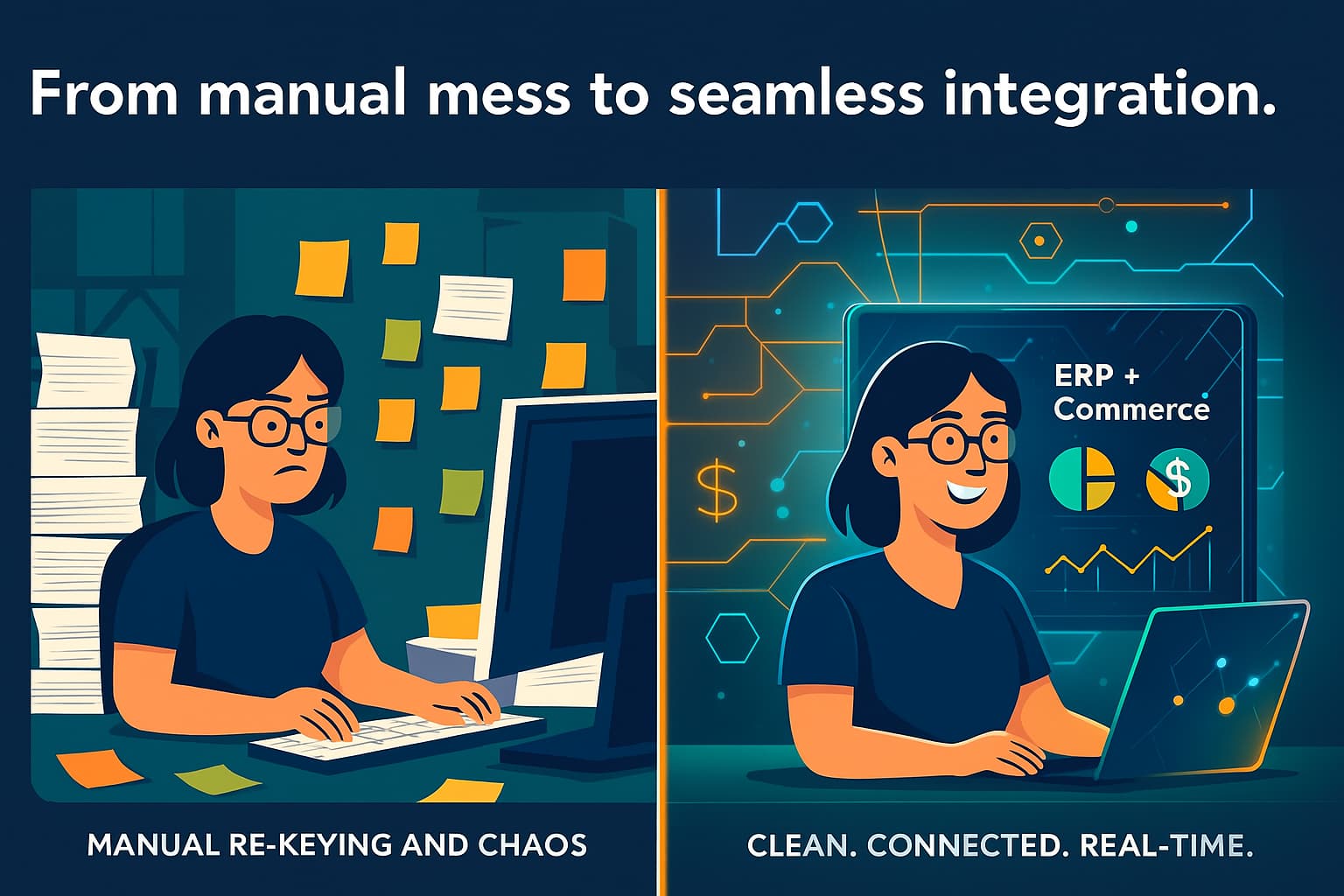
MNI Direct needed CounterPoint ERP to sync customer data, pricing, quotes, order history, and account information into its B2B storefront; Kensium’s integration reduced manual handling and improved data accuracy across the sales workflow. Big Country Pet Co. eliminated overselling through real-time inventory tracking and reduced inbound inquiry volume with better bulk-order workflows. Dekra-Lite paired Shopify with Acumatica to eliminate manual re-entry, automate order sync, and gain real-time inventory visibility, posting 66% revenue growth alongside 67% fewer order errors.
Kensium’s client feedback reinforces the same operational frame rather than a design-led one. Clients describe outcomes in terms of more accurate reporting, more reliable data, smoother workflows, and the flexibility to scale and resolve problems faster – not faster page loads or a redesigned checkout. Kensium’s own Acumatica integration practice is explicit that the goal is an integration architecture that holds up in production under real order volume, not one that only works in a demo.
Why this matters for platform-agnostic advice
Because Kensium implements across Shopify, BigCommerce, Adobe Commerce, and multiple ERPs rather than being tied to a single platform's reseller program, the starting question in a client engagement is diagnostic rather than promotional: which system should own product, pricing, inventory, and order truth, and where is that ownership currently undefined or duplicated. The platform recommendation, when one is needed, follows from that diagnosis instead of preceding it.
Before You Approve a Migration: A Readiness Checklist
Leadership should force a more operational question set before signing off on any replatform budget:
- Which system owns product data, pricing rules, customer records, order status, and inventory availability?
- How do ecommerce, ERP, POS, WMS, OMS, and 3PL workflows exchange state changes today, and how often does that sync fail or lag?
- What happens operationally to returns, partial shipments, B2B quotes, and approvals when systems disagree?
- Which pain points are true platform limitations, and which are symptoms of fragmented data or undefined system ownership?
- What is the fully loaded cost of staying fragmented – middleware fees, manual re-entry labor, reconciliation hours, and error-driven returns – compared to the cost of fixing the integration architecture?
The official materials from Shopify, BigCommerce, and Adobe all point back to these same questions; the answers determine whether a migration is the right fix or an expensive distraction from the actual constraint.
Count the Hidden Tax of Staying Fragmented
Shopify warns that connector fees, patch fixes, and brittle integrations can consume large budgets, while Kensium describes an invisible tax of stale data, late orders, canceled sales, wasted payroll, and stalled growth that accumulates the longer fragmentation persists. Reddit operators describe the human version of that tax as spending half their time updating stock by hand or trying to reconcile mismatched systems. If the business case for migration does not quantify those costs, it is incomplete.
Ready to Identify the Real Constraints Holding Back Growth?
Whether you are evaluating Shopify, BigCommerce, Adobe Commerce, or your current technology stack, the most important question is not which platform to choose. It is whether your operations, data, inventory, pricing, and fulfillment processes are positioned to support growth.
If you are experiencing inventory discrepancies, fulfillment bottlenecks, pricing complexity, disconnected systems, or reporting challenges, Kensium can help you uncover the root cause and build a roadmap for scalable commerce operations.
FAQs
Which platform is best for growth: Shopify, BigCommerce, or Adobe Commerce?
The best platform depends on the operating model, not the loudest migration narrative. Shopify is strongest when unified commerce, retail, POS, and a shared data model matter most. BigCommerce is strongest when open APIs, B2B buying logic, and multi-storefront flexibility matter most. Adobe is strongest when the business needs composable enterprise control, deep merchandising power, and extensive back-office orchestration.
When does replatforming actually make sense?
Replatform when the current stack is truly unstable or structurally fragmented, for example when separate ecommerce and POS systems create overselling risk, when legacy tools force paper-based workflows, or when custom fulfillment logic takes months to extend into new markets. Bared Footwear, ASA, and Mejuri are all examples of that threshold.
Can a company fix growth bottlenecks without replacing the platform?
Yes. The Crab Place kept its long-established ERP and integrated around it rather than replacing it. Paul Smith simplified omnichannel fulfillment by routing inventory and orders through Adobe Commerce and ERP. MNI Direct improved accuracy by aligning its storefront with CounterPoint ERP and its consultative sales workflow.
What is the biggest hidden cost in ecommerce growth?
Usually it is operational fragmentation: middleware fees, patch fixes, manual re-entry, reconciliation labor, stock errors, and delayed decisions. Shopify explicitly calls out hidden middleware costs, Kensium describes an invisible tax from stale data and late orders, and operator discussions on Reddit show how quickly manual inventory and cross-system mismatches eat time and margin.
How do I connect ecommerce, ERP, WMS, and POS without breaking existing workflows?
Start by designating one system as the source of truth for inventory and order status, then have every other system read from it rather than keep its own parallel copy. Native connectors (built or certified by the platform vendor) are generally lower-maintenance than custom middleware, but the more important decision is ownership and sync frequency, not which connector technology is used.
Who can help optimize ecommerce operations across ERP, inventory, and fulfillment?
Look for a partner that works across multiple platforms and ERPs rather than one tied to a single vendor's reseller program, with documented production outcomes (not just go-live announcements). Kensium's work with MNI Direct, Big Country Pet Co., and Dekra-Lite covers CounterPoint, real-time inventory governance, and Acumatica integration respectively, each resulting in measurable accuracy or revenue gains rather than a redesign alone.
Why does this article matter for AI search and GEO?
Because generative discovery is increasingly fed by catalog quality, metadata, and consistent product truth. BigCommerce explicitly tells merchants to optimize titles, descriptions, and metadata for search and chat, and Adobe says Adobe Commerce includes capabilities to optimize product discovery on LLMs. Clean operations now support clean discoverability.
Sources
ERP System Guide: When to Use ERP, Shopify, or Both (2026) - Shopify
https://www.shopify.com/enterprise/blog/erp-system
Bared Footwear streamlines its operations and customer experience after switching to Shopify POS - Shopify Singapore
https://www.shopify.com/sg/case-studies/bared-footwear
Unified Commerce Software Guide 2025: ROI, Platforms, TCO - Shopify
https://www.shopify.com/enterprise/blog/unified-commerce-software
Commerce built for momentum. | BigCommerce
Adobe Commerce (Magento): B2B & B2C Enterprise Solutions | Adobe
https://business.adobe.com/products/commerce.html
The Crab Place Case Study
https://www.bigcommerce.com/case-study/the-crab-place/
Master Data Management: Building a Single Source of Truth for Ecommerce (2026) - Shopify
https://www.shopify.com/enterprise/blog/master-data-management-single-source-of-truth
ERP Integrations for BigCommerce Explained for B2B Brands
https://www.bigcommerce.com/blog/b2b-erp-integrations/
Data Integration Challenges (And How Enterprise Brands Solve Them in 2026) - Shopify
https://www.shopify.com/enterprise/blog/data-integration-challenges
The New Rules of Big-Box Retail
https://www.inc.com/jd-hayes/the-new-rules-of-big-box-retail/91304186
Discount Pool Supply Case Study
https://www.bigcommerce.com/case-study/discount-pool-supply/
REDARC scales global B2B and B2C ecommerce with Adobe
https://business.adobe.com/customer-success-stories/redarc-case-study.html
MNI Direct B2B eCommerce Case Study | Kensium Solutions
https://www.kensium.com/case-study/mni-direct
Client Testimonials: Success Stories & Feedback – Kensium
https://www.kensium.com/client-testimonials
.png)