Left-pointing white chevron arrow on a transparent background.
Back to article listing
Articles

ERP-Led Commerce: How Modern B2B and B2C Systems Are Really Built

July 2, 2026
By-
Ricky Bhavnani
How Modern B2B and B2C Systems Are Really Built

Executive summary

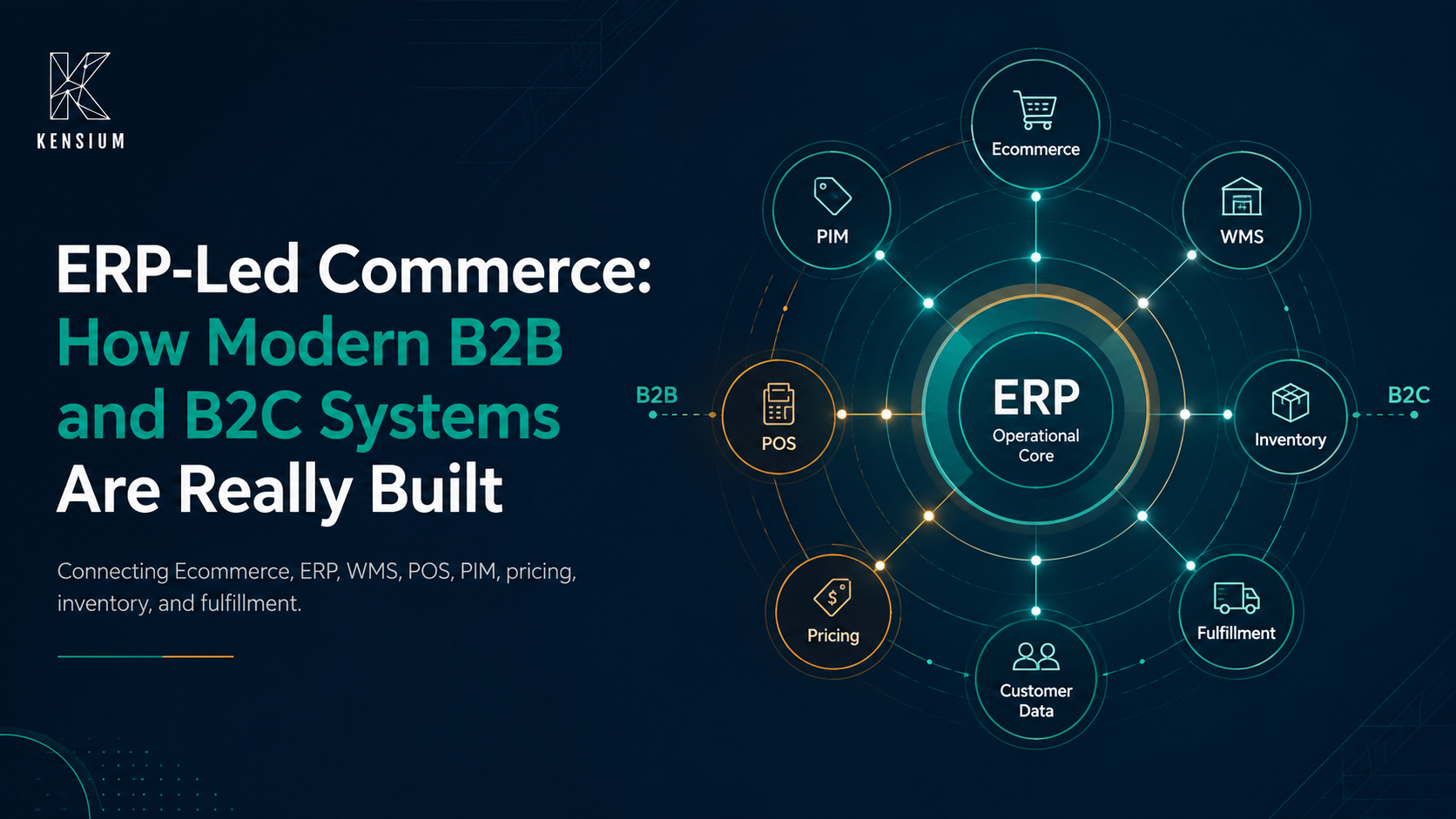
ERP-led commerce is not the idea that ERP should become the storefront. It is the operating model in which ecommerce owns the buyer experience,while ERP and adjacent systems own the business truth that makes those experiences trust worthy: pricing, inventory, customer terms,order status, taxes, fulfillment, and financial posting. Modern commerce is moving beyond the storefront. Shopify, BigCommerce, andAdobe Commerce all support deeper B2B capabilities such as company accounts, customer-specific catalogs, quotes, payment terms, and role-based buying flows. But those features only create value when they are connected to the systems that run the business: ERP, WMS,POS, pricing, inventory, fulfillment, and financial data. [1]

For buyer-side decision-makers, the core practical insight is simple:when growth stalls, the storefront is often blamed first, but the deeper constraint is usually misaligned system ownership. If pricing logic lives partly in ecommerce, partly in ERP, and partly in spreadsheets; if WMS, ERP, and storefront disagree on availability;or if B2B approvals and customer-specific terms are handled manually,then the real issue is architecture, not theme design. Across our work with Shopify Plus, Acumatica, BigCommerce, and Adobe Commerce,the pattern is consistent: the strongest commerce systems are not built around the storefront alone. They are built around the operational systems that keep pricing, inventory, fulfillment,customer data, and financial records accurate. [2]

The strongest commerce architectures are built around clear system ownership. The storefront should drive the customer experience. ERP should own operational truth. WMS should manage warehouse execution.PIM should enrich product data when catalog complexity demands it.And orchestration should govern how data, exceptions, and timing move across the stack. That is the architecture most likely to reduce cost-to-serve, improve buyer trust, and create content structures that AI search engines can actually cite and understand. [3]

Quick Answers: The Two Questions Behind This Article

1. What is ERP-led commerce?

ERP-led commerce is a model where Ecommerce owns the buyer experience, while ERP and adjacent systems own the operational truth behind that experience.

The storefront handles discovery, merchandising, self-service, cart, and checkout. ERP, WMS, POS, PIM, pricing, inventory, and fulfillment systems keep the business logic accurate behind the scenes.

2.Why does this matter?

Because when commerce grows, the biggest problems are usually not just website problems.

Pricing errors, inventory gaps, fulfillment delays, manual approvals,disconnected order data, and reconciliation issues all show up in the customer experience. But they usually start inside the operating model.

ERP-led commerce gives each system a clear role so the business can scale with better accuracy, fewer manual fixes, and stronger control.

The Core Commerce Model

This article is written for mid-market B2B and blended B2B/B2C leaders who need to connect Ecommerce with the systems that actually run the business.

The principles apply across modern commerce environments, including Shopify, BigCommerce, Adobe Commerce, Acumatica, NetSuite, Sage,Microsoft Dynamics 365, WMS, POS, PIM, marketplaces, and other operational systems. [4]

ERP-led commerce. A commerce architecture in which ERP and adjacent operational systems define the business rules that must remain accurate across channels,while ecommerce presents those rules in a buyer-friendly experience.[5]

System of record.The platform that owns authoritative operational data such as customers, inventory, orders, invoices, taxes, and financial posting.In practice, this is usually ERP, sometimes with WMS owning execution-level warehouse events and POS owning store-level retail events. [6]

System of experience.The storefront, portal, or headless front end where buyers search,configure, quote, reorder, and check out. Shopify B2B, BigCommerce B2B Edition, and Adobe Commerce B2B all support buyer-facing constructs, but none remove the need to define where business truth lives. [7]

Orchestration layer.The governed layer that maps fields, sequences events, handles failures, and keeps systems aligned. This is what prevents growing commerce stacks from turning into fragile point-to-point integrations. [8]

Operational cost-to-serve.The internal cost of selling and fulfilling an order after manual re-entry, pricing overrides, warehouse exceptions, support tickets,reconciliation, and correction work are counted. [9]

How ERP-Led Commerce Works in Practice

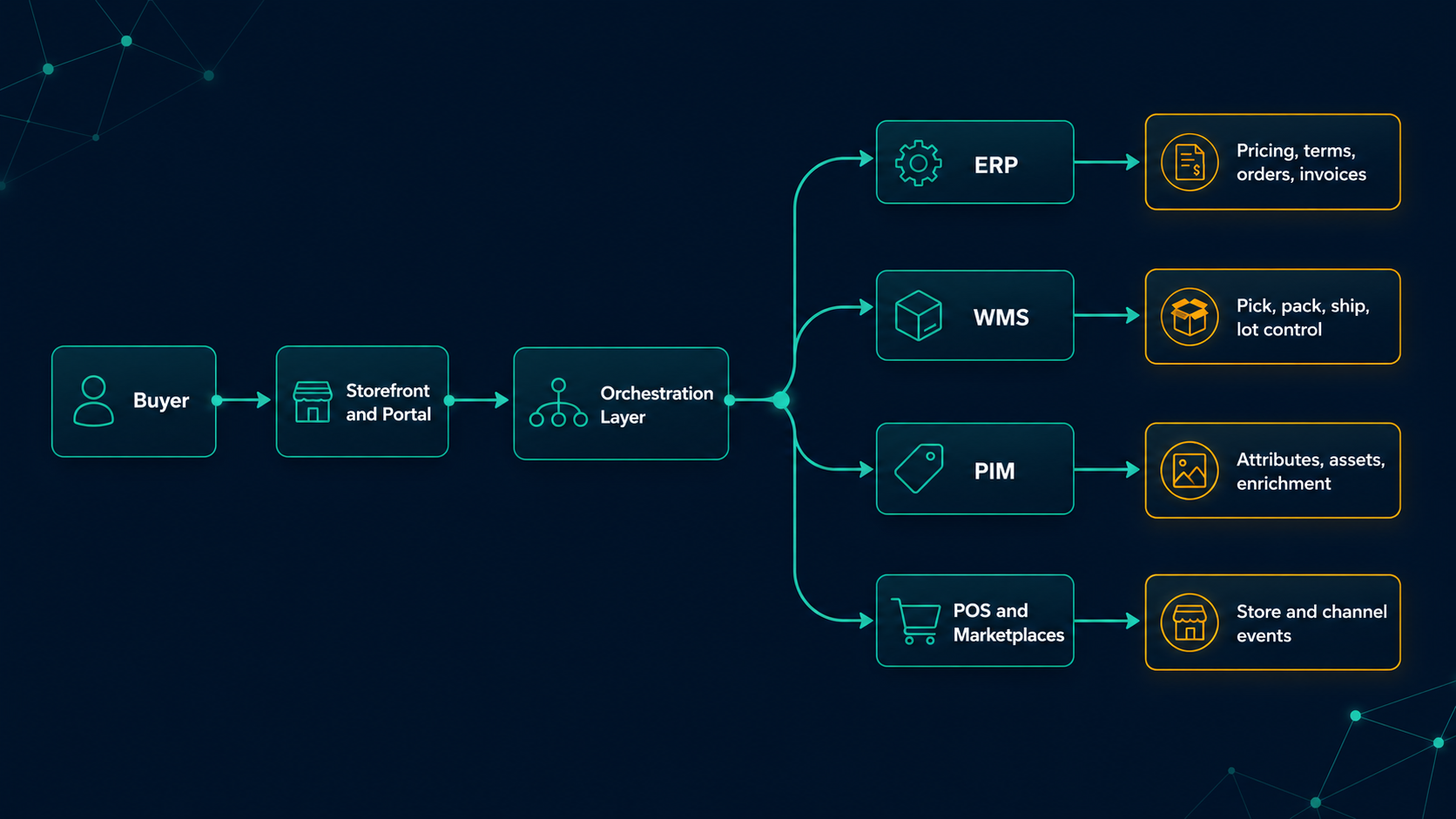
In an ERP-led commerce stack, the storefront is where the buyer engages,but the business logic comes from the systems behind it.

Shopify, BigCommerce, Adobe Commerce, or a headless front end may handle discovery, merchandising, cart, checkout, account experience, and self-service.

ERP provides the operational truth: customer terms, item data, pricing rules,available inventory, order status, invoice status, and financial controls.

WMS manages warehouse execution, including receiving, lot control, picking, packing, shipping, and shipment updates.

PIM enriches product content when the catalog becomes too complex for the ERP item master alone.

Orchestration keeps everything aligned by managing data flow, sequencing,transformations, failures, and exceptions across the stack. [10]
The most important design rule is ownership clarity. If a rule affects financial posting, credit, tax, inventory valuation, or contractual pricing, ERP should usually own it. If it affects pick logic, lot assignment, or warehouse movement, WMS should own it. If it affects discovery, merchandising, content, or checkout UX, ecommerce should own it. If it spans systems, orchestration should own the workflow.[11]
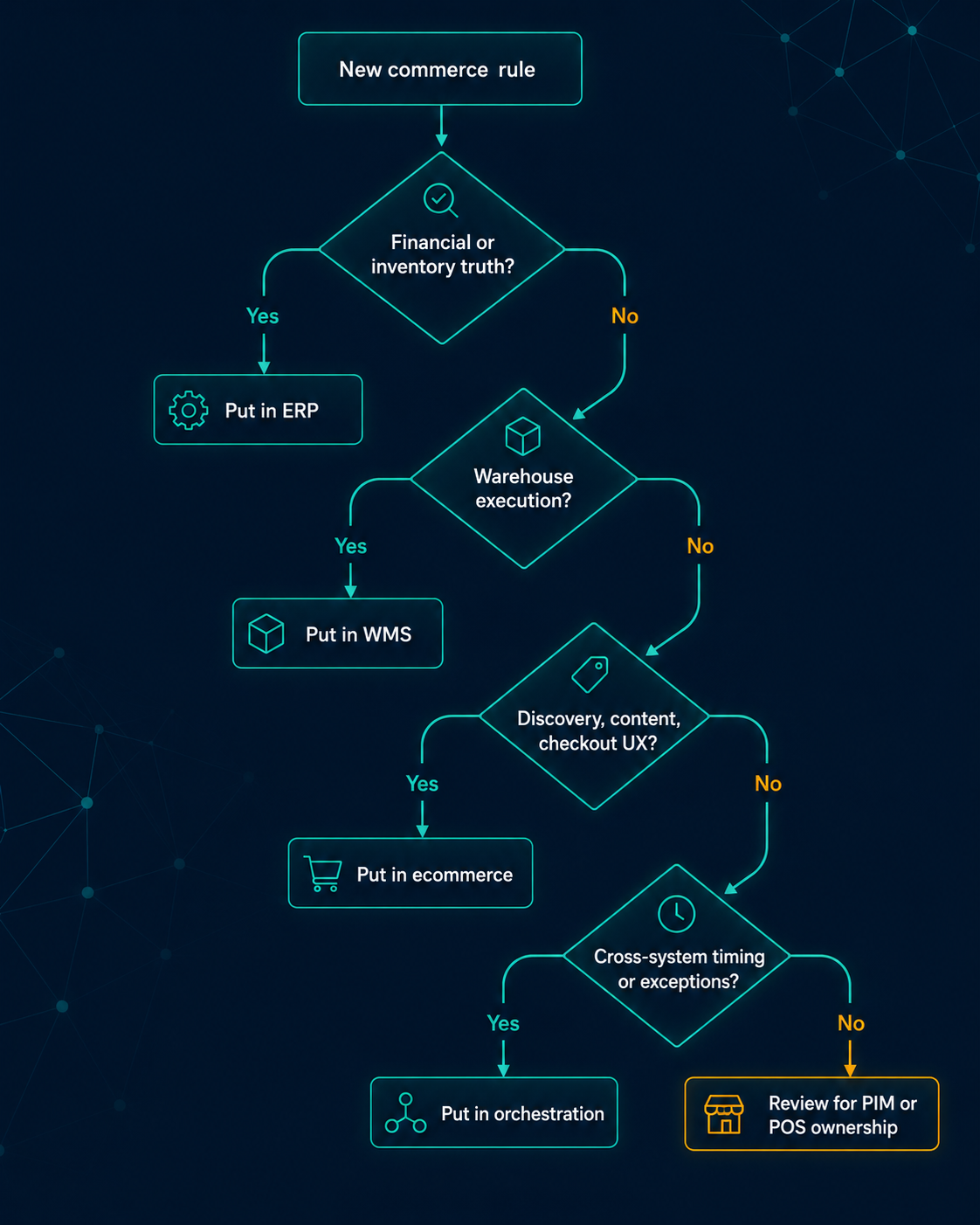
A practical buying algorithm follows from that decision tree. First,map the order journey from browse to fulfill to invoice. Second, mark the authoritative owner for each object: customer, price,availability, order, shipment, invoice, return. Third, remove duplicated logic. Fourth, add orchestration where timing and exceptions cross system boundaries. Fifth, only then decide whether the storefront platform is the main bottleneck. [12]
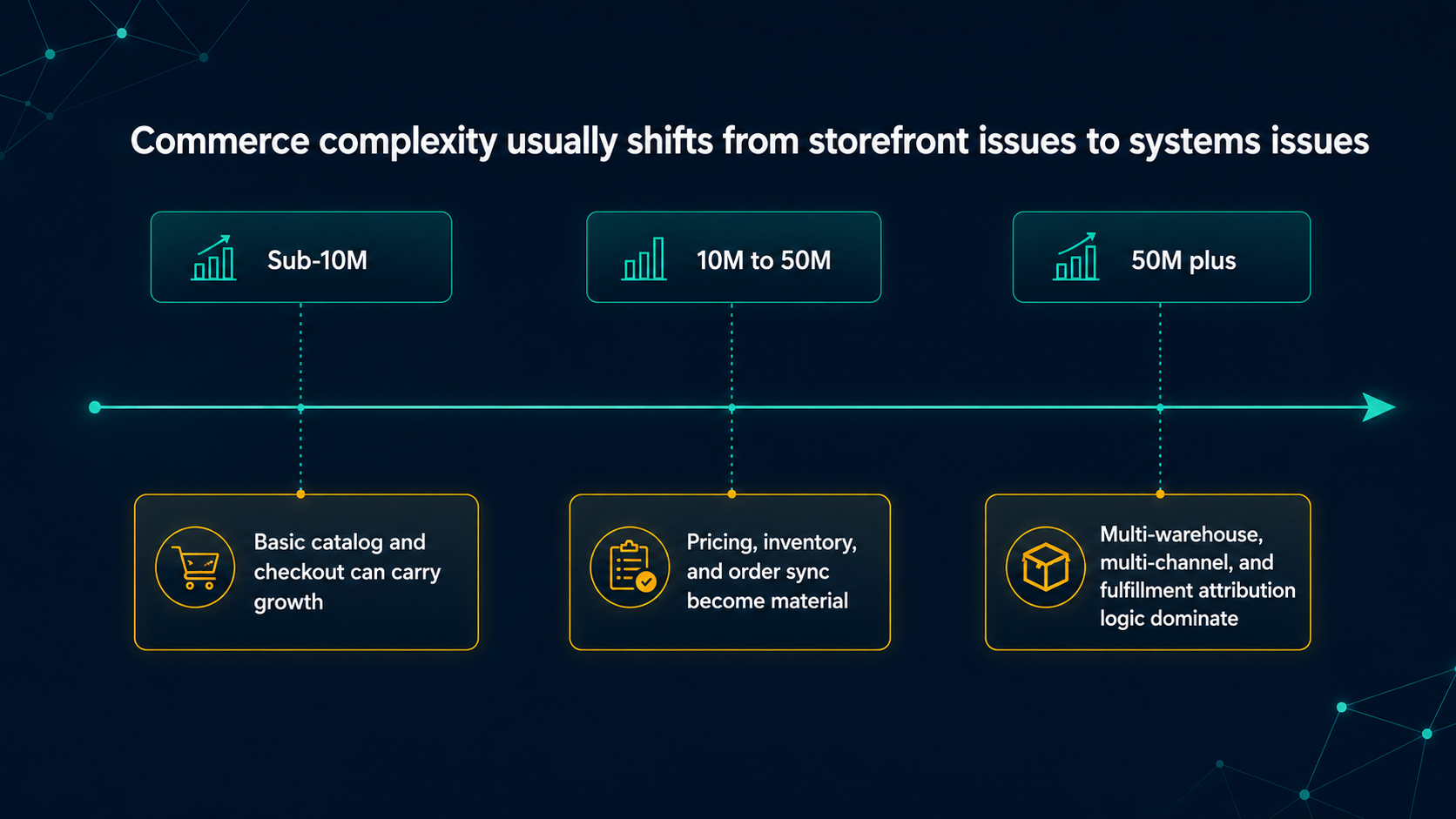
The tradeoff is real. ERP-led commerce improves accuracy, governance, and scale readiness, but it also exposes bad master data, requires cleaner ownership, and often forces process cleanup before launch.That is why the right sales message is not “just integrate ERP,”but “design around operational truth.” [9]

ERP-Led Commerce Readiness Checklist

Use this checklist to identify whether your commerce challenges are really storefront issues, systems issues, or operating model issues.

A business may be ready for ERP-led commerce if:

  • Pricing rules live in more than one place
  • Inventory availability is not consistent across Ecommerce, ERP, WMS, POS, or marketplaces
  • B2B customer terms, quotes, approvals, or payment rules require manual work
  • Orders need to be re-entered, corrected, or reconciled after they are placed
  • Warehouse teams rely on workarounds to pick, pack, ship, allocate, or confirm orders
  • Product data is hard to manage across Ecommerce, ERP, sales teams, marketplaces, and catalogs
  • The business cannot clearly define which system owns pricing, inventory, customer data, orders, fulfillment, invoices, or returns
  • Ecommerce teams depend on spreadsheets to manage operational rules
  • Support teams spend time explaining order, inventory, or fulfillment issues that should have been prevented upstream
  • Leadership cannot trust reporting because data is delayed, duplicated, or inconsistent across systems

If several of these are true, the next step is usually not another app or another redesign.

It is a commerce architecture review.

The goal is to define system ownership, remove duplicated logic, and connect the storefront to the operational systems that control pricing, inventory, fulfillment, warehouse execution, customer data,and financial truth.

Platform Fit in an ERP-Led Commerce Model

The matrix below compares how Shopify, BigCommerce, and Adobe Commerce typically fit into ERP-led commerce environments.

There is no one-size-fits-all answer. The right platform depends on how the business sells, how complex its pricing and catalog are, how tightly Ecommerce needs to connect with ERP, WMS, POS, and fulfillment systems, and how much operational control the team needs behind the storefront. [13]

Platform Where it fits best What to watch ERP-led takeaway
Shopify Strong fit for fast-moving B2C and blended B2B/B2C businesses that need speed, usability, ecosystem depth, and a modern buying experience. Shopify Plus can also support more advanced B2B needs such as company accounts, catalogs, payment terms, and customer-specific buying experiences. Advanced B2B, contract pricing, fulfillment logic, and complex inventory rules still need clear ERP ownership. Shopify should not become the place where operational truth is recreated manually. Best when the storefront moves fast, while ERP, WMS, POS, and orchestration keep the business logic accurate behind the scenes.
BigCommerce Strong fit for B2B and blended commerce models that need SaaS flexibility, buyer portals, account-based buying, quote workflows, custom pricing, multi-user roles, and multi-storefront support. Complex catalogs, ERP integrations, custom product rules, and warehouse workflows may still require deeper integration planning. Best when the business needs B2B flexibility without turning the commerce platform into the entire operating system.
Adobe Commerce Strong fit for businesses with highly customized commerce requirements, complex B2B workflows, shared catalogs, negotiable quotes, purchase orders, API-driven experiences, and headless or custom front-end needs. Adobe can require more governance, development discipline, upgrade planning, and long-term maintenance than lighter SaaS models. Best when the business needs deep customization and has the operational maturity to support it.


Across our work, the same pattern shows up in different platform environments. Shopify Plus can work well when speed, usability, and ERP connectivity matter. BigCommerce can support strong B2B and multi-storefront use cases when the integration model is planned correctly. Adobe Commerce can be the right fit for highly customized,complex commerce environments that need stronger governance and technical control.

The platform matters, but it is not the whole architecture. In an ERP-led commerce model, the platform should support the buying experience while ERP, WMS, POS, PIM, and orchestration keep the business logic accurate across the stack.[23]

The Pattern Across Real Commerce Projects

Across real commerce projects, the same pattern shows up: growth depends on more than the storefront.

Whether the platform is Shopify, BigCommerce, or Adobe Commerce, the strongest results come when Ecommerce is connected to the systems that control pricing, inventory, fulfillment, warehouse execution,customer data, and financial truth.[24]

Kensium case Technical problem solved Why it matters for ERP-led commerce
3DXTECH Replatformed to Shopify Plus, connected to Acumatica, supported both B2B and B2C journeys, improved site speed by 54 percent, and reduced order-processing effort. [25] Shows that a modern storefront can move quickly when ERP remains the operational anchor.
Dekra-Lite Extended Shopify Connector between Acumatica and Shopify to sync product availability, pricing, and key website data, improving inventory accuracy and customer satisfaction. Kensium later summarized public results as 66 percent revenue growth, 40 percent higher average order value, and 67 percent fewer errors. [26] Strong evidence that pricing and inventory truth belong behind the storefront, not inside manual workarounds.
MNI Direct Built an Adobe Commerce B2B portal designed around a consultative sales workflow, with CounterPoint ERP integration for customer data, pricing, order history, and quotes. [27] Shows why B2B ecommerce is often an ERP-and-workflow problem before it is a checkout problem.
Half Price Banners Used BigCommerce to improve navigation, product discovery, PDP usability, speed, and engagement, improving active users and engaged sessions. [28] Useful reminder that ERP-led does not mean UX-led by ERP. Experience still matters, especially when the operational layer is stable.
Door County Candle Shopify and Acumatica helped support a mission-driven commerce model with significant revenue growth. [29] Connected operations helped the business scale demand, manage order complexity, and reduce the need for manual reconciliation behind the scenes.

The larger pattern is clear: successful commerce programs are not just website projects or ERP projects. They are operating model projects with revenue consequences.

The storefront may be where buyers experience the brand, but the systems behind it determine whether the business can price accurately,fulfill reliably, reduce manual work, and scale profitably.[30]

FAQ and next step

What is ERP-led commerce in one sentence?

It is a commerce architecture where ecommerce owns the buyer experience,while ERP and adjacent operational systems own the truth for pricing, inventory, orders, and fulfillment. [31]

Is ERP-led commerce only for B2B?

No.It matters most in B2B, wholesale, manufacturing, distribution, and complex omnichannel retail, but the same pattern applies to B2C brands once pricing, fulfillment, warehouse logic, or channel complexity starts to scale. [32]

Does ERP-led commerce mean ERP should own the website?

No.The storefront should still own discovery, merchandising, content,and checkout experience. ERP should own the business facts that the site cannot afford to get wrong. [33]

When does a business need orchestration instead of simple integrations?

A business needs orchestration when multiple systems depend on each other for accurate pricing, inventory, orders, fulfillment, customer data, and financial records.

Simple integrations move data. Orchestration governs how that data moves,when it moves, what happens when something fails, and which system owns the truth. [8]

How should buyers think about PIM?

A business needs a PIM when the catalog outgrows the ERP item master.

The real threshold is not just SKU count. It is variant complexity,product attributes, digital assets, channel-specific content,marketplace syndication, and the need to make product data clear for buyers, search engines, and AI systems. [34]

Which platform is best for ERP-led commerce?

There is no universal winner. Shopify, BigCommerce, and Adobe can all work.The right answer depends on whether your business needs speed and blended commerce, SaaS B2B ergonomics, or deeper customization. The platform should fit the operating model, not replace it. [35]

Three ways to start:

If your business is outgrowing disconnected systems, manual pricing, inventory issues, or fragile integrations, the next step is not always a new platform.

Start by looking at the operating model behind the storefront.

  1. Schedule a Commerce & Operations Assessment - Review where your pricing, inventory, fulfillment, customer data, warehouse execution, and financial data actually live, and where ownership is unclear.
  2. Build an ERP-Led Commerce Readiness Checklist - Use the checklist above as a working document for your next leadership or technology review. The goal is to identify duplicated rules, manual workarounds, disconnected systems, and unclear ownership before they become larger growth constraints.
  3. Talk to Kensium about your ERP and commerce platform combination - Kensium works across Shopify, BigCommerce, Adobe Commerce, Acumatica, NetSuite, Sage, Microsoft Dynamics 365, WMS, POS, PIM, fulfillment, and other operational systems.

Ready to evaluate your commerce architecture?

Contact Kensium’s commerce team:

https://www.kensium.com/contact-us

[1][3][4][5][6][10][11][30][31][33] Unified Commerce Solutions & ERP Integration | Kensium

https://www.kensium.com/

[2] Shopify, Adobe Commerce & BigCommerce: ERP Integration Guide

https://www.kensium.com/blog/shopify-adobe-commerce-bigcommerce-erp-integration-guide

[7][14][23][32][35] Shopify B2B

https://help.shopify.com/en/manual/b2b

[8] Integration Isn't Enough Anymore: Why Modern Commerce ...

https://www.kensium.com/blog/integration-vs-orchestration-commerce

[9] The Cost of Doing Nothing: Why Manual Processes Hurt ...

https://www.kensium.com/blog/manual-processes-costs-for-online-business

[12] ERP Implementation: The 9-Step Guide

https://www.forbes.com/advisor/business/erp-implementation/

[13] What Companies Should Know About The Rise Of Self ...

https://www.forbes.com/councils/forbestechcouncil/2023/07/07/what-companies-should-know-about-the-rise-of-self-service-b2b-sales/

[15] Shopify Plus plan

https://help.shopify.com/en/manual/intro-to-shopify/pricing-plans/plans-features/shopify-plus-plan

[16][25] 3DXTech Shopify Integration Case Study – Kensium

https://www.kensium.com/case-study/3dxtech

[17] B2B ecommerce built for how business buyers actually buy

https://www.bigcommerce.com/solutions/b2b-ecommerce-platform/

[18] B2B Edition User Guide | Upgrading to the Buyer Portal ...

https://support.bigcommerce.com/s/article/Buyer-Portal-Migration

[19][28] Case Study: Half Price Banners BigCommerce Redesign

https://www.kensium.com/case-study/half-price-banners

[20] Introduction to Adobe Commerce B2B | Adobe Commerce

https://experienceleague.adobe.com/en/docs/commerce-admin/b2b/introduction

[21] Looking for honest feedback — debating sticking with Adobe CommerceCloud vs switching to Shopify or Magento Open Source : r/Magento

https://www.reddit.com/r/Magento/comments/1onvdh9/looking_for_honest_feedback_debating_sticking/

[22][27] MNI Direct B2B eCommerce Case Study | Kensium Solutions

https://www.kensium.com/case-study/mni-direct

[24] Kensium Case Studies: Success Stories for E-Commerce and ERPIntegration

https://www.kensium.com/case-study

[26] Dekra Lite Shopify & ERP Integration Case Study – Kensium

https://www.kensium.com/case-study/dekra-lite

[29] Door County Candle’s Shopify & Acumatica ERP Integration CaseStudy – Kensium

https://www.kensium.com/case-study/door-county-candle

[34] AI Search Engine Optimization Services | Kensium

https://www.kensium.com/ai-search-optimization

Share this on
Black Facebook social media logo icon on transparent background.Twitter bird logo in light blue on a transparent background.LinkedIn social media platform icon in blue and white.
Written by
Ricky Bhavnani
Ricky Bhavnani is the Marketing Manager at Kensium, overseeing internal marketing initiatives to highlight successful projects, client successes, and company achievements. With a focus on content strategy and brand storytelling, he ensures Kensium’s innovations and expertise are showcased to the right audiences. Passionate about engaging content and digital marketing, Ricky continuously explores new ways to drive visibility and engagement.
Left-pointing chevron arrow icon.
Back to Blogs

ERP-Led Commerce: How Modern B2B and B2C Systems Are Really Built

Ecommerce
Reading Time:
3
min
Published on:
July 2, 2026
Updated on:
July 2, 2026
How Modern B2B and B2C Systems Are Really Built
Our Editorial Team
Ricky Bhavnani
Manager & Internal Marketing

Executive summary

ERP-led commerce is not the idea that ERP should become the storefront. It is the operating model in which ecommerce owns the buyer experience,while ERP and adjacent systems own the business truth that makes those experiences trust worthy: pricing, inventory, customer terms,order status, taxes, fulfillment, and financial posting. Modern commerce is moving beyond the storefront. Shopify, BigCommerce, andAdobe Commerce all support deeper B2B capabilities such as company accounts, customer-specific catalogs, quotes, payment terms, and role-based buying flows. But those features only create value when they are connected to the systems that run the business: ERP, WMS,POS, pricing, inventory, fulfillment, and financial data. [1]

For buyer-side decision-makers, the core practical insight is simple:when growth stalls, the storefront is often blamed first, but the deeper constraint is usually misaligned system ownership. If pricing logic lives partly in ecommerce, partly in ERP, and partly in spreadsheets; if WMS, ERP, and storefront disagree on availability;or if B2B approvals and customer-specific terms are handled manually,then the real issue is architecture, not theme design. Across our work with Shopify Plus, Acumatica, BigCommerce, and Adobe Commerce,the pattern is consistent: the strongest commerce systems are not built around the storefront alone. They are built around the operational systems that keep pricing, inventory, fulfillment,customer data, and financial records accurate. [2]

The strongest commerce architectures are built around clear system ownership. The storefront should drive the customer experience. ERP should own operational truth. WMS should manage warehouse execution.PIM should enrich product data when catalog complexity demands it.And orchestration should govern how data, exceptions, and timing move across the stack. That is the architecture most likely to reduce cost-to-serve, improve buyer trust, and create content structures that AI search engines can actually cite and understand. [3]

Quick Answers: The Two Questions Behind This Article

1. What is ERP-led commerce?

ERP-led commerce is a model where Ecommerce owns the buyer experience, while ERP and adjacent systems own the operational truth behind that experience.

The storefront handles discovery, merchandising, self-service, cart, and checkout. ERP, WMS, POS, PIM, pricing, inventory, and fulfillment systems keep the business logic accurate behind the scenes.

2.Why does this matter?

Because when commerce grows, the biggest problems are usually not just website problems.

Pricing errors, inventory gaps, fulfillment delays, manual approvals,disconnected order data, and reconciliation issues all show up in the customer experience. But they usually start inside the operating model.

ERP-led commerce gives each system a clear role so the business can scale with better accuracy, fewer manual fixes, and stronger control.

The Core Commerce Model

This article is written for mid-market B2B and blended B2B/B2C leaders who need to connect Ecommerce with the systems that actually run the business.

The principles apply across modern commerce environments, including Shopify, BigCommerce, Adobe Commerce, Acumatica, NetSuite, Sage,Microsoft Dynamics 365, WMS, POS, PIM, marketplaces, and other operational systems. [4]

ERP-led commerce. A commerce architecture in which ERP and adjacent operational systems define the business rules that must remain accurate across channels,while ecommerce presents those rules in a buyer-friendly experience.[5]

System of record.The platform that owns authoritative operational data such as customers, inventory, orders, invoices, taxes, and financial posting.In practice, this is usually ERP, sometimes with WMS owning execution-level warehouse events and POS owning store-level retail events. [6]

System of experience.The storefront, portal, or headless front end where buyers search,configure, quote, reorder, and check out. Shopify B2B, BigCommerce B2B Edition, and Adobe Commerce B2B all support buyer-facing constructs, but none remove the need to define where business truth lives. [7]

Orchestration layer.The governed layer that maps fields, sequences events, handles failures, and keeps systems aligned. This is what prevents growing commerce stacks from turning into fragile point-to-point integrations. [8]

Operational cost-to-serve.The internal cost of selling and fulfilling an order after manual re-entry, pricing overrides, warehouse exceptions, support tickets,reconciliation, and correction work are counted. [9]

How ERP-Led Commerce Works in Practice

In an ERP-led commerce stack, the storefront is where the buyer engages,but the business logic comes from the systems behind it.

Shopify, BigCommerce, Adobe Commerce, or a headless front end may handle discovery, merchandising, cart, checkout, account experience, and self-service.

ERP provides the operational truth: customer terms, item data, pricing rules,available inventory, order status, invoice status, and financial controls.

WMS manages warehouse execution, including receiving, lot control, picking, packing, shipping, and shipment updates.

PIM enriches product content when the catalog becomes too complex for the ERP item master alone.

Orchestration keeps everything aligned by managing data flow, sequencing,transformations, failures, and exceptions across the stack. [10]

The most important design rule is ownership clarity. If a rule affects financial posting, credit, tax, inventory valuation, or contractual pricing, ERP should usually own it. If it affects pick logic, lot assignment, or warehouse movement, WMS should own it. If it affects discovery, merchandising, content, or checkout UX, ecommerce should own it. If it spans systems, orchestration should own the workflow.[11]

A practical buying algorithm follows from that decision tree. First,map the order journey from browse to fulfill to invoice. Second, mark the authoritative owner for each object: customer, price,availability, order, shipment, invoice, return. Third, remove duplicated logic. Fourth, add orchestration where timing and exceptions cross system boundaries. Fifth, only then decide whether the storefront platform is the main bottleneck. [12]

The tradeoff is real. ERP-led commerce improves accuracy, governance, and scale readiness, but it also exposes bad master data, requires cleaner ownership, and often forces process cleanup before launch.That is why the right sales message is not “just integrate ERP,”but “design around operational truth.” [9]

ERP-Led Commerce Readiness Checklist

Use this checklist to identify whether your commerce challenges are really storefront issues, systems issues, or operating model issues.

A business may be ready for ERP-led commerce if:

  • Pricing rules live in more than one place
  • Inventory availability is not consistent across Ecommerce, ERP, WMS, POS, or marketplaces
  • B2B customer terms, quotes, approvals, or payment rules require manual work
  • Orders need to be re-entered, corrected, or reconciled after they are placed
  • Warehouse teams rely on workarounds to pick, pack, ship, allocate, or confirm orders
  • Product data is hard to manage across Ecommerce, ERP, sales teams, marketplaces, and catalogs
  • The business cannot clearly define which system owns pricing, inventory, customer data, orders, fulfillment, invoices, or returns
  • Ecommerce teams depend on spreadsheets to manage operational rules
  • Support teams spend time explaining order, inventory, or fulfillment issues that should have been prevented upstream
  • Leadership cannot trust reporting because data is delayed, duplicated, or inconsistent across systems

If several of these are true, the next step is usually not another app or another redesign.

It is a commerce architecture review.

The goal is to define system ownership, remove duplicated logic, and connect the storefront to the operational systems that control pricing, inventory, fulfillment, warehouse execution, customer data,and financial truth.

Platform Fit in an ERP-Led Commerce Model

The matrix below compares how Shopify, BigCommerce, and Adobe Commerce typically fit into ERP-led commerce environments.

There is no one-size-fits-all answer. The right platform depends on how the business sells, how complex its pricing and catalog are, how tightly Ecommerce needs to connect with ERP, WMS, POS, and fulfillment systems, and how much operational control the team needs behind the storefront. [13]

Platform Where it fits best What to watch ERP-led takeaway
Shopify Strong fit for fast-moving B2C and blended B2B/B2C businesses that need speed, usability, ecosystem depth, and a modern buying experience. Shopify Plus can also support more advanced B2B needs such as company accounts, catalogs, payment terms, and customer-specific buying experiences. Advanced B2B, contract pricing, fulfillment logic, and complex inventory rules still need clear ERP ownership. Shopify should not become the place where operational truth is recreated manually. Best when the storefront moves fast, while ERP, WMS, POS, and orchestration keep the business logic accurate behind the scenes.
BigCommerce Strong fit for B2B and blended commerce models that need SaaS flexibility, buyer portals, account-based buying, quote workflows, custom pricing, multi-user roles, and multi-storefront support. Complex catalogs, ERP integrations, custom product rules, and warehouse workflows may still require deeper integration planning. Best when the business needs B2B flexibility without turning the commerce platform into the entire operating system.
Adobe Commerce Strong fit for businesses with highly customized commerce requirements, complex B2B workflows, shared catalogs, negotiable quotes, purchase orders, API-driven experiences, and headless or custom front-end needs. Adobe can require more governance, development discipline, upgrade planning, and long-term maintenance than lighter SaaS models. Best when the business needs deep customization and has the operational maturity to support it.


Across our work, the same pattern shows up in different platform environments. Shopify Plus can work well when speed, usability, and ERP connectivity matter. BigCommerce can support strong B2B and multi-storefront use cases when the integration model is planned correctly. Adobe Commerce can be the right fit for highly customized,complex commerce environments that need stronger governance and technical control.

The platform matters, but it is not the whole architecture. In an ERP-led commerce model, the platform should support the buying experience while ERP, WMS, POS, PIM, and orchestration keep the business logic accurate across the stack.[23]

The Pattern Across Real Commerce Projects

Across real commerce projects, the same pattern shows up: growth depends on more than the storefront.

Whether the platform is Shopify, BigCommerce, or Adobe Commerce, the strongest results come when Ecommerce is connected to the systems that control pricing, inventory, fulfillment, warehouse execution,customer data, and financial truth.[24]

Kensium case Technical problem solved Why it matters for ERP-led commerce
3DXTECH Replatformed to Shopify Plus, connected to Acumatica, supported both B2B and B2C journeys, improved site speed by 54 percent, and reduced order-processing effort. [25] Shows that a modern storefront can move quickly when ERP remains the operational anchor.
Dekra-Lite Extended Shopify Connector between Acumatica and Shopify to sync product availability, pricing, and key website data, improving inventory accuracy and customer satisfaction. Kensium later summarized public results as 66 percent revenue growth, 40 percent higher average order value, and 67 percent fewer errors. [26] Strong evidence that pricing and inventory truth belong behind the storefront, not inside manual workarounds.
MNI Direct Built an Adobe Commerce B2B portal designed around a consultative sales workflow, with CounterPoint ERP integration for customer data, pricing, order history, and quotes. [27] Shows why B2B ecommerce is often an ERP-and-workflow problem before it is a checkout problem.
Half Price Banners Used BigCommerce to improve navigation, product discovery, PDP usability, speed, and engagement, improving active users and engaged sessions. [28] Useful reminder that ERP-led does not mean UX-led by ERP. Experience still matters, especially when the operational layer is stable.
Door County Candle Shopify and Acumatica helped support a mission-driven commerce model with significant revenue growth. [29] Connected operations helped the business scale demand, manage order complexity, and reduce the need for manual reconciliation behind the scenes.

The larger pattern is clear: successful commerce programs are not just website projects or ERP projects. They are operating model projects with revenue consequences.

The storefront may be where buyers experience the brand, but the systems behind it determine whether the business can price accurately,fulfill reliably, reduce manual work, and scale profitably.[30]

FAQ and next step

What is ERP-led commerce in one sentence?

It is a commerce architecture where ecommerce owns the buyer experience,while ERP and adjacent operational systems own the truth for pricing, inventory, orders, and fulfillment. [31]

Is ERP-led commerce only for B2B?

No.It matters most in B2B, wholesale, manufacturing, distribution, and complex omnichannel retail, but the same pattern applies to B2C brands once pricing, fulfillment, warehouse logic, or channel complexity starts to scale. [32]

Does ERP-led commerce mean ERP should own the website?

No.The storefront should still own discovery, merchandising, content,and checkout experience. ERP should own the business facts that the site cannot afford to get wrong. [33]

When does a business need orchestration instead of simple integrations?

A business needs orchestration when multiple systems depend on each other for accurate pricing, inventory, orders, fulfillment, customer data, and financial records.

Simple integrations move data. Orchestration governs how that data moves,when it moves, what happens when something fails, and which system owns the truth. [8]

How should buyers think about PIM?

A business needs a PIM when the catalog outgrows the ERP item master.

The real threshold is not just SKU count. It is variant complexity,product attributes, digital assets, channel-specific content,marketplace syndication, and the need to make product data clear for buyers, search engines, and AI systems. [34]

Which platform is best for ERP-led commerce?

There is no universal winner. Shopify, BigCommerce, and Adobe can all work.The right answer depends on whether your business needs speed and blended commerce, SaaS B2B ergonomics, or deeper customization. The platform should fit the operating model, not replace it. [35]

Three ways to start:

If your business is outgrowing disconnected systems, manual pricing, inventory issues, or fragile integrations, the next step is not always a new platform.

Start by looking at the operating model behind the storefront.

  1. Schedule a Commerce & Operations Assessment - Review where your pricing, inventory, fulfillment, customer data, warehouse execution, and financial data actually live, and where ownership is unclear.
  2. Build an ERP-Led Commerce Readiness Checklist - Use the checklist above as a working document for your next leadership or technology review. The goal is to identify duplicated rules, manual workarounds, disconnected systems, and unclear ownership before they become larger growth constraints.
  3. Talk to Kensium about your ERP and commerce platform combination - Kensium works across Shopify, BigCommerce, Adobe Commerce, Acumatica, NetSuite, Sage, Microsoft Dynamics 365, WMS, POS, PIM, fulfillment, and other operational systems.

Ready to evaluate your commerce architecture?

Contact Kensium’s commerce team:

https://www.kensium.com/contact-us

[1][3][4][5][6][10][11][30][31][33] Unified Commerce Solutions & ERP Integration | Kensium

https://www.kensium.com/

[2] Shopify, Adobe Commerce & BigCommerce: ERP Integration Guide

https://www.kensium.com/blog/shopify-adobe-commerce-bigcommerce-erp-integration-guide

[7][14][23][32][35] Shopify B2B

https://help.shopify.com/en/manual/b2b

[8] Integration Isn't Enough Anymore: Why Modern Commerce ...

https://www.kensium.com/blog/integration-vs-orchestration-commerce

[9] The Cost of Doing Nothing: Why Manual Processes Hurt ...

https://www.kensium.com/blog/manual-processes-costs-for-online-business

[12] ERP Implementation: The 9-Step Guide

https://www.forbes.com/advisor/business/erp-implementation/

[13] What Companies Should Know About The Rise Of Self ...

https://www.forbes.com/councils/forbestechcouncil/2023/07/07/what-companies-should-know-about-the-rise-of-self-service-b2b-sales/

[15] Shopify Plus plan

https://help.shopify.com/en/manual/intro-to-shopify/pricing-plans/plans-features/shopify-plus-plan

[16][25] 3DXTech Shopify Integration Case Study – Kensium

https://www.kensium.com/case-study/3dxtech

[17] B2B ecommerce built for how business buyers actually buy

https://www.bigcommerce.com/solutions/b2b-ecommerce-platform/

[18] B2B Edition User Guide | Upgrading to the Buyer Portal ...

https://support.bigcommerce.com/s/article/Buyer-Portal-Migration

[19][28] Case Study: Half Price Banners BigCommerce Redesign

https://www.kensium.com/case-study/half-price-banners

[20] Introduction to Adobe Commerce B2B | Adobe Commerce

https://experienceleague.adobe.com/en/docs/commerce-admin/b2b/introduction

[21] Looking for honest feedback — debating sticking with Adobe CommerceCloud vs switching to Shopify or Magento Open Source : r/Magento

https://www.reddit.com/r/Magento/comments/1onvdh9/looking_for_honest_feedback_debating_sticking/

[22][27] MNI Direct B2B eCommerce Case Study | Kensium Solutions

https://www.kensium.com/case-study/mni-direct

[24] Kensium Case Studies: Success Stories for E-Commerce and ERPIntegration

https://www.kensium.com/case-study

[26] Dekra Lite Shopify & ERP Integration Case Study – Kensium

https://www.kensium.com/case-study/dekra-lite

[29] Door County Candle’s Shopify & Acumatica ERP Integration CaseStudy – Kensium

https://www.kensium.com/case-study/door-county-candle

[34] AI Search Engine Optimization Services | Kensium

https://www.kensium.com/ai-search-optimization

Our Editorial Team
Ricky Bhavnani
Manager & Internal Marketing

Explore Related Blogs

caret right
How Modern B2B and B2C Systems Are Really Built
Ecommerce
ERP-Led Commerce: How Modern B2B and B2C Systems Are Really Built
Why Ecommerce Growth Stalls
Ecommerce
Why Ecommerce Growth Stalls: ERP Integration, Inventory, and the Platform Question (Shopify vs. BigCommerce vs. Adobe Commerce)
Ecommerce
ERP
ERP vs Ecommerce Pricing: Why B2B Pricing Belongs in ERP
OmnifiCX by Kensium – future of connected commerce architecture connecting ecommerce, payments, and systems
Ecommerce
Future of Connected Commerce: Key Leader Questions
Ecommerce
Acumatica BigCommerce Integration Without Spreadsheets
Ecommerce
ERP
Who Can Actually Integrate Acumatica with Ecommerce, POS, and Warehouse Systems?
Ecommerce
Keeping Your Adobe Commerce Site Secure: Why Regular Patches and Upgrades Matter
Ecommerce
Why Growth Breaks Without Integration and Tax Compliance
Ecommerce
ERP
Why Most ERP–Ecommerce Integrations Fail at Scale: A System Architecture Autopsy
Ecommerce
Which Ecommerce Platform Is Right for Your Business?
Ecommerce
2026 Ecommerce Trends Forecast: What’s Next for B2B & B2C
Ecommerce
B2B Buyer Portals: Empowering U.S. Businesses in the Digital Age
Ecommerce
Here’s What IDC Found About BigCommerce B2B Edition
Shopify
ERP
Ecommerce
Shopify, Adobe Commerce & BigCommerce: ERP Integration Guide
How B2B Ecommerce ERP Integration Boosts Sales
ERP
Ecommerce
B2B Ecommerce ERP Integration for Wholesale Sales Growth Pro
Seamless Workspace Transformation – Integrating ERP and Ecommerce for Efficiency
Ecommerce
ERP
Distribution Needs eCommerce ERP Integration: 5 Signs
Ecommerce Optimization Dashboard – Data-Driven Insights for Shopify Merchants
Ecommerce
Marketing
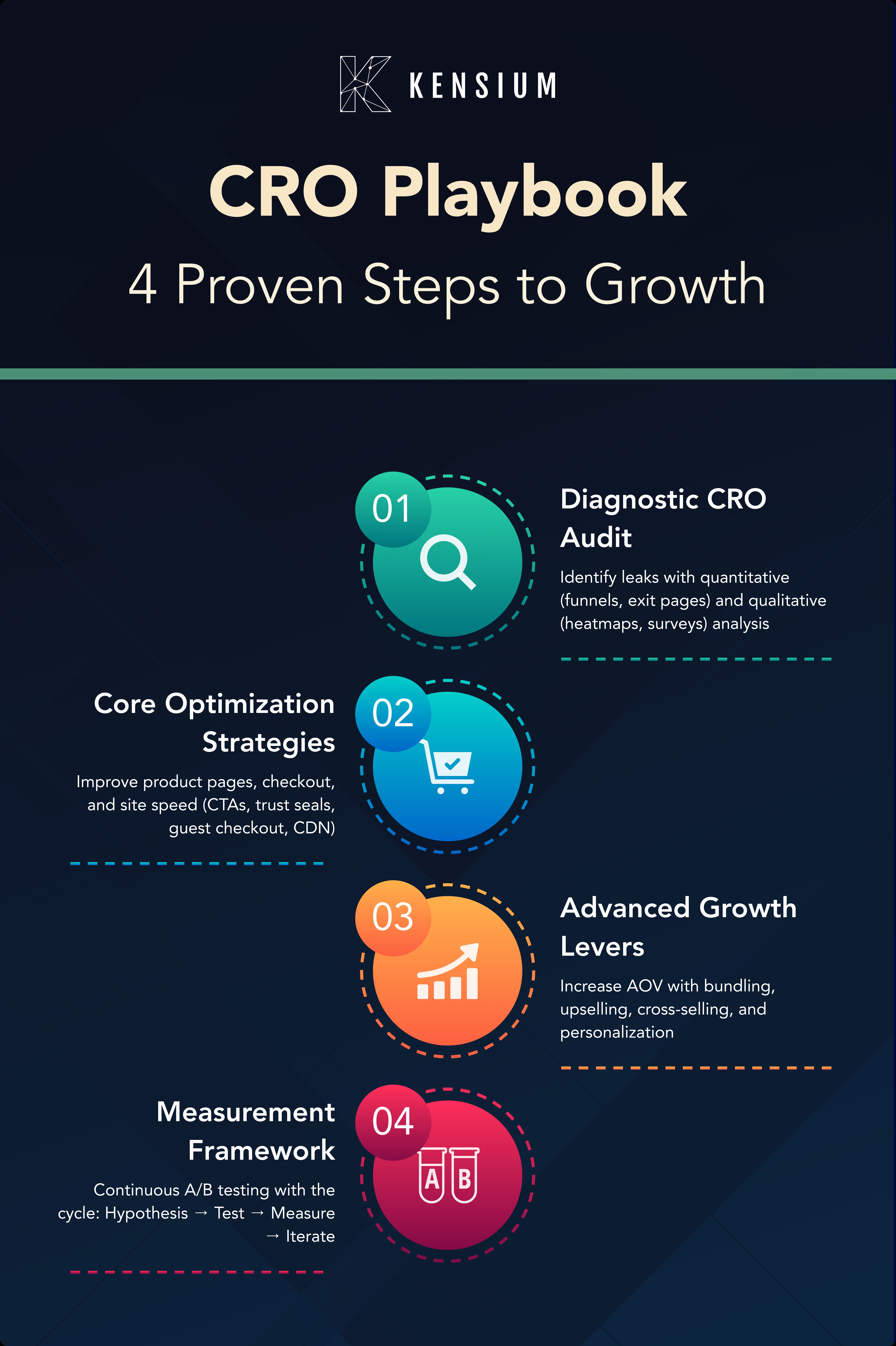
eCommerce CRO Checklist & Playbook for Higher Conversions
Ecommerce
E-Commerce Growth Playbook: Holiday Shopping 2026
Ecommerce
Integrating eCommerce Platforms with NetSuite
Ecommerce
B2B Ecommerce Customization Framework: How Kensium Maximizes ROI & Avoids Costly Pitfalls
B2B eCommerce Strategy Guide to Generative Engine Optimization by Kensium
Ecommerce
Generative Engine Optimization for B2B eCommerce in 2026| Kensium
Ecommerce
Cost-Cutting Strategies for eCommerce Growth in 2026
Ecommerce
Behavioral Economics in E-commerce: 10 Proven Tactics That Convert
Artificial Intelligence (AI)
Ecommerce
10 AI Strategies That Actually Drive B2B Ecommerce Growth
Ecommerce
Is Your B2B Store Costing You Sales? UX Fixes D2C Brands Already Use
Ecommerce
Amazon Prime Day 2025: Record Sales, AI Chatbots, and Key Takeaways for Sellers
Ecommerce
News & Update
Shopify
Embrace the Future: USDC Payments on Shopify via Coinbase & Stripe – Powered by Kensium
Ecommerce
How E-commerce Brands Can Profit from US Tariffs: A Complete Guide
Unlocking the Power of Shopify Magic: AI-Driven Commerce for the Modern B2B Merchant
Ecommerce
Artificial Intelligence (AI)
Shopify
Unlocking the Power of Shopify Magic: AI-Driven Commerce for the Modern B2B Merchant
Ecommerce
Your Website Is Not a Brochure: 5 Upgrades That Convert B2B Traffic
Ecommerce
7 Signs Your B2B eCommerce Platform Is Dying
Ecommerce
Customized B2B eCommerce Solutions: Max ROI, Avoid Templates
Ecommerce
Retrieving data. Wait a few seconds and try to cut or copy again.
Ecommerce
Marketing
How Tech & Analytics Elevate eCommerce Marketing
Ecommerce
The Vanishing Product: Don’t Let End-of-Life Cost You Loyal Customers
Ecommerce
The Delivery Deadline Doom: Are Late Shipments Killing Your Brand?
Ecommerce
Click to Convert: Mastering CTAs for Maximum Ecommerce Success
Ecommerce Shipping Delays: Impact, Causes & Solutions by kensium
Ecommerce
Ecommerce Shipping Delays: How Delivery Issues Hurt Brands
Ecommerce
The Abandoned Cart Cemetery: Revive Your Lost Sales
Ecommerce
Unlock the Potential of Your Adobe Commerce Store with Adobe App Builder
Ecommerce
The Holiday Hangover: Don't Let Lost Sales Haunt You All Year
Ecommerce
Is it Time to Refresh Your Company’s Website?
Ecommerce
how-omnichannel-ecommerce-will-drive-b2b-sales-in-2025-insights-from-mckinseys-latest-survey
Ecommerce
The Rise of Composable Commerce: How Adobe Commerce is Leading the Charge
Ecommerce
Sustainable E-Commerce: How BigCommerce Supports Eco-Friendly Practices
Ecommerce
The Power of User-Generated Content: Boosting Engagement on Shopify Stores
Ecommerce
The Rise of Conversational Commerce: Revolutionizing Customer Support and Boosting Conversion Rates
Ecommerce
Upgrading to Magento 2.4.7 and PHP 8.3
Ecommerce
Managing Multi-Channel Inventory with Ease on Shopify
Ecommerce
Why Every Ecommerce Business Needs an ERP
Ecommerce
The Power of PunchOut Integrations: How They Revolutionize B2B Transactions
Ecommerce
How Shopify Merchants Can Dominate with Dynamic Pricing
Ecommerce
Unifying B2B and B2C Experiences with Headless Commerce: How Kensium Leads the Charge
Ecommerce
Solo but Strong: My Experience as the Only Woman in Kensium's Sales Team
Ecommerce
Unlocking Success: Essential Ecommerce Metrics Every Business Should Track
Ecommerce
Ecommerce Predictions in 2024: Reimagining Customer Experience with Hyper-Personalization
Ecommerce
Exploring the Potential of the Metaverse to Revolutionize Ecommerce Businesses
Ecommerce
Top 20 Best Practices to Protect your Magento Store from Cyber Attacks
Ecommerce
Top 8 Cyber Resilience Strategies to Safeguard your Magento Store
Ecommerce
Harnessing the Power of ChatGPT for Ecommerce Transformation
Ecommerce
Composable Commerce: Understanding its Significance
Ecommerce
Picking right Adobe Commerce (Magento) trends
Ecommerce
How ChatGPT Transforms Ecommerce & Cybersecurity
Ecommerce
How to Increase Ecommerce Average Order Value (AOV)?
Ecommerce
Navigating the New Adobe Commerce Lifecycle Policy with Kensium's Support
Ecommerce
BigCommerce Unveils Powerful Features for B2B Edition. How can Kensium Help you Leverage Them?
Ecommerce
Simplify Online Shopping with Quick Checkout by Bolt for Adobe
Ecommerce
Amazon Buy with Prime
Ecommerce
Headless vs Composable vs PWA
Ecommerce
Allparts - Support Case Study
Ecommerce
Boost Your E-commerce Sales with BigCommerce's BOPIS Feature
Ecommerce
Stay Ahead of the Game with Adobe Magento 2.4.6's Improved Functionality
Ecommerce
How To Choose The Right Ecommerce Platform
Ecommerce
How To Drive Ecommerce Platform Adoption
Ecommerce
Customized Ecommerce Platform Or Out-Of-The-Box - Which Is Better?
Ecommerce
What You Need To Know About Upgrading To Magento 2.4.4+
Ecommerce
BigCommerce Launches #BigHackathon And Kensium Rises To The Challenge
Ecommerce
How To Be Ready To Update Your Ecommerce Analytics to GA4
Ecommerce
Progressive Web Apps vs. Responsive Websites - Which Is Better?
Ecommerce
Finding The Right Ecommerce Technology Stack
Ecommerce
How To Beat Stress At Work And At Home
Ecommerce
How Developing A PWA Is Unique From Traditional Web Apps
Ecommerce
What You Need To Know About Progressive Web Apps
Ecommerce
Unite Omnichannel Sales Through BigCommerce Channel Manager
Ecommerce
The BigDev Bootcamp Is Can't-Miss For BigCommerce Developers
Ecommerce
Green Monday - The Greatest Shopping Day You've Never Heard Of
Ecommerce
Magento 1 End of Life: Extend with Nexcess Safe Harbor
Ecommerce
Home Science Tools Helps Your Kids Learn From Home While You Work From Home
Ecommerce
Dekra-Lite Creates Extraordinary Decor For Any Occasion
Ecommerce
ParkingZone Thinks Outside The Lines Of The Parking Industry
Ecommerce
Adobe Summit 2020 Breakout Session: How To Integrate Magento With External Systems
Ecommerce
Real Street Performance Turbocharges Average Order Value Using Adobe Commerce
Ecommerce
Why Personalization Has Become An ECommerce Necessity In 2020
Ecommerce
The Differences Between Magento Open Source And Magento Commerce
Ecommerce
Fight Back Against Fraud: How To Prepare For Holiday ECommerce Scams In 2020
Ecommerce
Resources For ECommerce Businesses During The COVID-19 Pandemic
Ecommerce
Magento 1 Reaches Its End-Of-Life This Month: Here Are Your Options
Ecommerce
The Exceptional Value Of Referral Marketing In ECommerce
Ecommerce
Deploy Magento 2 In As Little As 6-8 Weeks
Ecommerce
Ecommerce Options For Volusion Customers Post-Bankruptcy