Watch the Full Webinar
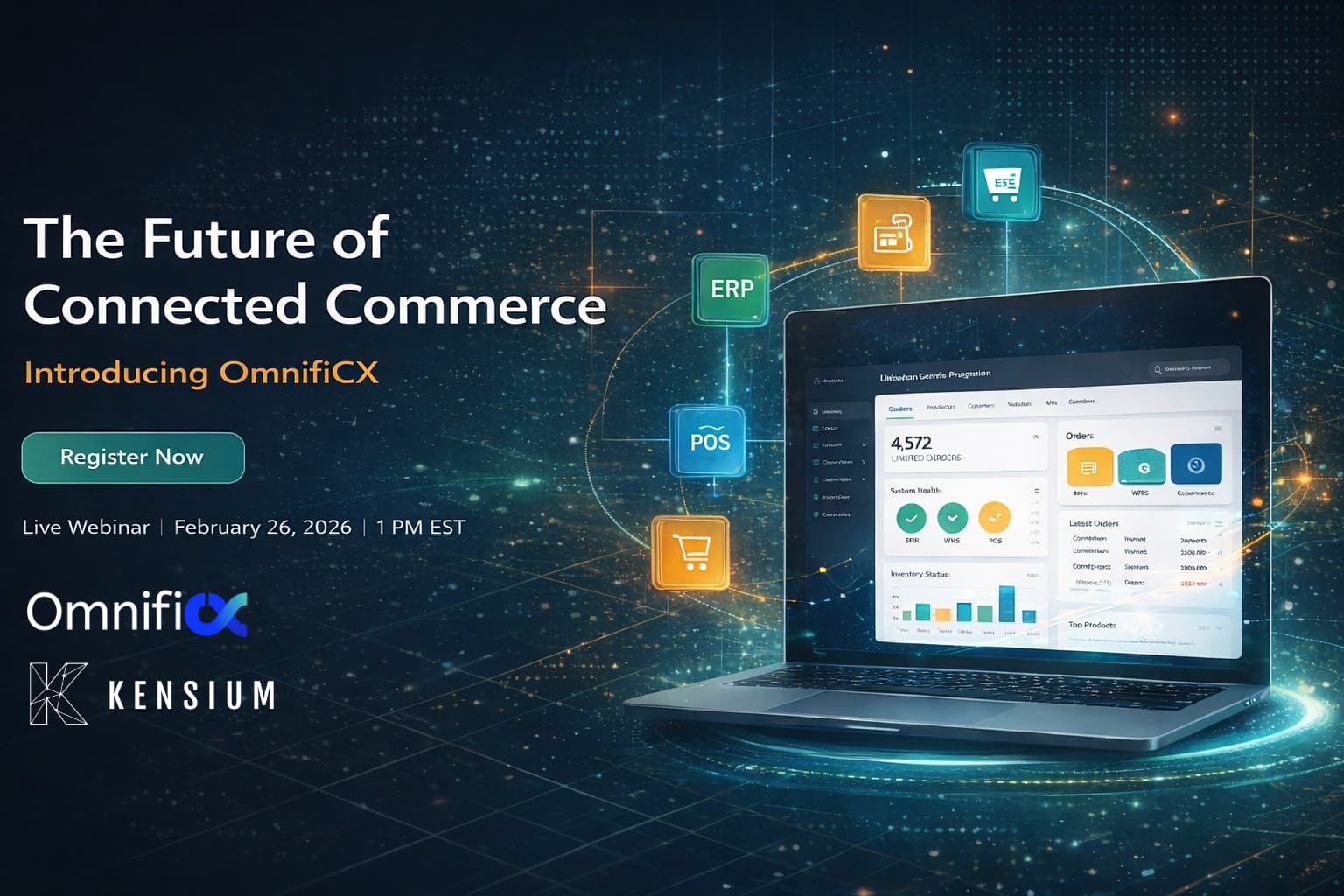
If you missed the live session or want to revisit the discussion, you can now watch the full recording of The Future of Connected Commerce with OmnifiCX.
In this session, Kensium CEO Rahul Gedupudi walked through the real challenges modern commerce teams face when their ERP, ecommerce platforms, POS systems, and marketplaces operate as disconnected systems — and how OmnifiCX creates a unified operational foundation.
The webinar included a walkthrough of the platform architecture, examples of how data fragmentation slows businesses down, and a live look at how OmnifiCX unifies commerce operations.
Don’t Miss the Next One
Kensium regularly hosts sessions exploring the intersection of ecommerce, ERP integration, AI-driven commerce, and operational strategy.
Subscribe to Kensium’s newsletter to receive:
Early invitations to upcoming webinars
Customer success stories and platform updates
Insights on connected commerce, AI-ready data, and ERP-driven operations
📩 Sign up to stay informed
Why Connected Commerce Is Still Broken
Most businesses today run on multiple commerce systems.
Ecommerce platforms manage the buying experience.
ERP systems control operations and finance.
POS systems handle in-store transactions.
Marketplaces create additional sales channels.
Warehouse systems manage fulfillment.
Individually, these systems work well.
The problem appears between them.
During the webinar, Rahul highlighted the operational friction businesses encounter every day:
Inventory inconsistencies across channels
Orders requiring manual reconciliation
Pricing mismatches between systems
Customer records duplicated across platforms
Reporting that requires manual exports
These issues rarely stem from a single system failing.
They emerge because the systems do not share a unified operational model.
For many organizations, integrations solve individual connections but fail to solve the larger problem: data alignment and governance across the entire ecosystem.
Introducing OmnifiCX
OmnifiCX was designed to address that exact challenge.
Rather than acting as another connector between systems, the platform establishes a unified commerce foundation that normalizes data across ERP, ecommerce, POS, warehouse, and marketplace environments.
During the session, Rahul introduced the core concept behind OmnifiCX:
One truth.
Every system.
Every operation.
Instead of relying on dozens of point-to-point integrations, OmnifiCX introduces a canonical commerce data model that becomes the shared operational layer across the ecosystem.
Orders, products, customers, and inventory flow through that unified layer, allowing every system to operate with consistent information.
Inside the OmnifiCX Architecture
A major portion of the webinar focused on the platform architecture and how it differs from traditional integration tools.
Traditional middleware solutions often rely on:
Point-to-point connectors
Custom integration scripts
Complex ETL pipelines
Reporting layers that do not affect operations
Heavy engineering cycles for every change
OmnifiCX approaches the problem differently.
The platform includes:
A prebuilt commerce data model
Master data management and governance controls
Real-time and batch synchronization options
Operational logic for order aggregation and routing
Built-in intelligence layers for analytics and automation
Rather than treating integration as a technical task, the platform treats it as an operational design problem.
This architectural approach allows businesses to align systems without constantly building new connectors.
What Attendees Saw in the Live Demo
During the walkthrough, attendees were shown how OmnifiCX coordinates activity across systems.
Examples demonstrated in the session included:
Orders arriving from multiple channels and being aggregated into a unified order flow
Inventory updates synchronizing across ecommerce, ERP, and fulfillment systems
Product and pricing data managed centrally instead of duplicated across platforms
Intelligent fulfillment routing based on available inventory and operational rules
The demonstration focused on showing how unified data changes operational behavior, not simply how systems exchange information.
This shift allows businesses to move from reactive reconciliation to proactive orchestration.
Why This Matters for AI and Automation
A key theme throughout the webinar was the relationship between data quality and AI readiness.
Many organizations are exploring AI-driven automation, predictive analytics, and intelligent fulfillment models.
However, Rahul emphasized a fundamental constraint:
AI trained on fragmented data amplifies errors instead of creating efficiency.
Disconnected systems lead to:
Inconsistent product data
Misaligned inventory signals
Incomplete customer profiles
Conflicting operational reports
Without a governed data foundation, automation cannot operate reliably.
OmnifiCX addresses this by ensuring that the data flowing into AI models originates from a consistent and controlled operational layer.
In practical terms, this means businesses can build automation with confidence rather than constantly correcting system mismatches.
Questions from the Live Q&A
The webinar concluded with a live Q&A session covering practical questions from attendees evaluating their commerce architecture.
Topics discussed included:
How OmnifiCX differs from traditional middleware and iPaaS solutions
Whether the platform replaces existing integrations or works alongside them
How businesses migrate from point-to-point integrations to a unified model
What role ERP systems play in a connected commerce architecture
How the platform supports future AI and automation initiatives
These questions reflected the reality many organizations face today:
commerce ecosystems have grown complex, and businesses are searching for a more sustainable operating model.
Key Takeaways
Disconnected commerce systems create operational friction even when each platform works correctly.
Traditional integrations connect systems but rarely align the data behind them.
A canonical commerce data model creates a shared operational foundation across ERP, ecommerce, POS, and fulfillment environments.
Unified data is essential for automation, intelligent routing, and AI-driven operations.
OmnifiCX was designed to provide that foundation without requiring businesses to rebuild their entire commerce stack.
Frequently Asked Questions
If we upgrade our ERP or ecommerce platform, what changes need to be made inside OmnifiCX?
Upgrades typically require creating a new connection in OmnifiCX and refreshing the system documents associated with that integration.
If the upgrade introduces changes such as new fields, removed fields, or updated APIs, only the affected mappings or flows need to be modified. Other systems connected to the hub remain unaffected.
Is OmnifiCX something internal teams can operate themselves, or does it require specialized support?
The platform provides visual tools for configuring integrations, flows, and mappings. Internal teams can learn to operate these tools with training.
However, managing integrations still requires some understanding of workflows and system architecture. Organizations that prefer not to manage these changes internally can work with implementation partners to maintain their integrations.
How does pricing work if order volume fluctuates seasonally?
Pricing is based on transactional usage.
Businesses can choose to move to a higher plan if they anticipate sustained increases in volume. For short-term spikes, the platform supports overage pricing so organizations can handle temporary increases in activity without changing plans.
How does OmnifiCX help reduce duplicate customer records or messy data?
The platform centralizes records in the hub and maintains references to the source system identifiers.
Instead of creating new numbering sequences, OmnifiCX tracks the original identifiers from each connected system and links them through external ID references. This makes it easier to detect duplicates and maintain consistent records across platforms.
Can OmnifiCX support custom fields or user-defined fields in systems like Acumatica, BigCommerce, or Shopify?
Yes. The platform can retrieve and map custom attributes such as meta fields, metadata, and user-defined fields from connected systems.
These fields can be stored in the hub and mapped to other systems as needed.
What is the process for integrating a new system that does not already have a prebuilt connector?
The platform includes a growing set of prebuilt integrations called subscriptions.
If a system does not yet have a prebuilt integration, users can create custom subscriptions by uploading the system’s API specifications and defining the integration flows themselves.
This allows organizations to connect specialized platforms such as custom 3PL systems or niche ERP solutions.
Does OmnifiCX support bidirectional synchronization between systems?
Yes, synchronization is bidirectional.
However, integrations are always routed through the hub. Each system communicates with OmnifiCX rather than directly with other systems.
For example:
• ERP → OmnifiCX → Ecommerce
• Ecommerce → OmnifiCX → ERP
This architecture simplifies upgrades and isolates systems from one another.
The Bottom Line
Commerce systems are not becoming simpler.
Businesses now operate across ecommerce platforms, ERP systems, marketplaces, POS environments, and fulfillment networks.
Connecting those systems technically is only the first step.
What matters is alignment.
OmnifiCX was built to create that alignment — providing a unified data foundation that allows commerce teams to operate with clarity, consistency, and intelligence.
For organizations planning their next phase of growth, that foundation becomes increasingly important.
If you missed the session, now is the perfect time to watch the recording and explore how connected commerce can actually work in practice.
.png)





.png)

.jpg)