Left-pointing white chevron arrow on a transparent background.
Back to article listing
Articles

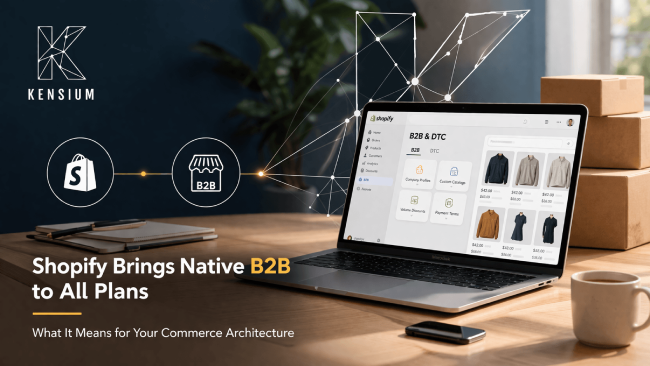
Shopify Brings Native B2B to All Plans - What It Means for Your Commerce Architecture

April 14, 2026
By-
Kensium’s Shopify B2B Solutions Team
Shopify Native B2B on All Plans: Architecture, ERP Integration & Strategy

Executive Summary

Shopify has expanded its native B2B capabilities across all plans.

This is a meaningful shift.

For the first time, businesses can manage wholesale (B2B) and direct-to-consumer (DTC) from a single platform without relying on external tools or fragmented workflows.

But the real impact goes beyond features.

This is about how modern commerce systems are being designed.

For Kensium clients and partners, the real question is:

How do you take advantage of Shopify’s native B2B while keeping your architecture scalable, governed, and future-ready?

What Shopify Just Enabled

Shopify’s latest release extends core B2B functionality to Basic, Grow, and Advanced plans.

Key capabilities include:

  • Company profiles for wholesale customers
  • Custom catalogs with tailored pricing
  • Volume discounts and quantity rules
  • Payment terms and vaulted payment methods
  • A unified admin for both B2B and DTC

Why This Matters

Historically, B2B and DTC operated in parallel:

  • Different tools
  • Different workflows
  • Different data sources

Shopify is bringing both together into a single commerce experience.

That reduces friction significantly, especially for growing businesses.

The Bigger Shift: B2B Is Now a Default Channel

B2B ecommerce is no longer something businesses “add later.”

It’s becoming a core part of how companies grow.

  • Wholesale buyers expect self-service
  • Pricing needs to be personalized
  • Reorders need to be frictionless
  • Sales teams need visibility

Shopify’s move reflects this shift.

It makes B2B accessible earlier in a company’s journey, not just at enterprise scale.

Where This Fits in Your Architecture

To fully benefit from Shopify’s native B2B capabilities, it’s important to look at the bigger system.
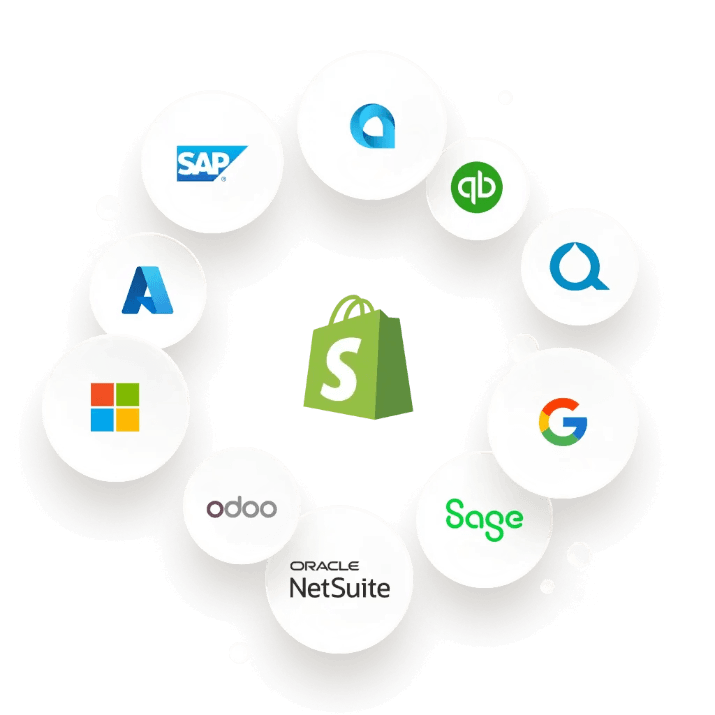
In most successful implementations:

ERP remains the system of record

  • Pricing rules
  • Contracts
  • Customer classes
  • Financial controls

Shopify becomes the engagement layer

  • Product discovery
  • Customer experience
  • Order capture
  • Self-service B2B portal

Integration ensures everything stays aligned

  • Pricing flows correctly
  • Orders sync seamlessly
  • Inventory remains accurate
  • Customer data stays consistent

This is what creates a connected commerce environment.

Why This Combination Works

When Shopify’s B2B features are paired with a strong backend system, businesses unlock:

Unified Buying Experience

Customers can move between B2B and DTC seamlessly.

Faster Ordering Cycles

Self-service reduces reliance on manual processes.

Accurate Pricing Visibility

Customers see the right price at the right time.

Operational Efficiency

Less manual intervention across order processing and fulfillment.

Scalable Growth

New customers, catalogs, and channels can be added without breaking the system.

Understanding the Role of Pricing

One of the most important areas to get right in B2B is pricing.

Shopify now provides strong capabilities for:

  • Catalog-based pricing
  • Volume discounts
  • Customer-specific configurations

At the same time, many businesses rely on their ERP for:

  • Contract pricing
  • Customer-specific agreements
  • Margin controls
  • Financial audit requirements

The most effective approach is not choosing one over the other.

It is aligning both systems so that:

  • Pricing logic is governed centrally
  • Pricing is presented consistently across channels

The Role of Orchestration
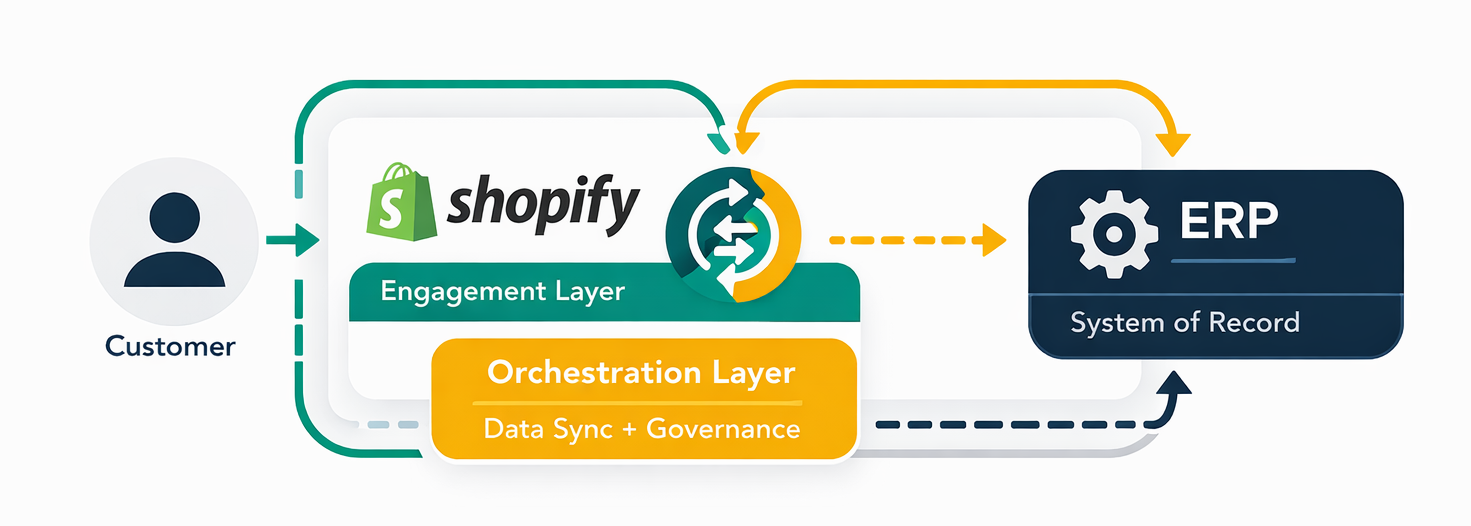
Shopify orchestration layer connecting customer engagement with ERP system for data sync and governance

As systems grow, integration becomes more important than individual features.

A modern approach includes an orchestration layer that:

  • Connects ERP and Shopify
  • Distributes pricing and product data
  • Ensures clean, reliable synchronization
  • Prevents data duplication or drift

This creates a foundation where every system operates in sync.

Execution at Scale: Why It Matters

As B2B operations grow, so does the complexity of data and workloads.

Businesses often deal with:

  • Large catalog updates
  • Customer-specific pricing structures
  • Bulk data synchronization
  • Ongoing operational changes

This is where execution capability becomes critical.

Smart Elastic Processing (SEP) supports this by:

  • Handling large workloads without interruption
  • Allowing long-running jobs to complete reliably
  • Avoiding manual batching of processes
  • Ensuring data updates remain consistent

Why This Matters

B2B systems depend on accuracy and timing.

If pricing or catalog updates are delayed or inconsistent, it impacts:

  • Customer experience
  • Order accuracy
  • Operational efficiency

Strong execution ensures that your systems keep up with your business.

What This Means for Kensium Clients and Partners

Shopify’s expansion of native B2B capabilities creates a strong foundation.

The opportunity now is to build on top of that foundation with the right architecture.

That means:

  • Keeping ERP as the source of truth
  • Using Shopify as the commerce layer
  • Ensuring systems are properly connected
  • Designing for scale from the beginning

This is how businesses move from:

Fragmented systems

→ to

Connected commerce

Practical Decision Criteria

If you’re evaluating Shopify B2B after this update, consider:

Where does pricing live?

Ensure pricing logic is governed and consistent.

How are systems connected?

Look beyond basic integrations toward scalable architecture.

Can your system handle growth?

Catalog size, customer complexity, and transaction volume matter.

What happens during large updates?

Migrations, bulk changes, and peak operations should run smoothly.

Are you building for long-term scale?

Short-term convenience should not create long-term limitations.

Final Take

Shopify’s move to bring B2B capabilities to all plans is a strong step forward.

It simplifies adoption, improves accessibility, and aligns with how modern businesses operate.

The next step is making sure your systems work together as one.

Because the real advantage is not just having B2B capabilities.

It’s having a connected commerce system that supports how your business actually runs.

If you’re exploring Shopify B2B or looking to align your systems:

Talk to a Commerce Architect at Kensium

👉 https://www.kensium.com/shopify

FAQ

Does Shopify’s B2B feature eliminate the need for separate wholesale tools?

For many businesses, yes. Shopify now provides core B2B functionality natively within the platform, reducing the need for additional tools.

Can Shopify handle both B2B and DTC in the same store?

Yes. Shopify allows businesses to manage both B2B and DTC within a single platform and admin interface.

Where should B2B pricing be managed?

Shopify supports pricing at the catalog level, while many businesses also maintain pricing logic within their ERP. The best approach is to align both systems for consistency.

What is Smart Elastic Processing (SEP)?

SEP is a capability that enables systems to handle large workloads, long-running processes, and bulk operations reliably without manual intervention.

How important is integration in a Shopify B2B setup?

Integration is critical. It ensures that data such as pricing, orders, and inventory flows correctly between systems.

Is Shopify B2B suitable for growing businesses?

Yes. With native features now available across all plans, businesses can adopt B2B capabilities earlier and scale over time.

What should businesses prioritize when implementing Shopify B2B?

Focus on architecture, data consistency, and scalability to ensure long-term success.

Share this on
Black Facebook social media logo icon on transparent background.Twitter bird logo in light blue on a transparent background.LinkedIn social media platform icon in blue and white.
Written by
Kensium’s Shopify B2B Solutions Team
Kensium’s Shopify B2B Solutions Team specializes in turning Shopify into a scalable B2B engine. From pricing frameworks and checkout customization to ERP integrations and wholesale portals, the team helps merchants streamline operations, enable customer-specific experiences, and unlock profitable growth on Shopify.
Left-pointing chevron arrow icon.
Back to Blogs

Shopify Brings Native B2B to All Plans - What It Means for Your Commerce Architecture

Marketing
Reading Time:
3
min
Published on:
April 14, 2026
Updated on:
April 14, 2026
Shopify Native B2B on All Plans: Architecture, ERP Integration & Strategy
Our Editorial Team
Kensium’s Shopify B2B Solutions Team

Executive Summary

Shopify has expanded its native B2B capabilities across all plans.

This is a meaningful shift.

For the first time, businesses can manage wholesale (B2B) and direct-to-consumer (DTC) from a single platform without relying on external tools or fragmented workflows.

But the real impact goes beyond features.

This is about how modern commerce systems are being designed.

For Kensium clients and partners, the real question is:

How do you take advantage of Shopify’s native B2B while keeping your architecture scalable, governed, and future-ready?

What Shopify Just Enabled

Shopify’s latest release extends core B2B functionality to Basic, Grow, and Advanced plans.

Key capabilities include:

  • Company profiles for wholesale customers
  • Custom catalogs with tailored pricing
  • Volume discounts and quantity rules
  • Payment terms and vaulted payment methods
  • A unified admin for both B2B and DTC

Why This Matters

Historically, B2B and DTC operated in parallel:

  • Different tools
  • Different workflows
  • Different data sources

Shopify is bringing both together into a single commerce experience.

That reduces friction significantly, especially for growing businesses.

The Bigger Shift: B2B Is Now a Default Channel

B2B ecommerce is no longer something businesses “add later.”

It’s becoming a core part of how companies grow.

  • Wholesale buyers expect self-service
  • Pricing needs to be personalized
  • Reorders need to be frictionless
  • Sales teams need visibility

Shopify’s move reflects this shift.

It makes B2B accessible earlier in a company’s journey, not just at enterprise scale.

Where This Fits in Your Architecture

To fully benefit from Shopify’s native B2B capabilities, it’s important to look at the bigger system.

In most successful implementations:

ERP remains the system of record

  • Pricing rules
  • Contracts
  • Customer classes
  • Financial controls

Shopify becomes the engagement layer

  • Product discovery
  • Customer experience
  • Order capture
  • Self-service B2B portal

Integration ensures everything stays aligned

  • Pricing flows correctly
  • Orders sync seamlessly
  • Inventory remains accurate
  • Customer data stays consistent

This is what creates a connected commerce environment.

Why This Combination Works

When Shopify’s B2B features are paired with a strong backend system, businesses unlock:

Unified Buying Experience

Customers can move between B2B and DTC seamlessly.

Faster Ordering Cycles

Self-service reduces reliance on manual processes.

Accurate Pricing Visibility

Customers see the right price at the right time.

Operational Efficiency

Less manual intervention across order processing and fulfillment.

Scalable Growth

New customers, catalogs, and channels can be added without breaking the system.

Understanding the Role of Pricing

One of the most important areas to get right in B2B is pricing.

Shopify now provides strong capabilities for:

  • Catalog-based pricing
  • Volume discounts
  • Customer-specific configurations

At the same time, many businesses rely on their ERP for:

  • Contract pricing
  • Customer-specific agreements
  • Margin controls
  • Financial audit requirements

The most effective approach is not choosing one over the other.

It is aligning both systems so that:

  • Pricing logic is governed centrally
  • Pricing is presented consistently across channels

The Role of Orchestration

Shopify orchestration layer connecting customer engagement with ERP system for data sync and governance

As systems grow, integration becomes more important than individual features.

A modern approach includes an orchestration layer that:

  • Connects ERP and Shopify
  • Distributes pricing and product data
  • Ensures clean, reliable synchronization
  • Prevents data duplication or drift

This creates a foundation where every system operates in sync.

Execution at Scale: Why It Matters

As B2B operations grow, so does the complexity of data and workloads.

Businesses often deal with:

  • Large catalog updates
  • Customer-specific pricing structures
  • Bulk data synchronization
  • Ongoing operational changes

This is where execution capability becomes critical.

Smart Elastic Processing (SEP) supports this by:

  • Handling large workloads without interruption
  • Allowing long-running jobs to complete reliably
  • Avoiding manual batching of processes
  • Ensuring data updates remain consistent

Why This Matters

B2B systems depend on accuracy and timing.

If pricing or catalog updates are delayed or inconsistent, it impacts:

  • Customer experience
  • Order accuracy
  • Operational efficiency

Strong execution ensures that your systems keep up with your business.

What This Means for Kensium Clients and Partners

Shopify’s expansion of native B2B capabilities creates a strong foundation.

The opportunity now is to build on top of that foundation with the right architecture.

That means:

  • Keeping ERP as the source of truth
  • Using Shopify as the commerce layer
  • Ensuring systems are properly connected
  • Designing for scale from the beginning

This is how businesses move from:

Fragmented systems

→ to

Connected commerce

Practical Decision Criteria

If you’re evaluating Shopify B2B after this update, consider:

Where does pricing live?

Ensure pricing logic is governed and consistent.

How are systems connected?

Look beyond basic integrations toward scalable architecture.

Can your system handle growth?

Catalog size, customer complexity, and transaction volume matter.

What happens during large updates?

Migrations, bulk changes, and peak operations should run smoothly.

Are you building for long-term scale?

Short-term convenience should not create long-term limitations.

Final Take

Shopify’s move to bring B2B capabilities to all plans is a strong step forward.

It simplifies adoption, improves accessibility, and aligns with how modern businesses operate.

The next step is making sure your systems work together as one.

Because the real advantage is not just having B2B capabilities.

It’s having a connected commerce system that supports how your business actually runs.

If you’re exploring Shopify B2B or looking to align your systems:

Talk to a Commerce Architect at Kensium

👉 https://www.kensium.com/shopify

FAQ

Does Shopify’s B2B feature eliminate the need for separate wholesale tools?

For many businesses, yes. Shopify now provides core B2B functionality natively within the platform, reducing the need for additional tools.

Can Shopify handle both B2B and DTC in the same store?

Yes. Shopify allows businesses to manage both B2B and DTC within a single platform and admin interface.

Where should B2B pricing be managed?

Shopify supports pricing at the catalog level, while many businesses also maintain pricing logic within their ERP. The best approach is to align both systems for consistency.

What is Smart Elastic Processing (SEP)?

SEP is a capability that enables systems to handle large workloads, long-running processes, and bulk operations reliably without manual intervention.

How important is integration in a Shopify B2B setup?

Integration is critical. It ensures that data such as pricing, orders, and inventory flows correctly between systems.

Is Shopify B2B suitable for growing businesses?

Yes. With native features now available across all plans, businesses can adopt B2B capabilities earlier and scale over time.

What should businesses prioritize when implementing Shopify B2B?

Focus on architecture, data consistency, and scalability to ensure long-term success.

Our Editorial Team
Kensium’s Shopify B2B Solutions Team

Explore Related Blogs

caret right
Shopify Native B2B on All Plans: Architecture, ERP Integration & Strategy
Marketing
Shopify Native B2B on All Plans: Architecture, ERP Integration & Strategy
How Amazon’s New AI Interactive Voice Chatbot Will Transform Listings, Engagement, and Sales for Sellers
Marketing
Amazon’s AI Voice Chatbot: Impact on Listings, Sales & SEO
Marketing
Amazon Seller Margins Shrinking in 2025 and How to Fix it in 2026
Ecommerce Optimization Dashboard – Data-Driven Insights for Shopify Merchants
Ecommerce
Marketing
eCommerce CRO Checklist & Playbook for Higher Conversions
Marketing
From Chaos to Clarity: How an Integrated eCommerce Tech Stack Boosts Operational Efficiency
Marketing
Amazon Buy with Prime and Seller Central: Why Optimization Is Critical for eCommerce Growth in 2026
Marketing
7 B2B Email Automation Flows That Actually Drive Sales
Marketing
Why B2B Digital Marketing Needs More than Search in 2026
Marketing
Boost Conversions Without Boosting Traffic: Why CRO Matters
Image Altext: Team reviewing Meta Facebook Business Account Recovery process shown on a presentation screen.
Marketing
Meta (Facebook) Business Account Recovery Guide
Personalization and Automation in B2B E-Commerce Digital Marketing: Striking the Perfect Balance
Marketing
Personalization & Automation in B2B E-Commerce Marketing
Marketing
Data-Driven Strategies: Optimizing Your B2B E-Commerce Digital Marketing
Marketing
The Content Gap That’s Costing You Sales: Why Product Descriptions Matter More Than You Think
Artificial Intelligence (AI)
Marketing
Leveraging AI-Powered Analytics for Data-Driven SEO Success
Ecommerce
Marketing
How Tech & Analytics Elevate eCommerce Marketing
Marketing
Top B2B E-Commerce Digital Marketing Trends for 2026
Artificial Intelligence (AI)
Marketing
Leveraging AI for B2B E-Commerce Digital Marketing Success 
Marketing
How AI Is Changing the Game for Marketers (And What I Learned at SMMW) 
Marketing
Mastering D2C Marketing: A Step-by-Step Guide to Growing Your eCommerce Brand
Marketing
The Evolution of Marketing: How eCommerce Brands Can Blend Tradition with Innovation for Maximum Impact 
Marketing
Best Practices for Growing Direct-to-Consumer (D2C) Marketing Efforts
Marketing
B2B to B2C Marketing: Transition Strategies & Growth| Kensium
Marketing
Is Your Marketing Company Gaslighting You? Navigating the Maze of Digital Marketing Scams
Marketing
The Illusion of Marketing Control: Now you have it...now you don’t.
Marketing
Conversion Rate Optimization (CRO) Assessments Are a Win-Win!
Marketing
Five Effective Remarketing Strategies Tailored to your needs
Why Social Media Marketing Matters for B2B Companies
Marketing
Why Social Media Marketing Matters for B2B Companies in 2026
Marketing
End of UA and a Guide for Migrating to GA4
Marketing
How To Drive External Traffic To Your Amazon Listings
Marketing
How To Monetize Your Digital Ecommerce Solutions
Marketing
Digital Maturity Is The Key To Ecommerce Growth
Marketing
How Get Lit Boosted Their User Base By Over 100%
Marketing
The B2B Digital Maturity Model
Marketing
Pro Social Media Tips: YouTube, Reddit, Spotify & Pinterest
Marketing
Kensium's Pro Tips For Social Media Marketing (Part 1)
Marketing
3 Low-Cost Ways To Grow Your Small Business In 2019
Marketing
Efficiency Leads To Higher Customer Lifetime Value
Marketing
Why HTTPS Certification Matters - And How To Get Secure For Google's July Update
Marketing
A Comparison Of Free + Paid Product Listings Across Google Shopping
Marketing
Micro-Animating The Purchase Path To Boost Conversions
Marketing
6 Ways To Maximize Conversions With Holiday Sales
Marketing
Website Performance Phishing
Marketing
Why Your Business Should Look Ahead To The Metaverse
Marketing
Why Google Chrome Ranks Your Website Better With An SSL Certificate
Marketing
The Powerful Value Of Referral Marketing In ECommerce