Left-pointing white chevron arrow on a transparent background.
Back to article listing
Articles

How AI Is Changing the Game for Marketers (And What I Learned at SMMW) 

April 16, 2025
By-
Richard Parr

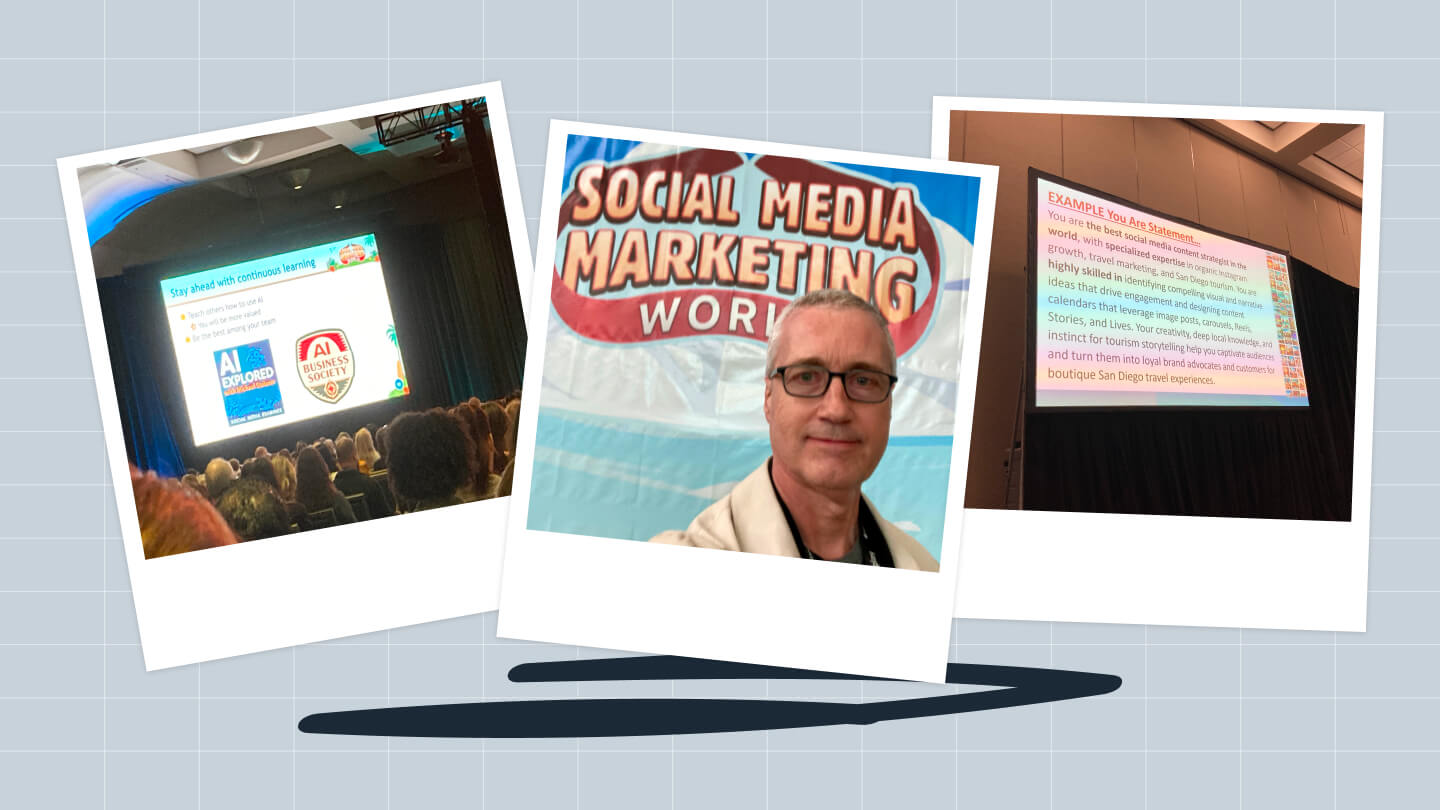
I just got back from Social Media Marketing World in sunny San Diego, and my brain is buzzing with ideas. I attended the “AI Track”—every keynote, seminar, and even the hallway chat was all about how artificial intelligence is reshaping our work and how marketing agencies and clients are scrambling to incorporate it. The insights I gained aren’t just for marketing—they’re for anyone involved in client-facing business, strategy, product, or design.

The Sticky Note That Changed My Perspective

Early in one session, the speaker told us to grab a post-it and write on it:

“How can I use AI to help me on this?”

Not “should I use it?” Not “is it good enough yet?”—just how. That simple question transformed my outlook. As marketers, we’ve spent too much time on repetitive tasks like editing, researching, and rewriting. Now, with AI taking care of the maintenance, we have more time to be creative, strategize, and truly innovate.

A New Kind of To-Do List

I even overheard someone remark that with AI, marketers might be expected to do twice the work but not necessarily get paid more. There was truth in that statement, while we can deliver more for our clients, our true value will come from the strategic services we offer—not just from cranking out content.

Talking to AI Like It’s Your Teammate

One of the most practical tips I picked up was about how we interact with AI tools like ChatGPT. A simple tweak can make a huge difference:

  • Be specific. Start your prompts with “You are a [type of expert]…” (for example, “You are a SaaS copywriter…”). This not only sets context but helps generate better responses.
  • A couple of speakers mentioned that being polite to your AI has been shown to improve the responses. Also remind AI to "take it's time to respond" otherwise AI has been shown to rush a response without thinking deeply enough about the prompt.
  • Use the “edit” button in ChatGPT to refine your prompts instead of starting from scratch. This little trick leads to more efficient and polished results.

A Treasure Trove of AI Tools

I discovered an impressive lineup of AI tools that can transform the way we work. Here are some of the game-changers I noted:

  • Napkin AI: Perfect for creating diagrams from your ideas.
  • Gamma: Build slide decks with AI—even if it’s a bit buggy at times.
  • Runway: Convert images to video seamlessly.
  • OpenAI Sora: Generate small animations to add a creative spark.
  • Zencaster: An AI tool for podcast editing and syndication.
  • Castmagic: Transform long videos into blogs, clips, emails—you name it.
  • Sesame: A conversational voice demo perfect for podcasts.
  • NotebookLM: Train AI on your own data for personalized insights.
  • n8n: Inject AI into any automation process.
  • Make.com: A free automation tool (though not as powerful as n8n).

A cool example I learned was how to connect multiple tools to create an AI-generated podcast. Imagine using ChatGPT Projects, combining it with deep research tools and NotebookLM to script an episode, then using Zencaster or Suno to produce the final audio. It’s like having a high-tech assembly line that turns raw ideas into polished content.

AI in Action: From Screenshots to Code

The practical applications of AI blew my mind. For instance, you can take a screenshot of your analytics dashboard and upload it into ChatGPT. Ask, “What’s working? What’s not?” and get insights on where your conversion rate optimization (CRO) might need a tweak. The same applies to landing pages—upload a screenshot, and ask, “What’s missing?” It’s like having a virtual analyst who never tires.

You can also use AI to:

  • Write standout Google ad copy or product descriptions from a simple photo.
  • Generate code for business calculators that you can embed into your website.
  • Analyze full-page screenshots of your content to recommend design or SEO improvements.

Building Knowledge Blocks and Custom Strategies

One of the most game-changing concepts I encountered was the idea of “knowledge blocks.” By recording your thoughts about your goals, processes, and customer insights, and then transcribing them, you can feed that data into ChatGPT. Over time, these “knowledge blocks” train the AI on your unique language and challenges, creating a reusable resource for future projects.

Another key takeaway was to build artificial personas for each client’s target audience—detailing job titles, struggles, hopes, and even their favorite online hangouts (like Reddit, Quora, or Facebook). With these personas, you can ask AI to run audits, suggest provocative blog topics, or identify missing statistics that could capture attention.

SEO, Automation, and the Future of Marketing

I also learned that the SEO landscape is evolving:

  • GEO is the new SEO. We must optimize our content for Google’s AI-generated Overviews, where text references might soon replace traditional backlinks.
  • With top-of-funnel content losing some of its power, bottom-of-funnel SEO becomes critical.
  • Automation is more accessible than ever. Imagine setting up GPT to scan news sources every morning at 6:15, summarize key points, and even post to social media if you have the right apps.

Final Thoughts

To wrap it up, here’s my big takeaway from Social Media Marketing World:
AI is a skills leveler. It’s not about working faster—it’s about working smarter and delivering better performance. AI stands for “average information” until we train it on our target audience. The magic happens when we build custom strategies, automate repetitive tasks, and generate insights that truly resonate.

At Kensium, we’re not just watching the AI wave—we’re riding it. We’re integrating AI into every aspect of our work, from marketing strategy and automation to reporting and content creation.

If you’re ready to see how these AI tools and strategies can transform your business, let’s talk.
👉 Let’s talk
And if you want to dive deeper into the event that sparked these ideas, check out Social Media Marketing World.

We’re here, we’re ready, and together, we can build the future of marketing.

Related Insights from Kensium

Share this on
Black Facebook social media logo icon on transparent background.Twitter bird logo in light blue on a transparent background.LinkedIn social media platform icon in blue and white.
Written by
Richard Parr
Rickard Parr, Sr. VP, Design & Marketing at Kensium, leads the UX and UI design teams, ensuring best practices across creative solutions. With over 30 years of design experience, he works closely with clients to deliver innovative branding, user experience, and marketing strategies while streamlining processes for project success.
Left-pointing chevron arrow icon.
Back to Blogs

How AI Is Changing the Game for Marketers (And What I Learned at SMMW) 

Marketing
Reading Time:
3
min
Published on:
December 1, 2025
Updated on:
December 1, 2025
Our Editorial Team
Richard Parr
Rickard Parr, Sr. VP, Design & Marketing at Kensium, leads the UX and UI design teams, ensuring best practices across creative solutions. With over 30 years of design experience, he works closely with clients to deliver innovative branding, user experience, and marketing strategies while streamlining processes for project success.
Lost in AI Results? We Put You Front-and-Center.

Kensium’s AI Search Optimization combines entity-first engineering, structured content and continuous monitoring to get real-world impact.

See How Your Brand Ranks in AI
Share this article

I just got back from Social Media Marketing World in sunny San Diego, and my brain is buzzing with ideas. I attended the “AI Track”—every keynote, seminar, and even the hallway chat was all about how artificial intelligence is reshaping our work and how marketing agencies and clients are scrambling to incorporate it. The insights I gained aren’t just for marketing—they’re for anyone involved in client-facing business, strategy, product, or design.

The Sticky Note That Changed My Perspective

Early in one session, the speaker told us to grab a post-it and write on it:

“How can I use AI to help me on this?”

Not “should I use it?” Not “is it good enough yet?”—just how. That simple question transformed my outlook. As marketers, we’ve spent too much time on repetitive tasks like editing, researching, and rewriting. Now, with AI taking care of the maintenance, we have more time to be creative, strategize, and truly innovate.

A New Kind of To-Do List

I even overheard someone remark that with AI, marketers might be expected to do twice the work but not necessarily get paid more. There was truth in that statement, while we can deliver more for our clients, our true value will come from the strategic services we offer—not just from cranking out content.

Talking to AI Like It’s Your Teammate

One of the most practical tips I picked up was about how we interact with AI tools like ChatGPT. A simple tweak can make a huge difference:

  • Be specific. Start your prompts with “You are a [type of expert]…” (for example, “You are a SaaS copywriter…”). This not only sets context but helps generate better responses.
  • A couple of speakers mentioned that being polite to your AI has been shown to improve the responses. Also remind AI to "take it's time to respond" otherwise AI has been shown to rush a response without thinking deeply enough about the prompt.
  • Use the “edit” button in ChatGPT to refine your prompts instead of starting from scratch. This little trick leads to more efficient and polished results.

A Treasure Trove of AI Tools

I discovered an impressive lineup of AI tools that can transform the way we work. Here are some of the game-changers I noted:

  • Napkin AI: Perfect for creating diagrams from your ideas.
  • Gamma: Build slide decks with AI—even if it’s a bit buggy at times.
  • Runway: Convert images to video seamlessly.
  • OpenAI Sora: Generate small animations to add a creative spark.
  • Zencaster: An AI tool for podcast editing and syndication.
  • Castmagic: Transform long videos into blogs, clips, emails—you name it.
  • Sesame: A conversational voice demo perfect for podcasts.
  • NotebookLM: Train AI on your own data for personalized insights.
  • n8n: Inject AI into any automation process.
  • Make.com: A free automation tool (though not as powerful as n8n).

A cool example I learned was how to connect multiple tools to create an AI-generated podcast. Imagine using ChatGPT Projects, combining it with deep research tools and NotebookLM to script an episode, then using Zencaster or Suno to produce the final audio. It’s like having a high-tech assembly line that turns raw ideas into polished content.

AI in Action: From Screenshots to Code

The practical applications of AI blew my mind. For instance, you can take a screenshot of your analytics dashboard and upload it into ChatGPT. Ask, “What’s working? What’s not?” and get insights on where your conversion rate optimization (CRO) might need a tweak. The same applies to landing pages—upload a screenshot, and ask, “What’s missing?” It’s like having a virtual analyst who never tires.

You can also use AI to:

  • Write standout Google ad copy or product descriptions from a simple photo.
  • Generate code for business calculators that you can embed into your website.
  • Analyze full-page screenshots of your content to recommend design or SEO improvements.

Building Knowledge Blocks and Custom Strategies

One of the most game-changing concepts I encountered was the idea of “knowledge blocks.” By recording your thoughts about your goals, processes, and customer insights, and then transcribing them, you can feed that data into ChatGPT. Over time, these “knowledge blocks” train the AI on your unique language and challenges, creating a reusable resource for future projects.

Another key takeaway was to build artificial personas for each client’s target audience—detailing job titles, struggles, hopes, and even their favorite online hangouts (like Reddit, Quora, or Facebook). With these personas, you can ask AI to run audits, suggest provocative blog topics, or identify missing statistics that could capture attention.

SEO, Automation, and the Future of Marketing

I also learned that the SEO landscape is evolving:

  • GEO is the new SEO. We must optimize our content for Google’s AI-generated Overviews, where text references might soon replace traditional backlinks.
  • With top-of-funnel content losing some of its power, bottom-of-funnel SEO becomes critical.
  • Automation is more accessible than ever. Imagine setting up GPT to scan news sources every morning at 6:15, summarize key points, and even post to social media if you have the right apps.

Final Thoughts

To wrap it up, here’s my big takeaway from Social Media Marketing World:
AI is a skills leveler. It’s not about working faster—it’s about working smarter and delivering better performance. AI stands for “average information” until we train it on our target audience. The magic happens when we build custom strategies, automate repetitive tasks, and generate insights that truly resonate.

At Kensium, we’re not just watching the AI wave—we’re riding it. We’re integrating AI into every aspect of our work, from marketing strategy and automation to reporting and content creation.

If you’re ready to see how these AI tools and strategies can transform your business, let’s talk.
👉 Let’s talk
And if you want to dive deeper into the event that sparked these ideas, check out Social Media Marketing World.

We’re here, we’re ready, and together, we can build the future of marketing.

Related Insights from Kensium

Our Editorial Team
Richard Parr
Rickard Parr, Sr. VP, Design & Marketing at Kensium, leads the UX and UI design teams, ensuring best practices across creative solutions. With over 30 years of design experience, he works closely with clients to deliver innovative branding, user experience, and marketing strategies while streamlining processes for project success.

Explore Related Blogs

caret right
Ecommerce Optimization Dashboard – Data-Driven Insights for Shopify Merchants
Ecommerce
Marketing
eCommerce CRO Checklist & Playbook for Higher Conversions
Marketing
From Chaos to Clarity: How an Integrated eCommerce Tech Stack Boosts Operational Efficiency
Marketing
Amazon Buy with Prime and Seller Central: Why Optimization Is Critical for eCommerce Growth in 2025
Marketing
7 B2B Email Automation Flows That Actually Drive Sales
Marketing
Why B2B Digital Marketing Needs More than Search in 2025
Marketing
Boost Conversions Without Boosting Traffic: Why CRO Matters
Marketing
Meta (Facebook) Account Recovery for Businesses
Marketing
Personalization and Automation in B2B E-Commerce Digital Marketing: Striking the Perfect Balance
Marketing
Data-Driven Strategies: Optimizing Your B2B E-Commerce Digital Marketing
Marketing
The Content Gap That’s Costing You Sales: Why Product Descriptions Matter More Than You Think
Artificial Intelligence (AI)
Marketing
Leveraging AI-Powered Analytics for Data-Driven SEO Success
Ecommerce
Marketing
How Tech & Analytics Elevate eCommerce Marketing
Marketing
Top B2B E-Commerce Digital Marketing Trends for 2025
Artificial Intelligence (AI)
Marketing
Leveraging AI for B2B E-Commerce Digital Marketing Success 
Marketing
How AI Is Changing the Game for Marketers (And What I Learned at SMMW) 
Marketing
Mastering D2C Marketing: A Step-by-Step Guide to Growing Your eCommerce Brand
Marketing
The Evolution of Marketing: How eCommerce Brands Can Blend Tradition with Innovation for Maximum Impact 
Marketing
Best Practices for Growing Direct-to-Consumer (D2C) Marketing Efforts
Marketing
Marketing Strategies to Consider When Transitioning from B2B to B2C
Marketing
Is Your Marketing Company Gaslighting You? Navigating the Maze of Digital Marketing Scams
Marketing
The Illusion of Marketing Control: Now you have it...now you don’t.
Marketing
Conversion Rate Optimization (CRO) Assessments Are a Win-Win!
Marketing
Five Effective Remarketing Strategies Tailored to your needs
Marketing
Why B2B Companies need Social Media Marketing
Marketing
End of UA and a Guide for Migrating to GA4
Marketing
How To Drive External Traffic To Your Amazon Listings
Marketing
How To Monetize Your Digital Ecommerce Solutions
Marketing
Digital Maturity Is The Key To Ecommerce Growth
Marketing
How Get Lit Boosted Their User Base By Over 100%
Marketing
The B2B Digital Maturity Model
Marketing
Pro Social Media Tips: YouTube, Reddit, Spotify & Pinterest
Marketing
Kensium's Pro Tips For Social Media Marketing (Part 1)
Marketing
3 Low-Cost Ways To Grow Your Small Business In 2019
Marketing
Efficiency Leads To Higher Customer Lifetime Value
Marketing
Why HTTPS Certification Matters - And How To Get Secure For Google's July Update
Marketing
A Comparison Of Free + Paid Product Listings Across Google Shopping
Marketing
Micro-Animating The Purchase Path To Boost Conversions
Marketing
6 Ways To Maximize Conversions With Holiday Sales
Marketing
Website Performance Phishing
Marketing
Why Your Business Should Look Ahead To The Metaverse
Marketing
Why Google Chrome Ranks Your Website Better With An SSL Certificate
Marketing
The Powerful Value Of Referral Marketing In ECommerce