Search



A B2B self-service portal lets business customers log in to see their own contract pricing, live inventory, orders and invoices, request quotes and reorder without calling a rep. It works only when it reads those answers from the ERP and governed customer data behind it.
Most mid-market manufacturers and distributors already have customers who would rather help themselves. What stops them is rarely the website. Pricing sits in the ERP, credit sits with finance, stock sits in the warehouse system, and a person has to stitch the answer together. We build the portal and the data foundation behind it as one program, so the answer a customer sees is the answer your team would give.
B2B buying has shifted toward buyers who research on their own, shortlist before they speak to anyone, and expect the ease they get as consumers. These are the data points we see most often in the research.
of B2B buyers prefer an overall rep-free buying experience.
of the time, the winning vendor was already on the buyer’s Day One shortlist. 79% of buyers said they, not a vendor rep, started the first conversation.
of B2B buyers have adopted generative AI, and rank it among their top sources of self-guided information in every phase of buying.
of B2B buyers make at least half of their purchases online, and 83% expect more digital transactions in the coming year.
of buyers are dissatisfied with their distributors’ online experience, and only 33% say they can reorder with a single click.
of B2B spend is forecast to be intermediated by AI agents by 2028, with agents handling the large majority of B2B purchases.
Buyers form a shortlist before they contact anyone. What they can find, trust and verify online decides whether you are on it.
Gartner found buyers prefer self-service for information and learning, and prefer seller input for judgment calls. A good portal takes routine work off your reps so they can advise.
Gartner also found that 69% of buyers see inconsistencies between a seller’s website and what the seller tells them. That is a data problem before it is a design problem.
Few customers start from nothing. Most already have a way of ordering that works, but it depends on people, phone calls and spreadsheets. The right first step depends on which of these describes you.
Where we start: A portal with contract pricing, order history and one-click reorder, read from the ERP.
Where we start: Quick order, bulk upload, search that understands part numbers, and ERP pricing.
Where we start: A quote-to-order workflow tied to ERP pricing and approval rules.
Where we start: Fix the data and integration layer first, then rebuild the experience on top of it.
Self-service does not mean sales-free. We design for rep-assisted ordering as well, so your team can place and manage orders on behalf of a customer using the same portal and the same data.
A portal that keeps its own copy of prices, stock and customers drifts out of date. We build it to read from the system that owns each answer, through one governed integration layer, so every channel gives the same answer.
Learn about ERP-led commerce™Kensium is platform-agnostic, and no single path fits every business. Most mid-market companies are well served by a commerce platform. A few have rules that no platform handles well. We set out the four paths plainly and say which one fits.

Adobe Commerce, BigCommerce or Shopify, extended for B2B and integrated to your ERP. Platform detail is on each platform page.
Platforms designed around B2B ordering, account hierarchies and distributor workflows from the start.
The portal or commerce module offered by your ERP vendor, with the closest coupling to ERP data.
A purpose-built experience layer on the governed OmnifiCX or Boomi data layer, with the ERP as system of record. Commodity parts such as payments, sign-in and search are bought. Only the workflows no platform handles are built.
If all five are available natively, choose a platform.
If three or four are, choose a platform and build the exceptions at the edges.
If only one or two are, consider a composable build.
Write down the five commercial rules that make your business awkward, such as validated product configuration, unusual pricing or a dealer-plus-direct model, and check each one against the options. If all five are available natively, choose a platform. If three or four are, choose a platform and build the exceptions at the edges. If only one or two are, consider a composable build. We avoid heavy customization of a platform core, because it makes every later upgrade harder.
AI-assisted engineering has lowered the cost of building the experience layer. It has not removed the work of keeping that layer secure, current and correct against your ERP. That is why a composable build rests on governed data and a support plan, and why it is a deliberate choice, not a default.
Platform Selection and Architecture groups the choices by the problem each one solves.
AI is changing B2B self-service in three ways at once. Buyers use it to find suppliers, portals use it to serve buyers faster, and buyers’ own AI agents are beginning to place orders. All three depend on the same thing: accurate, governed data and clear rules about who may do what.
See the Commerce Readiness Framework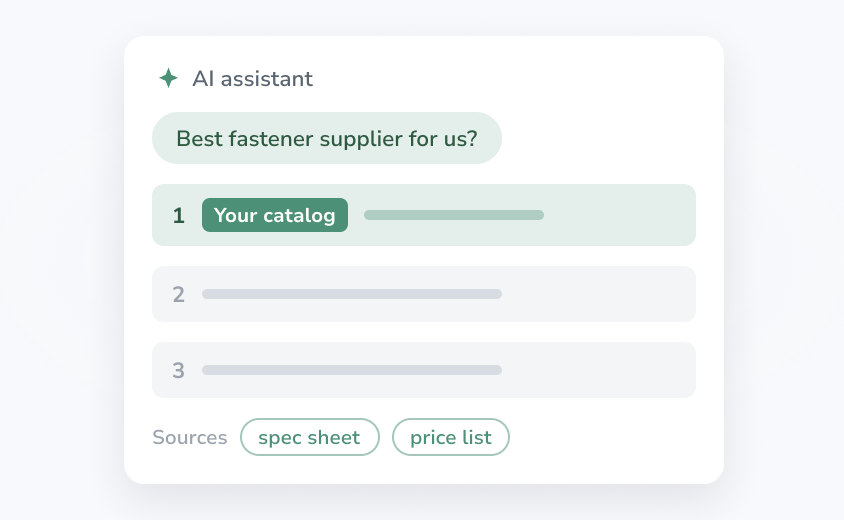
94% of buyers now use large language models during the buying process, and the winning vendor is already on the Day One shortlist 95% of the time. If an AI assistant cannot read and trust your catalog, specifications and policies, you may never reach the list.
Structured product data, content built for AI search, and AEO and GEO foundations on a governed catalog.
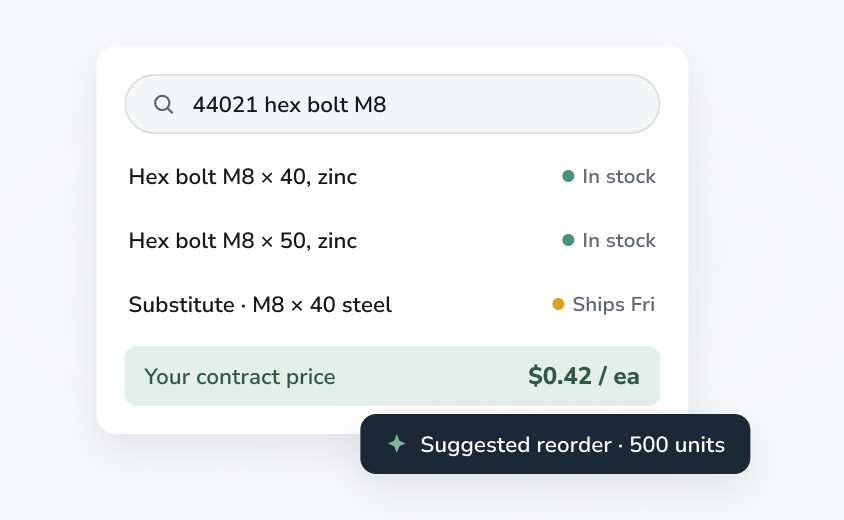
Search that understands part numbers, fitment and substitutes. Reorder suggestions based on real usage. Help with building a quote. Plain answers about order status and invoices. Each one saves a call, if the answer is right.
A suggested price that differs from the contract price destroys trust faster than no suggestion at all.
We assess which uses fit your customers and your data, then build them on the governed layer.
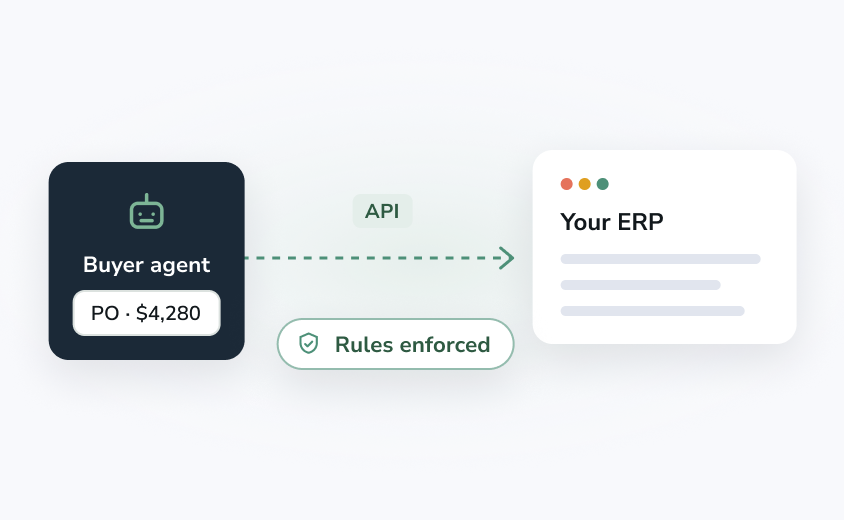
Gartner forecasts that AI agents will intermediate more than $15 trillion of B2B spend by 2028. An agent does not browse a website. It calls an interface, and it acts on whatever data it finds, right or wrong.
Agent-ready commerce needs governed access, pricing and credit rules enforced at the source, and a record of every action.
We design access, permissions and guardrails with you before agents arrive, not after.
Orders by phone, email and EDI. A portal, if one exists, shows stale data.
An inventory of systems and a decision on the system of record for each data object
The portal reads pricing, stock and orders from the ERP. Buyers handle core tasks themselves.
An integration hub with monitored flows
One customer, price and product record across the portal, reps, EDI and marketplaces. AI search can read the catalog.
Governed master data with OmnifiCX, plus AEO and GEO foundations
Personalized reorder, guided quoting, proactive alerts, and AI help for buyers and reps.
Clean history, behavioral signals, and a clear use-case roadmap from AI and Automation Advisory
Buyer and supplier agents transact within rules you set, with human override.
Governed APIs, permissions, audit trail and guardrails
Most mid-market businesses do not need to build for level 05 today. They do need the foundation that makes it possible when their customers ask. Every step up the table starts with the same work: better data and clearer rules.
Customers notice when a portal is wrong, and they stop using it. Gartner found that 69% of buyers see inconsistencies between a seller’s website and what the seller tells them. Governance is how you prevent that, and it is also what makes AI safe to switch on.
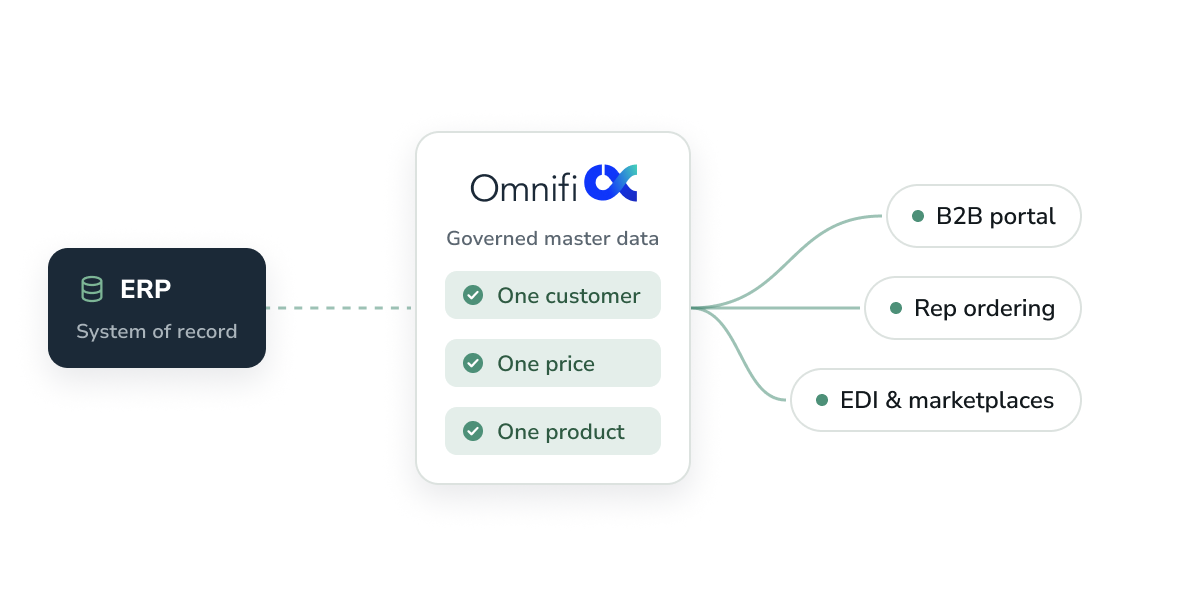
Connect your ERP, portal and other channels once, and keep the master data that every channel depends on under governance.
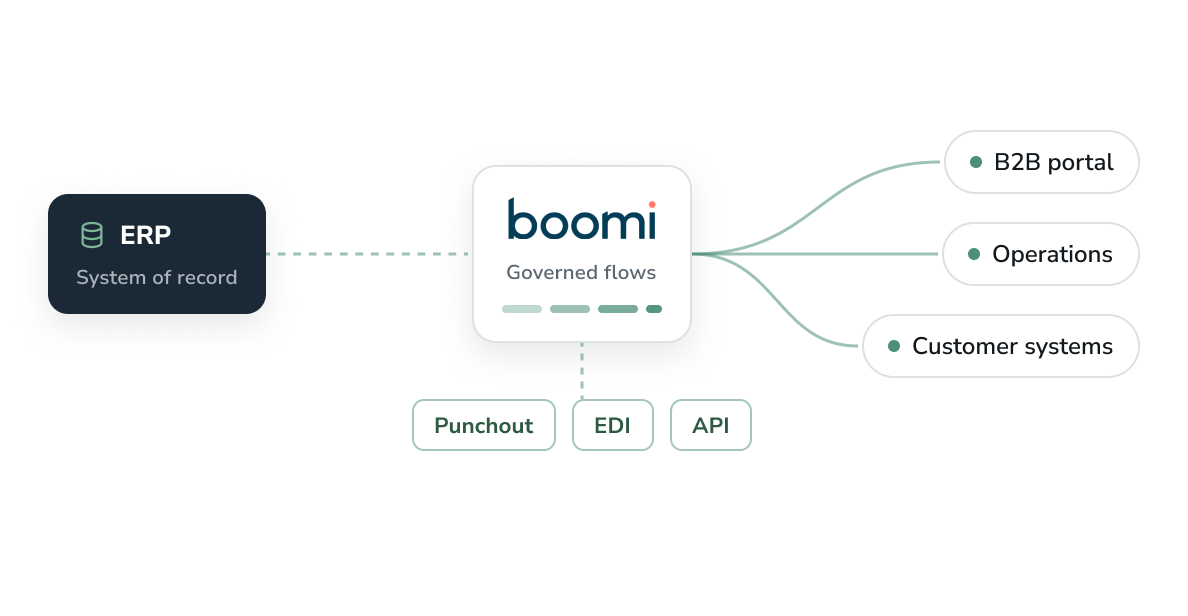
For businesses that have standardized on Boomi, we deliver the same governed integration pattern on that platform, so the portal reads from the ERP the same way.
Accounts, users, terms and credit defined once and trusted everywhere.
Contract and customer pricing that match across portal, rep and invoice.
A governed record that supports search, specifications and AI.
Permissions, approvals and limits applied the same way for people and for agents.
Want the detail? Data Governance covers how OmnifiCX is implemented and supported for governed commerce master data.
Data Governance with OmnifiCXNot every self-service idea is worth building, and not every AI idea is ready for your data. Advisory work helps you choose what to build first, and what to leave alone. It can come before a portal project or run alongside it.
Which tasks do your reps and customer service teams handle that customers could do themselves, and what would each one save?
What is missing in your catalog, pricing and customer data before search, assistants or agents can use it safely?
Which actions can be automated, which need approval, and in what order should they be built?
Not sure where you stand? The free Commerce Readiness assessment shows your level today and what to move first.
AI and Automation Advisory
We map how customers order today, which tasks consume the most rep time, and what data sits behind each one. We rank self-service use cases and confirm where you stand on the Commerce Readiness Framework.
We design the buyer experience, the account and permission model, the system of record for each data object, the integration approach (OmnifiCX or Boomi) and the platform.
We build the portal, the pricing and quote logic, the account hierarchies and the integrations, one capability at a time.
We cleanse customer and product data, then test with real accounts, real price lists and real scenarios such as backorders, partial shipments, approvals and credit holds. We train your reps.
We invite customers in waves, starting with the accounts most likely to benefit, keep phone support available while they learn, and watch adoption closely.
We track adoption, digital order share and rep time saved, then add the next capability, including AI, based on what customers actually use.
Orders are created once, at the source, and accepted by the ERP.
Pricing and approval rules apply automatically, and status is visible to everyone.
Order entry and status calls move to self-service, leaving time for larger accounts and growth.
Buyers order, check and pay when it suits them, not when your office is open.
The portal, the rep and the invoice all draw on the same record.
Governed data and clear rules are what assistants and agents need to act safely.

Verified businesses register automatically, browse the catalog, and move through a consultative quote-to-order process, with customer-based pricing, order history, and quotes synced from CounterPoint. Automated ERP integration reduced manual data handling and improved accuracy.
Read Case Study




See how ready your data, systems and processes are for B2B self-service and for AI. Take the free assessment to find your Commerce Readiness level and what to move first.
Take the assessmentDealer and distributor portals, configurable products, contract pricing and rep-assisted ordering.
Large catalogs, many price lists, quick order and bulk upload, and live availability across warehouses.
Phone, email and EDI ordering replaced by self-service built on ERP data.
One inventory and one customer record behind a trade portal and a consumer storefront.
Portal, platform, integration, governance and AI advisory from one team.
One source of truth behind every channel and every buyer.
One accountable team from discovery to support.
Governed data that AI assistants and agents can rely on.
Build the storefront on Shopify, BigCommerce or Adobe Commerce, ERP-led from day one.
Learn moreConnect the portal, channels and operations to your ERP with governed data.
Learn moreTurn unified data into practical AI, automation and agentic commerce.
Learn moreQuestions We Hear Often


Tell us how your customers order today, from the ERP to the phone calls to the spreadsheets in between. One of our experts will follow up to discuss the right path and where to start.
Take the Commerce Readiness Assessment311 S. Wacker Drive
Suite 2575
Chicago, IL 60606
4th Floor, Jyothi Pinnacle
Survey No. 11, Kondapur Village
Hyderabad, Telangana 500081
Magnia Tower, Street 15 #503
Altabrisa
Mérida, Yucatán 97130