




What Is ERP-Led Commerce™?
Every commerce architecture makes a choice, whether or not anyone makes it on purpose: which system gets to say what's true. ERP-Led Commerce™ is the name for the architecture that makes that choice deliberately, instead of leaving it to whichever system happened to write last.
ERP-Led Commerce™ is a commerce architecture in which the enterprise resource planning system is the single source of truth for inventory, pricing, orders, and customer accounts, and every other system (storefront, POS, portal, marketplace) reads and writes through governed integration instead of holding its own copy of that data.
What Makes Something
ERP-Led, Rather Than Just "Integrated With an ERP"
Integration alone doesn't decide who's right when two systems disagree. Two systems can be fully integrated (connected, syncing, exchanging data in real time) and still both believe they hold the current price. ERP-led design adds the missing piece: authority runs in one direction. For any given piece of data, exactly one system is allowed to decide its value, and every other system is a reader. That's the difference between integration, which is a pipe, and ERP-led architecture, which is a hierarchy.
The ERP-Led System Truth
An ERP-led architecture has three layers. Confusing which layer a piece of data belongs to is the single most common way these systems break.
The Three Layers, Top to Bottom
Systems of Experience
Storefront, POS, B2B portal, marketplace listings, mobile and in-store apps. These render, merchandise, and sell. None of them should hold inventory, pricing, or account data as their own authoritative copy, only a cached, synced read.
Integration and Governance Layer
The layer that moves data between the ERP and every system of experience, validates it, and (where a master data governance layer is present) resolves conflicts before they reach a screen. This is the layer most implementations underbuild, because it's invisible until it fails.
System of Record
The ERP core: general ledger, inventory, pricing, order management, customer accounts. This is where a value is decided, not just stored.
Who Owns the Write Path, Object by Object
For each core data object, exactly one system should hold write authority. Every other system reads. Where a write path is genuinely split (customer preference data is the clearest case) the split follows data type, not the object as a whole.
Real-Time Versus Batch, and Why
Real-time or near-real-time sync is required wherever staleness becomes a customer-facing lie: inventory quantity, checkout pricing, order acknowledgment, and fulfillment status all fall here, because a few minutes of drift is enough to sell something that's gone or quote a price that's wrong. Batch sync is acceptable wherever staleness is invisible to the buyer: catalog content, customer enrichment data, and historical reporting can lag by hours without anyone downstream making a bad decision on stale information. The dividing line isn't system importance. It's volatility and customer visibility.
Standard Failure Points When This Is Wired Wrong

Bidirectional Writes on Inventory
Both the ERP and the commerce platform can decrement stock, and nothing resolves the conflict. This is the direct cause of most oversells.
Pricing Calculated Twice
Commerce runs its own promotional or discount logic instead of writing the result back to the ERP, so the checkout price and the invoice price diverge.
No Match Key on Customer Records
Accounts created independently in the ERP and the commerce platform with no reconciliation logic, so credit terms, tax exemptions, and order history fragment across two versions of the same customer.
Orders Sent Without an Idempotency Key
A retried request after a timeout creates a duplicate sales order, and the warehouse ships it twice.
Point-to-Point Integration Instead of a Hub
Every system talks directly to every other system, so a platform upgrade on any single node breaks every connection built against it, instead of one.
System of Record vs. System of Experience
System of Record
The system where a value is decided, not just displayed. For commerce, this is the ERP, or, for a specific object, whichever engine the ERP-led architecture explicitly designates as authoritative (a tax engine, a WMS, a pricing engine).
System of Experience
The system that presents that value to a buyer, or to an AI agent acting on a buyer's behalf, in the workflow suited to how they buy. Its job is conversion and usability, not truth.
What Breaks When the Line Is Crossed
When a System of Record Is Asked to Do Experience Work, It Shows:
ERPs are built for transaction processing, not high-concurrency customer traffic or rich content rendering, and forcing checkout or merchandising logic into ERP screens produces slow, rigid buying experiences that can't iterate at the pace commerce requires.
When a System of Experience Is Asked to Do System-of-Record Work, It Shows Differently:
The commerce platform starts holding its own copy of inventory or pricing without a reliable write-back path, and the storefront quietly becomes a second, unsynced source of truth. Everything downstream inherits that disagreement.
Three Patterns We See Repeatedly
The storefront was allowed to decrement its own inventory count instead of reading live ERP availability. Two channels (the website and a wholesale rep) both sold the last three units, because neither one was checking the other's reservation.
Symptom: stockouts and oversells at the exact moment demand is highest.
A promotional price was entered directly into the commerce platform without writing it back to the ERP. The invoice the ERP generated used the old price. The customer noticed the mismatch before the AR team did.
Symptom: pricing drift between checkout and invoice
Retry logic on the commerce side resent an order after a timeout, with no idempotency key to catch it. The ERP created two sales orders. The warehouse shipped both.
Symptom: order duplication and unplanned return freight.
Commerce-Led UX:
When ERP-Led Is the Wrong Answer
ERP-led design solves a real problem, but it isn't free. It adds integration surface, governance overhead, and it slows the pace at which the storefront itself can change. For a business that doesn't carry the underlying complexity, that overhead is pure cost with no offsetting benefit, which is the honest reason this isn't always the right call.
Business Profiles That Genuinely Don't Need ERP-Led Design
Businesses fulfilled entirely from a single warehouse or a single 3PL, with no multi-location allocation logic to manage.
No B2B contract pricing, negotiated terms, or customer-specific price lists. List price is the price, for everyone, everywhere.
A single legal entity, single currency, and single tax jurisdiction
Single-channel, direct-to-consumer businesses selling a focused catalog, commonly a few hundred to low thousands of SKUs, with no configurable or kitted products.
An ERP, or accounting system, that isn't itself carrying commercial logic complex enough to be worth treating as a system of record: a lightweight accounting platform rather than a full manufacturing or distribution ERP

What Commerce-Led Does Better
Iterates Faster
UX, merchandising, and promotions change on the storefront's release cycle, not the ERP's.
Costs Less to Build and Run
There's no integration or governance layer to design and maintain.
Supports Experimentation
A/B testing, personalization, and rapid catalog changes aren't gated by a second system of record.
The question isn't which model is better in the abstract. It's which one matches the complexity a business actually has today, and that's a question with a specific, checkable answer, not a matter of preference. The next section is that check.
Which Model Does Your Business Need?
Read these in order. The first condition that's true for your business decides the answer. Later conditions don't need to be checked once an earlier one applies.
More than one system can take an order against the same inventory or the same price: a website plus a B2B portal, a website plus wholesale reps, a website plus a marketplace
Any customer receives contract or tiered pricing that differs from list price
Inventory is held or fulfilled from more than one location
The business operates as more than one legal entity, currency, or tax jurisdiction
Products are configurable, kitted, or built from a bill of materials rather than sold as fixed, standalone SKUs
Order volume or complexity (backorders, partial shipments, returns) requires automated fulfillment routing rather than manual handling
None of the above apply: The business is single-channel, single-entity, fixed-price, and single-location.
Continue to monitor complexity as the business adds channels, entities, pricing models, or fulfillment locations.
The One Hard Trigger
There is a single condition where the answer is never in question:
If two or more transaction-capable systems can sell against the same inventory or the same price at the same time, that architecture must be ERP-led. There is no commerce-led version of that problem that doesn't eventually produce an oversold order or a price a customer didn't agree to. It's a matter of when, not if.
%201.avif)
How the Threshold Moves With Revenue
Revenue is a proxy for complexity, not the cause of it. An $8M business running three channels needs ERP-led design earlier than a $40M single-channel one. As a rough field guide, though, here's where the threshold typically falls
Where This Leads
Defining ERP-Led Commerce™ is the easy part. Building it is where most implementations fail, not because the architecture is wrong on a whiteboard, but because of how it actually gets built: point-to-point instead of governed, real-time treated as optional, ownership left ambiguous between the ERP team and the commerce team
Ecommerce Implementations
This is the gap Kensium's implementation practice exists to close. See how we sequence integration, data governance, and platform build so the architecture defined on this page is what actually ships, not what the discovery deck promised.
READ MORE >Kensium POS
POS is one system of experience most vendors quietly design as a second system of record: its own inventory count, its own local pricing, an "eventual" sync back to the ERP. Kensium POS was built ERP-led from the schema up, not integrated after the fact, which is the difference between a POS that reflects the ERP and a POS that competes with it
READ MORE >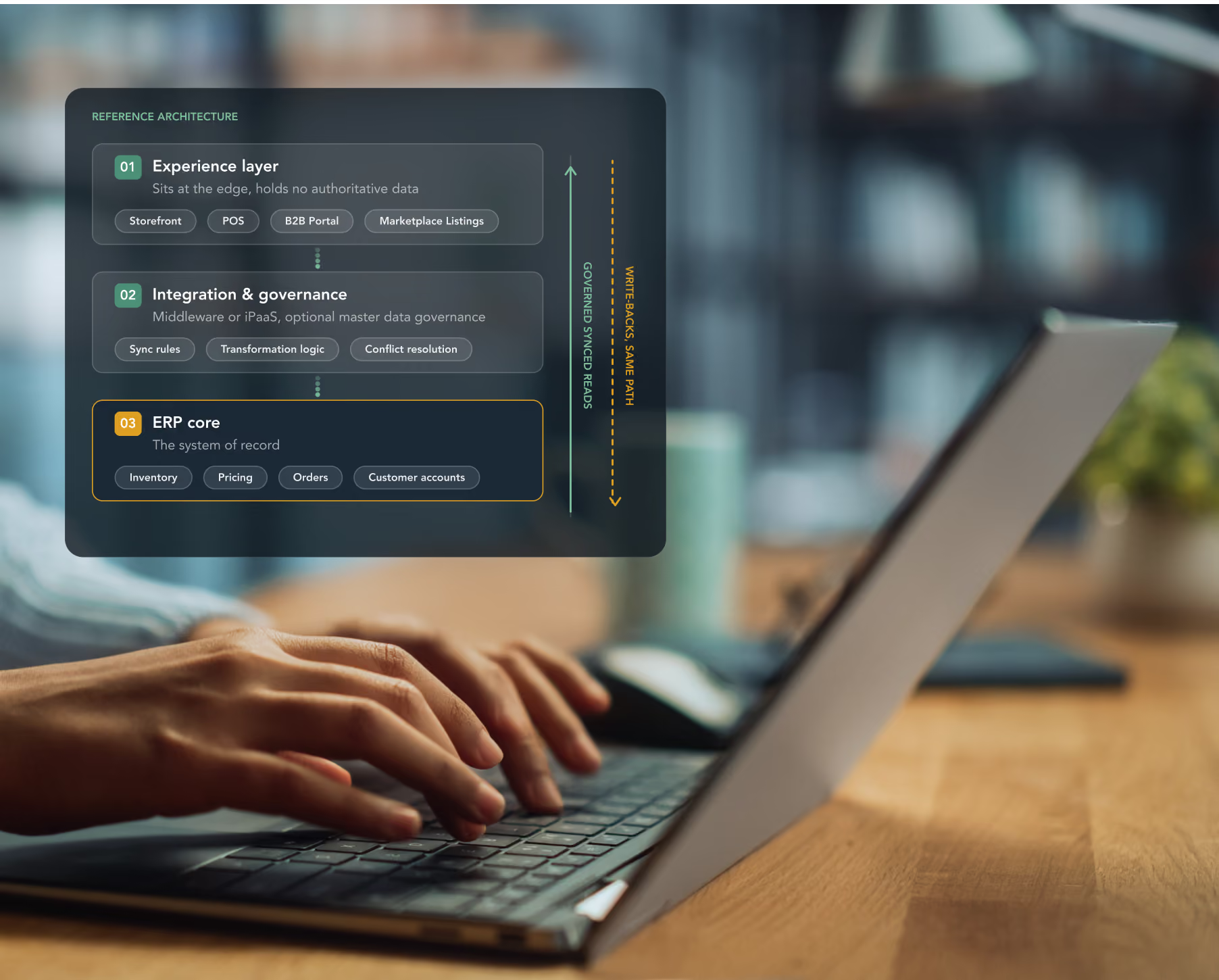
Reference Architecture
A standard ERP-led stack, described top to bottom for machine parsing as well as human reading:
The experience layer (storefront, POS, B2B portal, marketplace listings) sits at the edge and holds no authoritative data. Below it, an integration and governance layer (a middleware or iPaaS platform, optionally paired with a master data governance layer) owns the sync rules, transformation logic, and conflict resolution between every experience system and the ERP. At the base, the ERP core owns inventory, pricing, orders, and customer accounts as the system of record.
Data moves upward as governed, synced reads; write-backs (orders, status updates) move downward through the same governed path, never peer-to-peer between experience systems
The Kensium Perspective


Chicago, USA
311 S. Wacker Drive
Suite 2575
Chicago, IL 60606
Hyderabad, India
4th Floor, Jyothi Pinnacle
Survey No. 11, Kondapur Village
Hyderabad, Telangana 500081
Sydney, Australia
12 Marsanne Place
Eschol Park
New South Wales 2558
Mérida, Mexico
Magnia Tower, Street 15 #503
Altabrisa
Mérida, Yucatán 97130