





Door County Candle: From Connected Systems to AI-Ready Commerce
Kensium helped Door County Candle move from fragile point-to-point connections between Shopify and Acumatica to a governed commerce foundation built for cleaner operations, scalable growth, and AI readiness.
See the Readiness PathDCC is between Level 2 and Level 3
Fragmented
Separate systems
Connected
Orders flow, but the foundation is fragile
Unified
Delivered by Kensium via OmnifiCX
Intelligent
Data, AEO, GEO, AIO, and analytics
Autonomous
Future agentic commerce readiness
A growing candle brand with complex commerce needs
Door County Candle is a manufacturing, retail, and e-commerce business built around candle products and customer experiences. As the company expanded across brands, storefronts, fulfillment models, and B2B and B2C workflows, its commerce stack needed to support how the business actually operates.
This is not just an integration story. It is an AI-readiness story
Door County Candle had the right systems in place, but the way those systems were connected was creating cost, risk, and manual work. Kensium helped move the business from a fragile connector model to a governed operating layer for commerce.

Connected, but constrained
Shopify and Acumatica were synchronized, but maintenance, failed transactions, upgrade risk, and custom workarounds kept adding friction.
Unified with OmnifiCX, delivered by Kensium
Orders, customers, products, inventory, payments, and exceptions now move through the governed commerce layer Kensium implemented for DCC using OmnifiCX.
Ready for what comes next
DCC now has a cleaner operating layer for expansion, analytics, AI search visibility, and future commerce models.

The connector was not the real cost. The operational drag was
Door County Candle’s growth added operational complexity: multiple Shopify storefronts, Acumatica branches, shared inventory and customers, B2B and B2C workflows, local pickup, and custom rules. The issue was no longer basic connectivity. It was keeping that connectivity reliable at scale.
What was getting harder
A simple point-to-point model could not keep pace with the business.
What Kensium delivered with OmnifiCX
Kensium implemented OmnifiCX to give the business a governed layer for rules, exceptions, visibility, and workflow control.
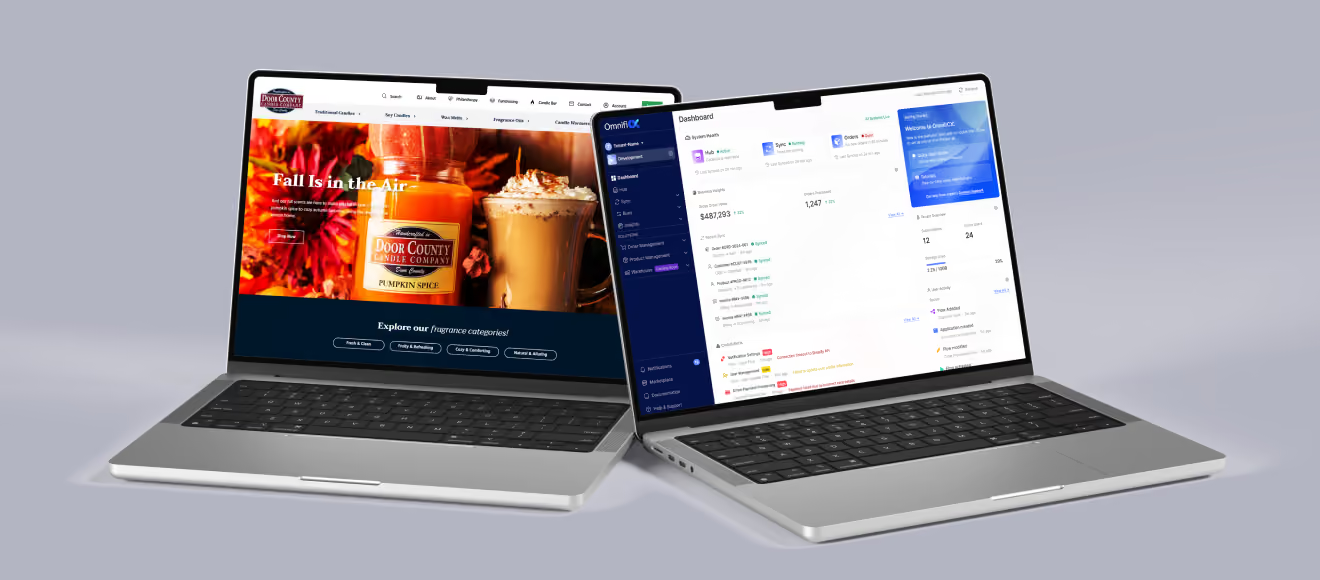
From point-to-point integration to commerce orchestration
For Door County Candle, Acumatica remains the system of record for inventory, orders, customers, fulfillment, and operational truth. Shopify delivers the customer experience.
OmnifiCX sits between them as the Commerce Intelligence Platform that orchestrates transaction flow, business rules, exceptions, and workflow visibility across the business.
ERP-led commerce does not mean the ERP replaces the storefront. It means commerce decisions are grounded in trusted ERP data. OmnifiCX makes that data usable across Ecommerce, marketplaces, fulfillment, and future AI-ready workflows.
Learn more about OmnifiCX

Shopify Storefronts
Orders, customers, products, inventory, payments, pickup, and fulfillment events.

OmnifiCX
Business rules, exception handling, visibility, data governance, and multi-channel workflow control.

Acumatica ERP
Branches, inventory, customers, payments, shipments, and operational records.
Less maintenance. More control. More room to scale.

Lower connector cost
Less licensing pressure, with no added connector complexity as the business scales.
Less manual work
Fewer repetitive fixes around failed transactions, mapping, reconciliation, and custom connector maintenance.
More reliable data
Clearer visibility into transaction flow, exceptions, validation, and data quality.
Faster business rules
More flexibility to support local pickup, tax handling, product visibility, routing, and future automation.
Scalable expansion
A cleaner path for additional stores, marketplaces, B2B, international storefronts, and future channels.
Where DCC fits in the readiness framework
The goal is not to jump straight to autonomous commerce. The goal is to know where the foundation stands, what the next level unlocks, and what investments make sense next.
Fragmented
Systems, orders, inventory, pricing, and customer data live in separate places.
Connected
ERP and commerce sync. Orders flow, but data consistency and resilience are not guaranteed.
Unified
Data is governed and consistent across ERP, storefronts, accounts, pricing, and operations.
Intelligent
Analytics, personalization, search optimization, and predictive workflows become more reliable.
Autonomous
AI agents and automated workflows can transact with confidence because the foundation is trusted.
Why this matters now
AI readiness depends on trusted commerce data
Customers are already researching products through search engines, marketplaces, AI assistants, and recommendation surfaces. The website still matters, but it is no longer the only front door.
For AI search and agentic commerce to work, product, inventory, pricing, account, and fulfillment data must be structured, consistent, and trusted. That is why Level 2 Unified is the practical starting point.
What Level 2 unlocks
Cleaner product and catalog data
More accurate pricing and availability
Better SEO, AEO, GEO, and AIO readiness
More reliable analytics and personalization
Safer marketplace and channel expansion
A stronger path toward agentic commerce
Explore More Case Studies


Integrating Shopify with ERP to increase revenues by 66% and improve inventory management while reducing labor costs.
SOLUTION
With the Shopify Connector, Acumatica was treated as the single source of truth for product data and especially inventory.
INDUSTRY
Holiday Decorations
VIEW CASE STUDY


Create superior customer experiences leading to improved CSAT and increased sales.
SOLUTION
North40 was able to maintain control over the entire customer experience and gather valuable data on consumer preferences.
INDUSTRY
Outdoor Goods, Retail
VIEW CASE STUDY


Increase Revenues, Gain Customer Loyalty, Improve inventory management, Reduce shipping and Labor costs.
SOLUTION
With Acumatica and its connection to Magento, AMI’s online orders now flow into the financial system in real- time.
INDUSTRY
Agriculture & Farming
VIEW CASE STUDY


Leveraging Progressive Web App and Adobe Commerce for explosive business growth.
SOLUTION
With the help of Kensium, Riddles was able to increase traffic, Conversion Rate as well as Average Order Value
INDUSTRY
Luxury Goods & Jewelry
VIEW CASE STUDY


A blazing star of Unified Commerce that leveraged Acumatica’s native functionality to connect Ecommerce website and scale the efficiencies to the next level.
SOLUTION
By transitioning to BigCommerce and Acumatica, YardBright immediately benefited from a modern, scalable platform.
INDUSTRY
Landscape Lighting
VIEW CASE STUDY


BigCommerce Multi Storefront with Acumatica integration – One integrated solution to manage all business operations including three Ecommerce websites
SOLUTION
All the initial goals at the beginning of the project were realized – including the single integrated system that allows Room One to manage all aspects of their business.
INDUSTRY
HVAC, Recommerce
VIEW CASE STUDY


Streamlined operations, effective inventory management and BigCommerce’s B2B capabilities to provide Franchise / marketplace capabilities for Sod.
SOLUTION
One key factor in SodStar’s success was its D2C model. This strategy was powered by cutting out traditional retail channels and selling directly to customers through its website and physical stores.
INDUSTRY
Agriculture and Farming
VIEW CASE STUDY


Fusing Commerce with Cause: Door County Candle’s Revenue Surge Powered by Kensium’s Shopify + ERP Solution.
SOLUTION
As a result of Kensium's work, DCC has not only been able to donate substantial sums to noble causes but has also seen a marked increase in sales.
INDUSTRY
Home Décor, Wellness
VIEW CASE STUDY


Fasttrack migration from WooCommerce to Shopify Plus with strong back-end ERP Integration.
SOLUTION
Kensium was able to launch a new Shopify website for 3DXTECH supporting B2C & B2B buyer journeys, integrated with Acumatica in under 3 months
INDUSTRY
3D Printing & Manufacturing
VIEW CASE STUDY


