Left-pointing white chevron arrow on a transparent background.
Back to article listing
Articles

The Dangers Of DIY Cloud

February 11, 2022
By-
Ajit D

When Webscale was founded in 2013, the question of whether or not the public cloud was the natural home for ecommerce was still a hotly debated topic. Today, that argument is over, and the cloud won! 

 For many, the next topic for discussion is whether or not to go the DIY route (managing your cloud infrastructure with an in-house team) or to employ the services of a provider who specializes in managing cloud infrastructure on behalf of their customers. Providers of this nature are certainly not all created equal, but we'll come to that in a bit.
 
There is no disagreement that DIY offers you total control over your cloud hosting and application lifecycle. Still, the cost savings are potentially more a perception than a reality for many.

To successfully carry out a DIY approach in the public cloud, IT teams at merchant organizations need the skill set and training to manage complex infrastructure and a multitude of integrations, not to mention the ecommerce application expertise to tie it all together. Above all, the organizational leadership will require considerable bandwidth to focus on cloud strategy as much as the core business strategy needed to succeed as an online business.

Blog - cloud computing graphic

To put this into context, managing your infrastructure means you will be entirely responsible for knowing how to leverage the immense resources of the public cloud – tools, services, and add-on solutions.

You will have a la carte/bundled security and performance optimization products, potentially priced at a high premium. How will you compare these with other solutions in the market if they fail to meet your expectations and make the right procurement decisions? Regarding support, your cloud provider will not have any application-specific expertise, so support tickets may take time to resolve and impact your customer experience.
 
Monitoring traffic and security incidents, backups, and disaster recovery, tracking compliance, scaling and optimizing your cloud infrastructure as your business grows, and keeping your web application(s) patched and secure. Everything will fall on your shoulders. 

It's a lot, so before deciding to embark on the DIY track, you need to ask yourself:
 

  • Does my business have a dedicated IT team of cloud experts? Do they require training on the public cloud? How long would it take to train them, and how much will it cost?
  • As the business grows, what if we develop a need to have applications in different public clouds? How do I decide which solutions to procure for enhanced security and performance?
  • If technical support is not as responsive as the business would like it to be, who can offer timely help?

Choosing the right cloud provider – typically AWS, Google Cloud Platform (GCP), or Microsoft Azure – requires experience and in-depth knowledge of their computing, storage, security, database services, pricing model, bundling, and more. As a result, many merchants may struggle to decide which is best suited to their business, opting for the best brand and most popular among their peers. 
 
Once you have decided on your public cloud provider, migrating your application is not an overnight exercise. It requires careful planning and resources to avoid unplanned downtime and loss of revenue and reputation. Depending on the complexity of your web application(s), migration can face numerous obstacles and consume both time and resources.
 

Blog - cloud providers


If this all sounds challenging, it's because it is. While many enterprise-class ecommerce brands have been successful, they have the resources and budget to allocate. Small to mid-size merchants are more likely to employ the services of cloud delivery or hosting partner services.

If that provider is cloud-agnostic and able to deploy anywhere, they can recommend a cloud provider based on your specific needs, geographies, etc. They will also support the migration and ongoing management of your cloud infrastructure. The digital agency you worked with to build your site is typically an excellent resource to consult when considering your options here. 

webscale image 1

 
Webscale manages thousands of ecommerce storefronts, across many cloud providers, in more than 12 countries. As a result, we ensure that our customers never have to worry about their infrastructure. Instead, they get to focus on growing their business. 

We have redefined cloud migration with a new standard for simplicity and predictability. Our migration process is unique in that it manages application configuration, network requirements, instance details, and the overall deployment and maintenance discipline as a 100% software-defined infrastructure.

That's a mouthful, but it means that with these highly defined DevOps workflows, we can move cloud migrations from months to weeks, even days if needed, depending on the project size. 

Share this on
Black Facebook social media logo icon on transparent background.Twitter bird logo in light blue on a transparent background.LinkedIn social media platform icon in blue and white.
Written by
Ajit D
Ajit Das, Chief Revenue Officer at Kensium brings over 24 years of experience in global operations. He leads teams in optimizing processes and managing client relationships, ensuring high-quality project outcomes. Skilled in business strategy, project management, and vendor management, Ajit excels in delivering results within budget and timelines.
Left-pointing chevron arrow icon.
Back to Blogs

The Dangers Of DIY Cloud

Ecommerce
Reading Time:
3
min
Published on:
September 23, 2024
Updated on:
September 10, 2025
Our Editorial Team
No items found.

When Webscale was founded in 2013, the question of whether or not the public cloud was the natural home for ecommerce was still a hotly debated topic. Today, that argument is over, and the cloud won! 

 For many, the next topic for discussion is whether or not to go the DIY route (managing your cloud infrastructure with an in-house team) or to employ the services of a provider who specializes in managing cloud infrastructure on behalf of their customers. Providers of this nature are certainly not all created equal, but we'll come to that in a bit.
 
There is no disagreement that DIY offers you total control over your cloud hosting and application lifecycle. Still, the cost savings are potentially more a perception than a reality for many.

To successfully carry out a DIY approach in the public cloud, IT teams at merchant organizations need the skill set and training to manage complex infrastructure and a multitude of integrations, not to mention the ecommerce application expertise to tie it all together. Above all, the organizational leadership will require considerable bandwidth to focus on cloud strategy as much as the core business strategy needed to succeed as an online business.

Blog - cloud computing graphic

To put this into context, managing your infrastructure means you will be entirely responsible for knowing how to leverage the immense resources of the public cloud – tools, services, and add-on solutions.

You will have a la carte/bundled security and performance optimization products, potentially priced at a high premium. How will you compare these with other solutions in the market if they fail to meet your expectations and make the right procurement decisions? Regarding support, your cloud provider will not have any application-specific expertise, so support tickets may take time to resolve and impact your customer experience.
 
Monitoring traffic and security incidents, backups, and disaster recovery, tracking compliance, scaling and optimizing your cloud infrastructure as your business grows, and keeping your web application(s) patched and secure. Everything will fall on your shoulders. 

It's a lot, so before deciding to embark on the DIY track, you need to ask yourself:
 

  • Does my business have a dedicated IT team of cloud experts? Do they require training on the public cloud? How long would it take to train them, and how much will it cost?
  • As the business grows, what if we develop a need to have applications in different public clouds? How do I decide which solutions to procure for enhanced security and performance?
  • If technical support is not as responsive as the business would like it to be, who can offer timely help?

Choosing the right cloud provider – typically AWS, Google Cloud Platform (GCP), or Microsoft Azure – requires experience and in-depth knowledge of their computing, storage, security, database services, pricing model, bundling, and more. As a result, many merchants may struggle to decide which is best suited to their business, opting for the best brand and most popular among their peers. 
 
Once you have decided on your public cloud provider, migrating your application is not an overnight exercise. It requires careful planning and resources to avoid unplanned downtime and loss of revenue and reputation. Depending on the complexity of your web application(s), migration can face numerous obstacles and consume both time and resources.
 

Blog - cloud providers


If this all sounds challenging, it's because it is. While many enterprise-class ecommerce brands have been successful, they have the resources and budget to allocate. Small to mid-size merchants are more likely to employ the services of cloud delivery or hosting partner services.

If that provider is cloud-agnostic and able to deploy anywhere, they can recommend a cloud provider based on your specific needs, geographies, etc. They will also support the migration and ongoing management of your cloud infrastructure. The digital agency you worked with to build your site is typically an excellent resource to consult when considering your options here. 

webscale image 1

 
Webscale manages thousands of ecommerce storefronts, across many cloud providers, in more than 12 countries. As a result, we ensure that our customers never have to worry about their infrastructure. Instead, they get to focus on growing their business. 

We have redefined cloud migration with a new standard for simplicity and predictability. Our migration process is unique in that it manages application configuration, network requirements, instance details, and the overall deployment and maintenance discipline as a 100% software-defined infrastructure.

That's a mouthful, but it means that with these highly defined DevOps workflows, we can move cloud migrations from months to weeks, even days if needed, depending on the project size. 

Our Editorial Team
No items found.

Explore Related Blogs

caret right
Ecommerce
Why Growth Breaks Without Integration and Tax Compliance
Ecommerce
ERP
Why Most ERP–Ecommerce Integrations Fail at Scale: A System Architecture Autopsy
Ecommerce
Which Ecommerce Platform Is Right for Your Business?
Ecommerce
2026 Ecommerce Trends Forecast: What’s Next for B2B & B2C
Ecommerce
B2B Buyer Portals: Empowering U.S. Businesses in the Digital Age
Ecommerce
Here’s What IDC Found About BigCommerce B2B Edition
Shopify
ERP
Ecommerce
Shopify, Adobe Commerce & BigCommerce: ERP Integration Guide
How B2B Ecommerce ERP Integration Boosts Sales
ERP
Ecommerce
B2B Ecommerce ERP Integration for Wholesale Sales Growth Pro
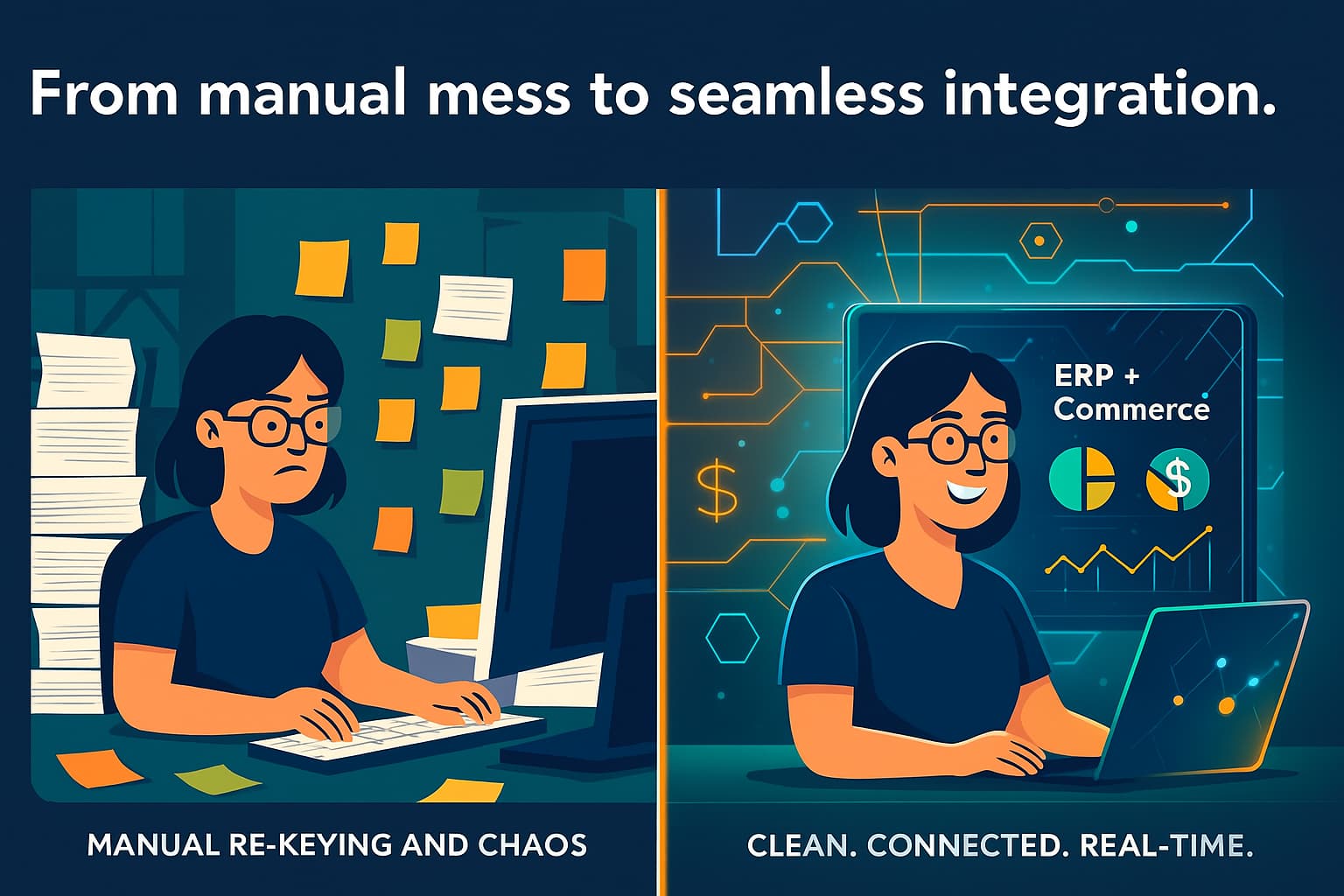
Seamless Workspace Transformation – Integrating ERP and Ecommerce for Efficiency
Ecommerce
ERP
Distribution Needs eCommerce ERP Integration: 5 Signs
Ecommerce Optimization Dashboard – Data-Driven Insights for Shopify Merchants
Ecommerce
Marketing
eCommerce CRO Checklist & Playbook for Higher Conversions
Ecommerce
E-Commerce Growth Playbook: Holiday Shopping 2025
Ecommerce
Integrating eCommerce Platforms with NetSuite
Ecommerce
B2B Ecommerce Customization Framework: How Kensium Maximizes ROI & Avoids Costly Pitfalls
Ecommerce
The 2025 B2B eCommerce Strategy Guide to Generative Engine Optimization
Ecommerce
Cost-Cutting Strategies for eCommerce Growth in 2025
Ecommerce
Behavioral Economics in E-commerce: 10 Proven Tactics That Convert
Artificial Intelligence (AI)
Ecommerce
10 AI Strategies That Actually Drive B2B Ecommerce Growth
Ecommerce
Is Your B2B Store Costing You Sales? UX Fixes D2C Brands Already Use
Ecommerce
Amazon Prime Day 2025: Record Sales, AI Chatbots, and Key Takeaways for Sellers
Ecommerce
News & Update
Shopify
Shopify Now Accepts USDC via Coinbase & Stripe | Powered by Kensium
Ecommerce
How E-commerce Brands Can Profit from US Tariffs: A Complete Guide
Unlocking the Power of Shopify Magic: AI-Driven Commerce for the Modern B2B Merchant
Ecommerce
Artificial Intelligence (AI)
Shopify
Unlocking the Power of Shopify Magic: AI-Driven Commerce for the Modern B2B Merchant
Ecommerce
Your Website Is Not a Brochure: 5 Upgrades That Convert B2B Traffic
Ecommerce
7 Signs Your B2B eCommerce Platform Is Dying
Ecommerce
Customized B2B eCommerce Solutions: Max ROI, Avoid Templates
Ecommerce
Retrieving data. Wait a few seconds and try to cut or copy again.
Ecommerce
Marketing
How Tech & Analytics Elevate eCommerce Marketing
Ecommerce
The Vanishing Product: Don’t Let End-of-Life Cost You Loyal Customers
Ecommerce
The Delivery Deadline Doom: Are Late Shipments Killing Your Brand?
Ecommerce
Click to Convert: Mastering CTAs for Maximum Ecommerce Success
Ecommerce Shipping Delays: Impact, Causes & Solutions by kensium
Ecommerce
Ecommerce Shipping Delays: How Delivery Issues Hurt Brands
Ecommerce
The Abandoned Cart Cemetery: Revive Your Lost Sales
Ecommerce
Unlock the Potential of Your Adobe Commerce Store with Adobe App Builder
Ecommerce
The Holiday Hangover: Don't Let Lost Sales Haunt You All Year
Ecommerce
Is it Time to Refresh Your Company’s Website?
Ecommerce
how-omnichannel-ecommerce-will-drive-b2b-sales-in-2025-insights-from-mckinseys-latest-survey
Ecommerce
Benefits of Composable Commerce with Adobe Commerce
Ecommerce
Sustainable E-Commerce: How BigCommerce Supports Eco-Friendly Practices
Ecommerce
The Power of User-Generated Content: Boosting Engagement on Shopify Stores
Ecommerce
The Rise of Conversational Commerce: Revolutionizing Customer Support and Boosting Conversion Rates
Ecommerce
Upgrading to Magento 2.4.7 and PHP 8.3
Ecommerce
Managing Multi-Channel Inventory with Ease on Shopify
Ecommerce
Why Every Ecommerce Business Needs an ERP
Ecommerce
The Power of PunchOut Integrations: How They Revolutionize B2B Transactions
Ecommerce
How Shopify Merchants Can Dominate with Dynamic Pricing
Ecommerce
Unifying B2B and B2C Experiences with Headless Commerce: How Kensium Leads the Charge
Ecommerce
Solo but Strong: My Experience as the Only Woman in Kensium's Sales Team
Ecommerce
Unlocking Success: Essential Ecommerce Metrics Every Business Should Track
Ecommerce
Ecommerce Predictions in 2024: Reimagining Customer Experience with Hyper-Personalization
Ecommerce
Exploring the Potential of the Metaverse to Revolutionize Ecommerce Businesses
Ecommerce
Top 20 Best Practices to Protect your Magento Store from Cyber Attacks
Ecommerce
Top 8 Cyber Resilience Strategies to Safeguard your Magento Store
Ecommerce
Harnessing the Power of ChatGPT for Ecommerce Transformation
Ecommerce
Composable Commerce: Understanding its Significance
Ecommerce
Picking right Adobe Commerce (Magento) trends
Ecommerce
How ChatGPT Transforms Ecommerce & Cybersecurity
Ecommerce
How to Increase Ecommerce Average Order Value (AOV)?
Ecommerce
Navigating the New Adobe Commerce Lifecycle Policy with Kensium's Support
Ecommerce
BigCommerce Unveils Powerful Features for B2B Edition. How can Kensium Help you Leverage Them?
Ecommerce
Simplify Online Shopping with Quick Checkout by Bolt for Adobe
Ecommerce
Amazon Buy with Prime
Ecommerce
Headless vs Composable vs PWA
Ecommerce
Allparts - Support Case Study
Ecommerce
Boost Your E-commerce Sales with BigCommerce's BOPIS Feature
Ecommerce
Stay Ahead of the Game with Adobe Magento 2.4.6's Improved Functionality
Ecommerce
How To Choose The Right Ecommerce Platform
Ecommerce
How To Drive Ecommerce Platform Adoption
Ecommerce
Customized Ecommerce Platform Or Out-Of-The-Box - Which Is Better?
Ecommerce
What You Need To Know About Upgrading To Magento 2.4.4+
Ecommerce
BigCommerce Launches #BigHackathon And Kensium Rises To The Challenge
Ecommerce
How To Be Ready To Update Your Ecommerce Analytics to GA4
Ecommerce
Progressive Web Apps vs. Responsive Websites - Which Is Better?
Ecommerce
Finding The Right Ecommerce Technology Stack
Ecommerce
How To Beat Stress At Work And At Home
Ecommerce
How Developing A PWA Is Unique From Traditional Web Apps
Ecommerce
What You Need To Know About Progressive Web Apps
Ecommerce
Unite Omnichannel Sales Through BigCommerce Channel Manager
Ecommerce
The BigDev Bootcamp Is Can't-Miss For BigCommerce Developers
Ecommerce
Green Monday - The Greatest Shopping Day You've Never Heard Of
Ecommerce
Magento 1 End of Life: Extend with Nexcess Safe Harbor
Ecommerce
Home Science Tools Helps Your Kids Learn From Home While You Work From Home
Ecommerce
Dekra-Lite Creates Extraordinary Decor For Any Occasion
Ecommerce
ParkingZone Thinks Outside The Lines Of The Parking Industry
Ecommerce
Adobe Summit 2020 Breakout Session: How To Integrate Magento With External Systems
Ecommerce
Real Street Performance Turbocharges Average Order Value Using Adobe Commerce
Ecommerce
Why Personalization Has Become An ECommerce Necessity In 2020
Ecommerce
The Differences Between Magento Open Source And Magento Commerce
Ecommerce
Fight Back Against Fraud: How To Prepare For Holiday ECommerce Scams In 2020
Ecommerce
Resources For ECommerce Businesses During The COVID-19 Pandemic
Ecommerce
Magento 1 Reaches Its End-Of-Life This Month: Here Are Your Options
Ecommerce
The Exceptional Value Of Referral Marketing In ECommerce
Ecommerce
Deploy Magento 2 In As Little As 6-8 Weeks
Ecommerce
Ecommerce Options For Volusion Customers Post-Bankruptcy
Ecommerce
Build The Next Great Promotional Campaign Using Magento Discounts
Ecommerce
How To Plan For 2021 And Hit The Ground Running
Ecommerce
How Mobile-First Magento Layouts Benefit Businesses And Customers
Ecommerce
Increase Efficiency And Sales With Magento 2
Ecommerce
The Future Of Web Development: Progressive Web Apps
Ecommerce
Ecommerce Conversion Rate Optimization 2019: Best Practices
Ecommerce
Nucleus Research: Acumatica Shows No Signs Of Slowing